|
Operation Ironclad - the Invasion
of Madagascar.
5 to 7 May 1942
Background
 This is a brief account of Operation Ironclad, the
invasion of Madagascar, by a member of No 5 Commando. The total campaign lasted 6
months but the bulk of the amphibious initial landings of Combined Operations
and the Commandos was concentrated into a few days in early May 1942. This is a brief account of Operation Ironclad, the
invasion of Madagascar, by a member of No 5 Commando. The total campaign lasted 6
months but the bulk of the amphibious initial landings of Combined Operations
and the Commandos was concentrated into a few days in early May 1942.
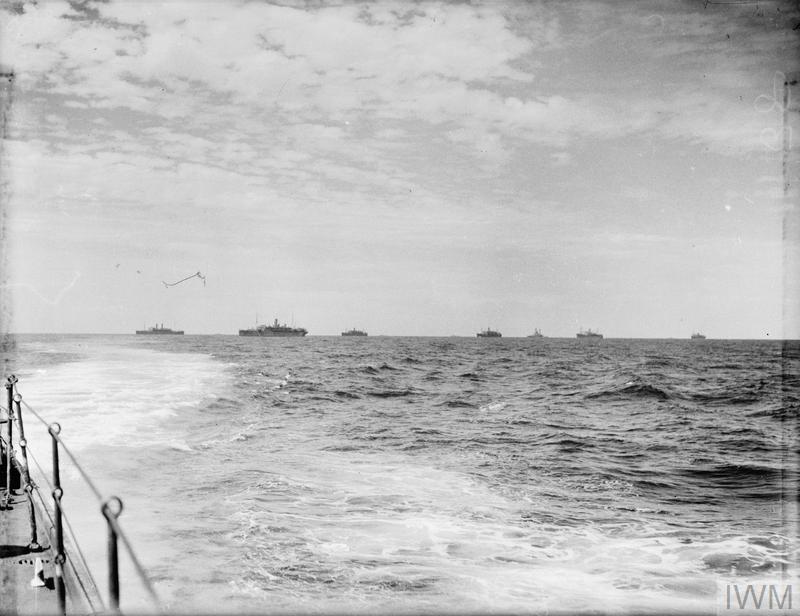
[Photo;
Troop convoy and escorting warships in harbour at Madagascar
taken from the cruiser HMS Hermione. © IWM (A 8862)].
On March 23, 1942, No 5 Commando sailed from Glasgow in the
Winchester Castle as part of the largest military convoy to leave Britain
at that stage of the war. The 365 men of No 5 Commando were part of a larger force, which included the 29th Independent
Brigade and the 13th Brigade. The convoy consisted of more than 50 Royal Navy
Ships and on reaching the Indian Ocean the total force included 3 Battleships, 3 N Aircraft Carriers, frigates, destroyers and corvettes.
We carried French Intelligence Officers with us and
correctly guessed our destination was a Vichy French administered colony. Our
briefing eventually explained the absolute necessity of preventing the Japanese
from capturing the Island of Madagascar, which would give them access to the third largest natural
harbour in the world at Diego Suarez. At a time when transit through the
Mediterranean was too risky to attempt, the long route to Egypt via the Cape of
Good Hope was of paramount importance. Had the Japanese taken control of
Madagascar, supporting the 8th Army in N. Africa or the 14th Army in Burma would
have been extremely hazardous and S. Africa would have been vulnerable to
attack.
The Landing
 At dawn on 5 May, 1942, we
followed mine sweeping Corvettes in our assault landing craft (ALCs) and landed at Courrier
Bay on the North West Coast of Madagascar, about 11 miles overland from Diego Suarez
in the east. There was no opposition, having caught the French forces completely unawares,
made possible by a triumph of seamanship from the Royal
and Merchant Navies, who penetrated coral reefs believed impassable to a force of
our size. At dawn on 5 May, 1942, we
followed mine sweeping Corvettes in our assault landing craft (ALCs) and landed at Courrier
Bay on the North West Coast of Madagascar, about 11 miles overland from Diego Suarez
in the east. There was no opposition, having caught the French forces completely unawares,
made possible by a triumph of seamanship from the Royal
and Merchant Navies, who penetrated coral reefs believed impassable to a force of
our size.
[See the coloured square markers, on the map
opposite, for the location of the landing beaches].
Above us, on cliffs 50 feet high, was a battery of Gin guns. We climbed the
cliffs and caught the Vichy gunners by surprise. They were asleep and Amen to
that! There were French Officers, NCOs and Malagash and Senegalese troops, who
were rounded up and placed under guard.
At first light, the Vichy counter-attack began.
On our flank, 40 Colonials with 2 NCOs charged up the hill towards us. We carried
out a bayonet charge and the NCOs were killed. The remainder gave up and threw
down their weapons. Our casualties were light. Capt "Chips" Heron went forward
to take the surrender of a separate party of battery observers on a nearby hill. As they came forward to surrender,
some grenades were lobbed over from their rear, wounding Capt Heron and others.
They did not get the chance to surrender again.
Cap
Diego
In sweltering heat, we marched against a hot wind
across the 18 mile long isthmus to Cap Diego loaded heavily with ammo and grenades.
There was a fracas with a Troop of Foreign Legionnaires. We wounded around 50 of
them before
they surrendered and then continued mopping up operations,
while 2 Brigades took the capital of Antsirane with heavy casualties after a
daring manoeuvre by 50 Royal Marines. They came off HMS Ramilles in Courrier Bay, boarded the destroyer
Anthony and, at 8 pm, in pitch darkness, entered the harbour under fire
from every gun which could be brought to bear on her. She ran alongside the
wharf as the Marines tumbled over the side to gain the shore.
The Commando orders were to attack everything except the barracks and the magazine, which
were strongly held but in half an hour they were in possession of both.
They had accomplished everything with only one casualty. They prevented much street
fighting and damage to the town. The official report quotes "These 50 Marines
created a disturbance in the town out of all proportion to their numbers!!"
 Majunga Majunga
We then sailed to Mombasa, Kenya to rehearse
for the next few operations, one of which involved ramming a boom at 30 knots
before pulling alongside the dock to allow us to leap off. On completion of the
training, we set course for Majunga, the largest port on the west coast of
Madagascar.
[Photo; At the end of Operation Ironclad, the Allied landings on
Madagascar. Aerial views of French Bay Harbour, Diego Suarez. General
view of the warships and British Merchant ships in harbour. © IWM A
8891].
The plan, on this occasion, was to steer our
landing craft directly into the docks but some of the craft broke down, causing serious
delays. We landed in broad daylight against machine gun fire on a small frontage
with 4 machine guns. Fortunately, we had good cover from the Royal Navy, which
kept our casualties down. We didn't need scaling ladders as we went up that
quayside like scuttling rats! I can still see our chaps going down like ninepins
out of the corner of my eyes.
We experienced street fighting and disposed of snipers
firing from windows. Our first target was the Post Office to cut communications with the capital of Madagascar, Tannanarive
and the
second was the Residency to capture the Governor and to raise the Union Jack.
We took both targets, during which I had my first face to face
'him or me' engagement. I spotted the barrel of a rifle coming into view from
behind a car, followed by a fez. The wearer stood straight
up and dodged to the right as he saw me when I instinctively fired from the hip,
killing him. I felt quite
horrible and will never know if I could have taken him prisoner. Our
Captain, Geoff Rees-Jones, took a quick look and said
"dead as
a door nail, well done Riley". French casualties were heavy.
Tamatave & Tannanarive
We returned to Diego Suarez and transferred to destroyers
HMS Arrow,
Active and Blackmore. We were escorted by HMS Warspite, the carrier
Illustrious, 3 cruisers and 14 destroyers as we sailed for Tamatave, the largest
port on the East Coast. We arrived at dawn and formed a
semi-circle half a mile from the port docks. Warspite and Illustrious
were positioned 10 miles out. With this show of power and under white flag, an
envoy approached the enemy to demand unconditional surrender. If he was refused or
he was fired on, there was to be a 55 minute bombardment by the destroyers and
Warspite's 15in guns, while Illustrious would send in Seafires and
Swordfishes. After this, our destroyers would ram the boom at 30 knots, pull hard
against the quay and we would leap off.
The envoy signalled he was being fired on. Immediately there was
a salvo from HMS Birmingham, the signal for the bombardment. This lasted
just a few minutes, in which time 2,000 shells had made contact. White flags popped up everywhere
and our destroyers steamed into the harbour with the boom opened for us by the subdued French.
We started the advance on Tannanarive, whilst the KARs advanced from
Majunga. The rifles got there first. We then chased the remnants of the French
southwards, which is another story. In October, an Armistice was signed. The whole
Island surrendered with the French troops signing up for De Gaulle.
We embarked for home, arriving in December. We
all got leave and I walked in on my family for Christmas. My mother dropped the
teapot and my Father (a Great War veteran) came out with his usual remark
whenever he saw me, "I don't believe it!" The bad penny had survived once again!
WW2 Diary of
Leading Telegraphist GHL Bowman, JX
181390.

Editorial notes
(*) have been added to certain paragraphs in the way of explanation.
Background
 Leading
Telegraphist, GHL Bowman, served in the Combined Operations Command. He
was trained to operate radio transmitters and receivers to provide
communications between field units and Commanding Officers and/or
Forward Observation Officers and those in charge of firing heavy guns. Leading
Telegraphist, GHL Bowman, served in the Combined Operations Command. He
was trained to operate radio transmitters and receivers to provide
communications between field units and Commanding Officers and/or
Forward Observation Officers and those in charge of firing heavy guns.
The bulk of his
recollections are taken from his wartime diary, but his account starts with some
amusing anecdotes of his induction into the Royal Navy training in amphibious
landings on a remote sea loch in the Scottish Highlands and participation in
early Commando raids. His son, Lt Col (retd) David Bowman writes;
My father, George Henry Lindsay Bowman (known as
Lindsay or sometimes “Bob” to his shipmates), served with the Combined Operations
Command as
a Telegraphist in 1941 and 1942. The first part of these reminiscences is taken
from notes he used for after-dinner speaking.
[Photo; Leading Telegraphist GHL Bowman].
Induction, Training and Early Commando Raids
When war broke out, I was a shipping clerk in Liverpool, so, when I volunteered for the
Royal Navy (RN), I expected to be put in the Writers’or Supply branch but their
Lordships thought otherwise and I became a telegraphist. With eleven other
volunteers, I travelled to London on the 29th of January, 1940, in arctic weather.
It took thirteen hours to reach Euston railway station in London, a distance of
just 220 miles.
We arrived at Chatham Barracks (HMS
Pembroke) in the afternoon of the next day. After a hurried issue of kit,
we were shown to our mess (3FF Anson Block). It was designed to hold about
sixty but, that night, there were over one hundred of us. There was a shortage of
plates, cups and cutlery and no space for us to sling our hammocks. Being newcomers,
we had to make do with *dossing on the
deck. After 'lights out', one of the rookies coughed
incessantly, which kept disturbing the silence. After a while, out of the darkness, one of the
old hands shouted out, “Die you bastard, die!”
At that moment, I knew for sure I was in the RN!
(*"dossing on the deck" - sleeping on the floor.)
After I completed my “sparkers” course, I received my
first draft to HMS Quebec on the 3rd of January 1941, a navy shore
based establishment, which was part of the No 1 Combined Training Centre (CTC) on the shores of
Loch Fyne in Argyllshire, Scotland. The journey through England was
uneventful, but that was to change on the last stage of our journey from Tarbet
to Inveraray. It involved a nightmarish journey by open truck over
a high mountain pass, appropriately called the 'Rest and Be Thankful'.
I was dumped, with
several others, in the middle of the night, in the small town of Inveraray, the seat of his Grace, the Duke of Argyll. Here, we began
our training for Combined Operations. For nearly a year, I trained with army
and air force contingents in landing craft operations on Loch Fyne. One evening, I was duty
orderly in the Regulating Office together with an elderly CPO (Chief Petty
Officer) Stoker, who had
been brought back to help the war effort. In walked a brand new
Sub-Lieutenant, RNVR, straight out of *HMS King Alfred, who proceeded to look
through a pile of papers on his desk. After a while, the officer spoke, “Tomorrow, Chief,
we will do this and after that we will do something else” and so on. The CPO
took his pipe out of his mouth, spat into the fire and replied without turning
round, “Scuse me Sir, but this isn’t my first bloody war, it’s my third.”
Collapse and retreat of the said Sub-Lieutenant! (*HMS King Alfred - a wartime officer training establishment at Hove.)
Despite the rigours of training and living in unheated Jimmy the One huts, I grew
very fond of Inveraray. I met many interesting and largely welcoming locals, including
an elderly gentleman, who played the harmonium
in the Episcopalian church where I worshipped every Sunday. He turned out to be His Grace, the Duke
of Argyll! Next in memory is the widow,
daughters and granddaughters of the novelist Neil Munroe. Their warm hospitality
was a great comfort to a raw recruit. So too was the friendship of a genuine
Scottish housewife, Mrs Smith, and her sons, Willie and Donald, who made me very
welcome in their home at Barn Park. Mrs Smith did my washing each week. It
flew alongside that of his Grace who, I heard, was very casual in regard to his
laundry!
My
enjoyment of my friends’ company and the delightful mountainous countryside came
to an end, when my training to equip me with the skills to join in
Commando raids was completed. The first such raid was to the Norwegian Lofoten
Islands on Boxing Day 1941, codenamed Operation Anklet. Catching
the German occupying forces unawares, we took prisoners and some Norwegian men,
who wished to join their compatriots in the UK. My job was not arduous, just to
signal back to the HQ ship that the landing had been effected. Unfortunately, I
couldn’t see the ship, since it was camouflaged against the fjord sides, so the
officer in charge ended up doing it himself.
Shortly after returning to Scotland,
we were posted to Warsash, on the south coast of England, in preparation for our
next Commando raid. This time, *fast motor boats, recently received from the USA,
would be our transport. We proceeded in these to Newhaven, where our
Commandos embarked. When darkness fell, we
slipped out of harbour bound for Boulogne, but sadly, the leading
boat grounded on a sandbank and the rest of the flotilla
followed suit! On the next high tide we re-floated and returned to the
quayside where, **Admiral Sir Roger
Keyes, who was then in charge of Combined Operations, was waiting for us. He was not amused.
We returned
to Inveraray to await our next assignment. (*fast motor boats - probably Higgins or Elco Motor Gun Boats.
**Admiral Sir Roger Keyes - a lapse of memory, Keyes had been replaced by
Mountbatten
in October 1941.)
Operation Ironclad
Lindsay's time at Inveraray
was coming to an end as preparations for the invasion of Madagascar came to
fruition. News of Operation Ironclad filtered down. As sometimes
happened at training establishments, with constant turnover in trainees,
accommodation for new intakes was made ready before previous intakes
had left. Lindsay was likely
caught up in this scenario, as his diary explains below.
7 March 1942. Awoke
to the depressing thought that today is possibly my last day in my highland
home.
9 March 1942. A typical CTC
day of humping kit and gear from one ship to another, a matter
of about a ¼ mile, taking all morning and most of the afternoon. Accommodation
reserved for us in none other than the swimming pool, until agitation changed it
to sleeping one extra in cabins already holding four.
12 March 1942. Endeavouring to settle down after the third move in four days. Accommodation even worse than
ever before – the prospect of a month or so aboard does not please. “What does
unhappiness mean if we are all unhappy together?” (E M Forster).
18 March 1942. I have been driven into the depths of despair and up again. The reason being a
sudden absorption into a two watch routine with resultant lack of sleep. More
and more I agree with the Ancient Mariner, “Sleep it is a blissful thing,
beloved from pole to pole”.
24 March 1942. Since last entry, have spent a week changing ships and consequent humping of kit
plus two days as a stevedore (unpaid of course, not even a meal allowance). *Have been at sea over 24 hours though hardly notice it. (* Convoy bound for Madagascar left Glasgow on the 23rd March).
3 April 1942. Saw flying fish for the first time. They are quite small, no bigger than
sprats.
5 May 1942. Operation Ironclad -
Madagascar. [See coloured square markers for location of beaches].
Zero Hour, but not for me.* Got up leisurely at about 04.30, bathed
before breakfast and checked over kit before falling in on for’ard well deck. By
this time, light was well up and the beaches had been established. After an
hour’s buffeting in an ALC** we reached White Beach, disembarking deep in
water. (* His after-dinner speech notes say “I was on a troop ship and my
job was to land with Brigadier Sturges, Royal Marines on the principal landing
beach”.**Assault Landing Craft).
Signal trolleys carried
ashore and eventually a quarter of a mile over very rough ground. Status established and snake killed. Tent set up, but
found unbearably hot – prepared to work in open. A few natives in evidence –
no opposition here. 2pm, word received to pack up and remove to Blue Beach. Brown, Meaby and I walked cross country through semi-jungle, across dry river bed
and through stinking swamp before arriving at BB.
Effort of walking in
heat had exhausted me – first taste of tropical fatigue. After a rest, spirits
revived at mention of
a bathe, followed by complete rejuvenation thanks to most exhilarating bathe
ever experienced! Kept watch (last dog), contacted old pals and had a lemon
drink with DPJ before turning in beneath the stars. Bed - hard earth; pyjamas cum bed clothes - a gas cape; anti-mosquito ointment and small piece
of netting, complete protective measures. Slept fairly well and awakened at
4.45 to take over morning watch.
6 May 1942. Bathe and wash before breakfast, latter consisting of biscuits, cheese + Nescafe
(supplied by Willie). Helped erect tent, rest of morning and
afternoon spent in and out of water, dodging the MPs! (Bathing officially
prohibited by the *PMLO). Took over first dog from Geoff Johnson but relieved at
end of half hour by Pem. Received orders to pack immediately and stand by to
go and relieve **FOO1.
(*Principal
Military Landing Officer with responsibility for the beach area.
**Forward
Observation Officer, whose job it was to direct remote gun fire onto a target).
Taken at full speed in *Eureka
to Red Beach, where Captain Melville, RM, awaited me with motorcycle. Most
hectic pillion ride imaginable followed, during which we had two spills, lost my
headgear and the officer’s maps. Road abominably bad and light fading. Startled once or twice by stray cattle. Part of road ablaze presumably
incendiaries. Met own sentries and, after proving identity, shot past field
artillery just as a salvo fired, causing officer to lose his toupee and me
very nearly my head! Rest of journey in convoy to Commando HQ where
no one knew anything about me or very interested.** After a lot of standing about, contacted FOOs 1 and 3 on balcony of building. Settled down to make myself at home with occasional noises off. As near to
front-line as I have yet been. Snatches of sleep but rather uncomfortable.
Awakened at 1.45 to set watch, continued to sleep until six. (*The Higgins
Eureka
was a US built vehicle and personnel landing-craft. **His
after-dinner speech notes say that the purpose of the journey was to deliver an
ultimatum to the occupying French troops).
7 May 1942. Washed and shaved in water trough, presumably washing place of native soldiers
as Diego (Suarez) appears to consist solely of barracks. Number of native
prisoners in evidence and a few French. The latter had caused trouble for a
while when they escaped from their sunken ships. Parted from FOO1, Captain
Marsh Stanley, and proceeded to hilltop overlooking channel and Antsirane. *Set not working satisfactorily. Made tea and got word to pack up and return to
HQ. Crossed channel in motor boat with an MO. Held ? (indecipherable) in bow to advertise
our identity. All quiet on (Antsirane) waterfront on arrival. (*radio transmitter/receiver).
Set out to
walk to Infantry HQ preparatory to spotting for naval bombardment of the town. Picked up by bren gun carrier and taken to Div HQ where we found FOO2 including
Meaby. Learnt that the ultimatum to surrender had been received, bombardment
stopped by Meaby sending *O-U.
Spent rest of daylight sitting on pavement
outside Div HQ. Prisoners (natives) in grounds, frequently visited by womenfolk
bringing food and drink. Tried out my French making cocoa but could not make
myself understood when asked for spoon. (*O-U. Operational - Urgent signal? In the confusion surrounding the surrender,
HMS Ramillies fired several rounds at the French batteries on the
Orangea Peninsula before the order could be given to cease fire).
Just as daylight ended, moved to
Boulevard Petain, where we found billets in garage of respectable house. Road
petered out into wood falling down to beach. Small dwellings occupied by
natives and half-castes hidden in the trees. Elected to sleep on iron mattress
with Stanley on veranda, repeating anti-mosquito measures and placing revolver
close at hand. Spent fairly comfortable night.
8
May 1942
Late arising – washed and shaved followed by protracted breakfast consisting of
boiled egg (minute), rasher of boiled bacon (tinned), about half a dozen beans
(tinned), biscuits, jam and tea. Lazy morning waiting for dinner. Visited
civil hospital (now overflowing with military and flying Tricolour and Union
Jack side by side). Large portrait of Marshal Petain at entrance and pro-Vichy
notices in evidence. Made tea for dinner after watching Madame coax the
small fire into life. Meaby and I explored beach below hospital with view to bathe –
mud and general atmosphere deterred us. Walked around bay, past slaughter
house and valley of dry bones. Evil looking birds, larger than gulls and
possibly a species of vulture, hovered overhead. Met small party of natives
coming from marshes where upturned Swordfish lay with engine hanging
loose. Inspected plane obtaining a number of leaflets addressed to Soldats de Madagascar
(click to enlarge). Wireless set
appeared to have been removed, otherwise gear complete and in good condition. Returned to find lettuce for tea, also small orange each. Slept as previous
night, but not so comfortably.
9 May 1942.
Awakened at 6am for early breakfast prior to
route march! Latter eventually began at about 8.30; made our way through
town past various barracks to quay. Received water in lager glass from Chinese
storekeeper – as afterthought he added a little cordial giving an aniseed flavour – spoilt drink for me. Discussed possibility of returning to ship. Helped to carry supply of provisions back to billet and learnt that party was
moving into RA barracks.
Meaby and I received permission to return to ship and
lost no time getting down to quay where we bumped into SSO. Received his
approval of our efforts of the past few days. After about an hour’s wait, and a
rough crossing in Eureka, reached *HMS “Wynyard". Never before have I been so glad to gain
ship. Reaction set in – attack of nervous debility necessitated a visit to
**SB. Caffeine followed next day by (indecipherable).
( *No ship of this name has been found in any records of the RN or Operation
Ironclad.
**SB - Sick bay).
14 May 1942.
A smile and a whistle on most lips – explanation –
first mail arrived for over 7 weeks, my share, 5 letters and a paper.
18 to 21 May 1942. Spent ashore in Antsirane on trials with L/T GM. Spent last day covering
countryside over 20 miles in bren gun carrier with *9 set.This mode of transport is very
uncomfortable owing to lack of space and great heat of engine. Parts of
chassis became too hot to touch. Otherwise riding in this machine
not so bad since springs are good and there are thick rubber sponge seats. The carrier
travels up to 40 mph and takes rough road very easily. (*The No 9 set was a British tactical radio).
27 May 1942.
Anchored in natural harbour on *East coast – at
first sight was reminded of the Norfolk Broads. No sign of habitation.A peculiar phenomenon noticed for the first
time this evening, was a small flash light coming intermittently from the sea
about 200 yds from the ship. It was seen after sunset and to my knowledge the
moon was not up. I suggested a ship’s flashing, but was told that no signalling was in progress. Believed to be floating life jacket fitted with
electric bulb fitting. *(This could be the East coast of Madagascar or East Africa).
30 May 1942. Tanga, Tanganyika. Visited native village on the beach today. Began by
bargaining with some of the natives for oranges, bananas and coconuts. They
always knew what they wanted though they could all be talked down.
3 June 1942
Mombasa, Kenya. Spent a pleasant afternoon sight-seeing and shopping, with a
haircut into the bargain.
8 June 1942. Having returned to DS, with great joy, have received second mail since leaving
home. Have had two day-visits ashore, working communications for disembarkation
of troops.* As traffic has been light, duties have been very small and in consequence we
have been free to enjoy bathing, which is really grand in these parts. Hear,
that since the occupation, there has been an alarming number of cases of malaria,
as much as 10% of one battalion being casualties. Many deaths have ensued.
(*Possibly the 22nd East African Brigade).
23 June 1942. Since last entry, the ship of 1000 drips, has brought us safely to our fifth port
of call, Bombay. Large selection of merchant ships spread, in long lines,
across the harbour, with a sprinkling of warships.
29 June 1942.
A further run ashore, shorn of some of its
pleasure by the neglect of the (hotel) night boy to call some of us at 6am. In
consequence, we missed the liberty boat and had to hire a native boat, reaching
ship 1hr 20mins adrift. For the first (and last I hope) time, I find myself
on Jimmy’s Report – got away with caution after enquiries had been made.
30 June 1942. Made my first rail journey out of Britain, doing some 100 odd miles to a higher
level. Heard from soldiers stationed here (Napoo), that attitude of “whites”
resident here, is very unpleasant. Spent a comfortable, but strange night, in
large army camp in bare barn like building.
 3 July 1942. Khadakwasla Camp. Arrived here, HMS Salsette,
(the Royal Navy Combined Operations base), two days ago after hectic drive in army trucks. The place is
in the catchment
area of a reservoir and must resemble *Arrowe Park at the time of the Jamboree.
Once again I find myself a pioneer and spend the days road-making and making
tents habitable. In this connection, it is comforting to know that officers’
accommodation is no different from the mens'. (*Arrowe Park, Birkenhead, site of the 3rd
World
Scout Jamboree in 1929). 3 July 1942. Khadakwasla Camp. Arrived here, HMS Salsette,
(the Royal Navy Combined Operations base), two days ago after hectic drive in army trucks. The place is
in the catchment
area of a reservoir and must resemble *Arrowe Park at the time of the Jamboree.
Once again I find myself a pioneer and spend the days road-making and making
tents habitable. In this connection, it is comforting to know that officers’
accommodation is no different from the mens'. (*Arrowe Park, Birkenhead, site of the 3rd
World
Scout Jamboree in 1929).
11 July 1942.
We have been here two weeks, yet still nothing has been done about our new
address – consequently it is not possible to give our people a chance of writing
to us, except via the ships.
18 July 1942. At last, we have been given our address so that we have been able to get
air-graphs off and, in my case, cables. (Start of illness that was to end in
invaliding to UK).
27July 1942.
The foolish separation of us* from
other ratings continues and is not always to our benefit. At weekend, our
leave was cancelled at the caprice of the SSO. I believe he would not agree to
us working about camp so, in retaliation, other officers threatened no transport
for our liberty men! When will these officers behave like men? (*telegraphists?)
29 July 1942. BG Hospital Poona. Admitted here yesterday after nearly two weeks of treatment
in camp. One doctor, one sister, a VAD and a couple of orderlies seem to be the
sole staff to manage about sixty patients.
8 August 1942. Last few days have been spent mainly reading and
taking short walks. Heard the surprising news of my colleagues’ departure on
HMS “Wynyard”.
Only
three CTC men remain in hospital now – and if my operation materialises, I shall
be the last to leave. What then I wonder?
17 August 1942.
Poona Station. Have been discharged from BG
Hospital since Saturday and this is my fourth visit to the station. Owing to
line defects, no trains have been running direct to Bombay, so I now
anticipate a journey of 12 to 16 hours duration, to cover a bare 120 miles.
22 August 1942.
St George’s Hospital Bombay. The journey to
Bombay was a long, almost a never ending one with two changes. Total time
spent travelling, 26 hours. My arrival here tells me nothing about my
colleagues and apparently, we stragglers, are to stay here indefinitely, together
with the *WC flotilla.
(*Probably the general duties men who kept
the barracks and toilets clean).
11 September 1942.
Arrived at Bandra Retreat House (for
convalescence).
2 October 1942. RN
Barracks. Returned here after a beneficial three weeks rest. Rather depressed
reaction on returning to bug-ridden barracks.
12 October 1942.
Visited by Capt GW today and given summary of
*second raid on Madagascar. From
all accounts, it was more interesting and far less costly in casualties than the
first. Makes me wish I had been with “the boys”. (*
Presumably Operation Stream – Line –Jane, launched on 10 September
1942).
17 October 1942.
St George’s Hospital Bombay. Admitted here
yesterday, for second time.
24 November 1942.
“The Medical Board has decided that you are
unfit for tropical service and to send you back to the UK.” Thus spake the
MO to me last Friday afternoon.
1 December 1942.
We said goodbye to Bombay 48hrs ago.
30 January 1943.
Bristol Channel. Arrived here and anchored this
afternoon.
Telegraphist's "If" Poem.
[Author unknown but loosely based on
Rudyard Kipling's original].
If you can keep your nerves when all about
you
Are stations jamming hard and blaming you,
If you can “Hold the Air” though others flout you,
Until you get your longest message through;
If you can send and not grow weary sending,
Nor overtire the man who has to read;
If your mistakes are rare but prompt their mending,
If you believe that haste is never speed.
If you can calmly contemplate the chatter
Of greenhorn operators fresh from school;
If you can sit with messages that matter
And wait until they’ve finished — and keep cool.
If you can read through half a dozen stations
The weaker signals that are meant for you
And pick ‘em out with few interrogations
Yet never feel ashamed to ask those few.
If you’re a Jack of all Trades, tinker, tailor,
If there is scarce a thing you cannot do,
If you’re an electrician and a sailor
Telegrapher, accountant, lawyer too:
If you’re propelled by energy that’s tireless,
If you don’t fear a job that’s never done,
Then, take my word, you’re fit to work at wireless
And anything you get, you’ll EARN, my son.
Post script.
Having been invalided from India, my father
spent six months recovering, followed by nine months at the HMS Pembroke signal
school. To break the monotony, he volunteered to go on a tour speaking about
Combined Operations to factory workers working on Admiralty contracts. He
returned to active service in June 1944 as a leading telegraphist on MTBs in HMS
Mantis at Felixstowe, where he spent the rest of the war. After demobilisation,
he was ordained as an Anglican priest, working as a prison chaplain and then as
a vicar in Yorkshire. He died in 1994 aged 78.
Bibliography
Operation Ironclad, Official Despatch
dated 16/6/42.
Further Reading
There are around 300 books listed on our 'Combined Operations Books' page which can be
purchased on-line from the Advanced Book Exchange (ABE) whose search banner
checks the shelves of thousands of book shops world-wide. Type in or copy and
paste the title of your choice or use the 'keyword' box for book suggestions.
There's no obligation to buy, no registration and no passwords. Click
'Books' for more information.
Supplement to The London Gazette dated
2/3/48.
Churchill's Secret Invasion. Britain’s First
Large-scale Combined Operations Offensive 1942 by John Grehan. Published
2014 by Pen & Sword Books. ISBN 978 1 78159 382 0.
Correspondence
Dear Geoff,
Some
years ago you kindly added my father’s memories of Op Ironclad (WW2
Diary of Leading Telegraphist GHL
Bowman, JX 181390) to this web page.
Last year,
whilst doing some research at the Imperial War Museum, I saw the private
papers of Captain Patterson RAMC who was the medical officer of 5
Commando during Op Ironclad. His diary includes the statement that 5
Commando twice failed to obey orders because the CO was an alcoholic who
was later dismissed by Brigadier Festing on 7 May 1942.
The only
other reference I have come across to this is a two line footnote in
Churchill’s Secret Invasion by John Grehan.
For my
family’s records I have added this to the end my father’s diary entry
for 6 May 1942. Please feel free to use the text below, as you see fit.
Best wishes
David
Bowman
6 May 1942
….. .…..
[The official report by the Force
Commander, Rear Admiral Syfret, sheds some light on the situation in
which Lindsay found himself on the evening of 6 May.
On 5 May the town of Diego Suarez
on the North shore of Antsiranana Bay had been occupied by 5 Commando
but 29 Brigade had failed to capture the port of Antsirane on the South
shore. Early in the afternoon of 6 May General Sturges decided to make
an attack on Antsirane that night and he asked Rear Admiral Syfret if
the navy could land a diversionary party in the enemy's rear. It was
agreed that 50 Royal Marines would be moved to Antsirane aboard a
destroyer and that 5 Commando would be asked to find some boats and
cross the bay to assist the Royal Marines as they landed. At 1530 HMS
Anthony sailed with the Royal Marines, whose chance of success was
assessed at less than 50%. At 2129, however, HMS Anthony reported she
had successfully accomplished her task but without any support from 5
Commando who "were unable to find boats (and) so could not assist".
5 Commando’s medical officer, Captain J H Patterson RAMC, however,
gave a different reason in his diary for the unit’s failure to support
the Royal Marines.
"There was considerable talk
about going over to Antsirane and catching the French in the back but
the project never came to anything although I know now that there were
two boats available in working order as Lt Mike Hunt checked up on
them as soon as he arrived (on 5 May) and it was only because the
Commanding Officer (Lt Col W S S Sanguinetti) was too dithering from
being without alcohol for 12 hours that the attempt was never made in
spite of repeated attempts to persuade him. An official request
for a landing party from the general the next day was ruled out on the
same grounds."
Captain Patterson further recorded
that he had discussed the situation with the 2i/c who, out of loyalty,
refused to overrule the Commanding Officer. On 7 May Captain Patterson
went to see the Senior Medical Officer for advice. A short time later
Brigadier Festing, the commander of 29 Brigade, arrived at Diego Suarez,
sacked Sanguinetti and appointed Major D M Shaw MC to be the commanding
officer].
 Deborah McShane posted a
message to our Facebook page; "I found this poem amongst my late father in law's paperwork; he received the Burma
Star." Deborah McShane posted a
message to our Facebook page; "I found this poem amongst my late father in law's paperwork; he received the Burma
Star."
The poem refers to the
role of the 2nd South East Lancashire Regiment and the 2nd East Lancashire
Regiment in the initial landings as part of the 6 months campaign
to subdue the whole island.
They were part of the 29th
Infantry Brigade (Independent), which made an amphibious landing near
Diego-Suarez on the 5th of May 1942 alongside the 1st Royal Scots Fusiliers, the
2nd Royal Welch Fusiliers, the 455th Light Battery (Royal Artillery), MG Company
and "B" Special Services Squadron with 6 Valentine Tanks and 6 Tetrarch tanks.
[Source Wikipedia].
The indistinct 3rd verse
reads;
Now before the battle
started
All the "Lancs" were full of cheer
But before the battle ended
Death came very near.
Dear Geoff
  Although my father destroyed most of his possessions when he
knew his life was ending, I did manage to persuade him to not destroy any more.
Amongst a tiny collection of papers and photographs is his pass book (diary),
which covers his naval service aboard many ships from
1941-1943. There are some wonderful snippets of wartime and social history -
surprising how many times he went to the cinema whilst abroad ! Although my father destroyed most of his possessions when he
knew his life was ending, I did manage to persuade him to not destroy any more.
Amongst a tiny collection of papers and photographs is his pass book (diary),
which covers his naval service aboard many ships from
1941-1943. There are some wonderful snippets of wartime and social history -
surprising how many times he went to the cinema whilst abroad !
 I thought that just a couple of pages in particular would
interest you and scans are attached. Those pages accompany a Morse code message
taken and written down by my father - also scanned and attached. I thought that just a couple of pages in particular would
interest you and scans are attached. Those pages accompany a Morse code message
taken and written down by my father - also scanned and attached.
The diary has dozens of pages but I recall my father saying
that he had to use many of the later pages because he had 'Delhi Belly'. I'd
love to know that his efforts to record events were not lost to history.
Regards
Ray Prichard
Dear Geoff
We've been in touch before regarding medals awarded to
participants in Operation Ironclad. Upon scrolling through a medal dealers list
I came across this account of a DCM awarded during this operation which I hope
may be of interest to your readers.
Kind regards
Glenn Stein (07/12)
Distinguished Conduct Medal, George VI. 3126021 Cpl. H. Lyle,
Royal Scots Fusiliers.
D.C.M. London
Gazette 16 June 1942.
"During the night
attack on Antsirane on 6 May 1942, this N.C.O. was leading his section which was
fired on from a Pill Box on the east side of the road. He showed conspicuous
gallantry and disregard for danger in entering the Pill Box and capturing over a
dozen prisoners."
Harry Lyle was from Mauchline
in Ayrshire and was one of four men awarded the D.C.M. for the
opening phase of Operation Ironclad, the first large scale amphibious assault
undertaken by British forces
since the Dardanelles campaign a generation earlier.
On the 5th, with
supporting fire from the Royal Navy's “Force H”, troops of the 13th, 17th and
29th Infantry Brigades (the latter including 1st Battalion, the Royal Scots), No. 5 Commando, the whole designated
Force 121 landed in Courrier Bay about 12 miles from the main objective, the
Vichy naval base at Diego Suarez situated to the east of the town at Antsirane.
The initial
landings proceeded without much difficulty but later in the day strong
resistance was encountered and plans were made to storm the enemy by night
during which Lyle had his encounter the pill box at Antsirane.
By dawn the assault had been accomplished with 105 killed and 283
wounded from the raiding force and 150 killed and 500 wounded on the Vichy
French side.
Following these
operations and the withdrawal of 13th and 17th Infantry Brigades, Lyle and the
29th Brigade remained in occupation because the Vichy French Governor
steadfastly refused to surrender. Further strikes were ordered at selected
points along Madagascar's coast resulting in the Royal Scots participating in another
amphibious landing at Majunga in September. The Regiment was finally withdrawn
in mid-October, shortly before the final surrender of the Vichy forces.
Don't know if of much interest to you but Anglo-Saxon Tanker SEPIA was with
the Operation Ironclad convoy early May 1942. Helen 18-03-07.
Acknowledgments
The first part of this account of Operation Ironclad was written by Geoff C Riley.
|