|
Sir
Roger John Brownlow Keyes.
Director, Combined Operations Command, July 1940 - October
1941
Background
Admiral of the Fleet, Sir
Roger Keyes, served as the First Director of Combined Operations from July 1940 to October 1941,
when he stepped down because his redefined role, at the head of the
Combined Operations Command, reduced the status and power of the post he
originally accepted and developed.
He was born in Tundiani
Fort, India, on the 4th Oct 1872 and entered the Royal Navy in 1885
to rise through the ranks to Commander in 1900, following action against the Boxer rebellion in China.
Later, as Commodore in charge of submarines from 1910 to
1914, he made a significant contribution to the British victory in the Battle of Heligoland Bight
of Aug 28, 1914.
 In 1915, he was appointed Chief of Staff for the unsuccessful Dardanelles expedition
and two years later, as Director of Plans at the Admiralty, he discouraged
German U boats from operating in the waters of Dover Command by sinking 5
of them in just one month, when the average, since the beginning of the
war, was one a year. He also blocked the entrances to Zeebrugge and Ostende harbours,
which further curtailed U boat activity. In 1915, he was appointed Chief of Staff for the unsuccessful Dardanelles expedition
and two years later, as Director of Plans at the Admiralty, he discouraged
German U boats from operating in the waters of Dover Command by sinking 5
of them in just one month, when the average, since the beginning of the
war, was one a year. He also blocked the entrances to Zeebrugge and Ostende harbours,
which further curtailed U boat activity.
[Photo - Keyes and Churchill watching a
Commando Exercise on the River Clyde, Scotland in 1941].
He was knighted after the Armistice and thereafter
held a number of commands, including Commander of the Battle Cruiser Squadron,
Deputy Chief of the Naval Staff, Commander in Chief of the Mediterranean
Fleet and Commander in Chief, Portsmouth. He didn't gain the
highest office of First Sea Lord, partly because there was insufficient political
support for his plans to expand the navy between the wars. He was also,
arguably, too young for WW1 and too old for WW2. His last appointment
ended in 1931, when he was around 60 years old.
Such was the public adulation, following the Zeebrugge operation, that the remainder of his life was, to an extent,
an anti-climax. He became a member of Parliament for Portsmouth in 1934 until his elevation to the Peerage in 1943.
In May 1940, he served as
liaison between the King of the Belgians and the British Government and
strongly defended the Belgians position when they capitulated to the
Germans. He rejected claims that the defeat of the Expeditionary Force in northern France and its hasty
withdrawal at Dunkirk was a consequence of their decision.
As he approached the age of 68, he was given a final chance to apply his
vast knowledge, skills and experience, when his good friend, Winston Churchill, appointed him to the post
of Director of Combined Operations.
Director of Combined Operations
 Keyes
inherited the directive (job description) from his temporary predecessor,
General Bourne, but his interpretation of the role was very different.
"Director" indicated power and control over the resources of Combined
Operations. His direct line of communication to Churchill as Prime
Minister and Minister of Defence, simply confirmed, in his mind, his autonomy. Keyes
inherited the directive (job description) from his temporary predecessor,
General Bourne, but his interpretation of the role was very different.
"Director" indicated power and control over the resources of Combined
Operations. His direct line of communication to Churchill as Prime
Minister and Minister of Defence, simply confirmed, in his mind, his autonomy.
Towards the end
of August 1940, Keyes moved his staff out of the Admiralty into offices at
1a Richmond Terrace, London, henceforth known as Combined Operations HQ (COHQ). He set about restructuring his
command, drawing on senior staff from the three services and placing them under his direct control. This unorthodox approach was a thorn in the flesh of
high ranking traditionalists from the three services but, under the protection of Churchill, Keyes'
uncompromising approach prevailed - at least for a while.
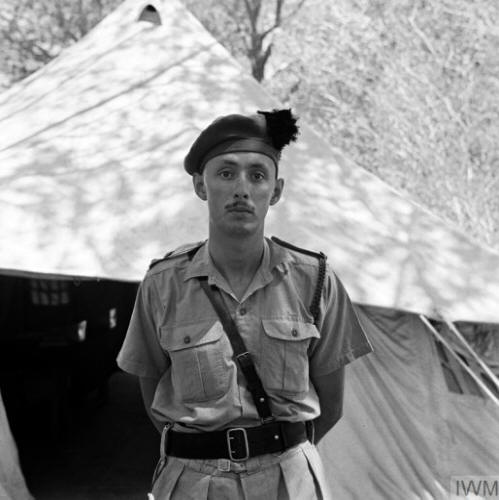
[Photo; Portrait of Geoffrey Charles Tasker Keyes, son
of Roger Keyes, posthumously awarded the Victoria Cross,
Operation Flipper, Libya, 17/18
November 1941.© IWM (E 4732)].
During his tenure
of office, it became evident that the three services could work together more efficiently and
more effectively as a combined force in pursuance of a common cause. Freed
from the constraints of inter-service rivalries, disparate internal procedures
and protocols, more was achieved in less time,
than would otherwise have been the case. However, despite this successful
integration, a little over a year later,
under severe pressure from the Chiefs of Staff, Churchill redefined the
post of Director of Combined Operations to Combined Operations Advisor - a change that was to have drastic consequences for Keyes. He was unable to accept the
loss of status, as he perceived it to be. An exchange of letters with Churchill followed but it was clear that no resolution was possible and, with
a heavy heart, Churchill replaced Keyes with a younger, more diplomatic officer by the name of Mountbatten.
In the final exchange of letters between the two old friends, Churchill wrote; " I need
not waste words on the pain and labour this matter has caused me." In reply Keyes wrote; "Please don't feel pain on my account, I have
none. I only grieve to have let down my splendid Commandos." Despite such negative thoughts, Keyes had in fact achieved a great deal in his
15 months as Director of Combined Operations. His departure was mourned by his Commandos, who shared much of his fighting spirit and
independent thinking.
As the Member of Parliament for the Portsmouth
North constituency, Keyes spoke during a debate on the King's speech in the House
of Commons on the 25th of November 1941. While he warmly expressed affection and
admiration for Prime Minister Churchill, his Commandos and amphibious forces, he
laid bare his frustrations with the Whitehall machinery that obstructed, rather
than assisted, Combined Operations.
Hansard,
the edited verbatim report of proceedings of both the House of Commons and the
House of Lords,
takes up the story.
Click here (Pdf File).
Using his house of Common's speech, United
Press International (UPI) issued a press release that was taken up by The
Columbus Telegram on November 27, 1941, just a week or so before the USA
entered the war following Pearl Harbour.
 British Make
Daring Raids On Normandy -
“Commando” Troops Get Ashore,
Finish Job, Get Back Safe. British Make
Daring Raids On Normandy -
“Commando” Troops Get Ashore,
Finish Job, Get Back Safe.
Britain’s
commandos, tough, black uniformed “phantom” troops, made a daring hit and
run raid on the Normandy coast Sunday night and early Monday morning, it
was disclosed officially today.
Commandos,
organized to reconnoiter German defenses and cause as much havoc and
destruction as possible, got ashore, completed their mission and returned,
the only casualty being a man who was shot in the arm by a machine gun
bullet.
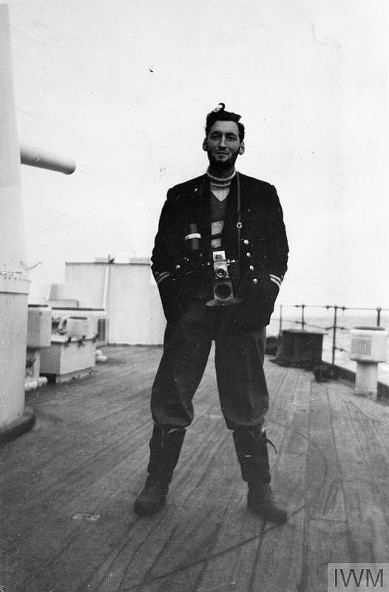
[Photo; Lieut Keyes, son of Admiral Sir Roger Keyes, on the
quarterdeck of one of HM Ships taking part in one of the 1941
Lofoten Raids. © IWM (A 6824)].
Ready
Year
As the ministry of information was announcing the raid,
Admiral Sir Roger J.B. Keyes said in the House of Commons the commandos
were eager and ready to act a year ago when, he said, they might have
altered the course of the war.
“The Prime Minister was as keen as I was to act vigorously in the face of
hazards and achieve great results which, if the commandos had been allowed
to carry them out, might have electrified the world and altered the whole
course of the war,”
Keyes said.
Work
at Night
Keyes
started training the men after the fall of France. Training was a closely
guarded secret and even war correspondents were not allowed to visit
them. Later, it was learned that the commandos operate with Tommy guns,
grenades, knives, sticks and dynamite. They always operate under the cover
of night.
The
commandos black their faces to make them match their weird black battle
dress. The daring hit and run raid made by the commandos Sunday night was
the first against the continent to have been acknowledged officially.
 Brass
Hats Brass
Hats
German high
command mentioned it in a communiqué issued from Adolf Hitler’s field
headquarters. Germans, however, said the raid had been repulsed and heavy
losses had been inflicted on the British.
Keyes
attacked the “brass hats of Whitehall” for “frustrating every worthwhile
offensive action I have ever tried to make.” Keyes said the service
committees and subcommittees, which have sprung up since the start of the
war, have become almost the dictators of military policy “instead of the
servants.”
Too Late
He said the service committees and subcommittees
“concentrated on the difficulties and dangers of every enterprise which I
suggested.”
“They have
hitherto succeeded in thwarting or delaying execution until we either have
been forestalled or actions have been taken too late for success,” he
said. “Until the staff system is thoroughly overhauled we will always be
too late for everything we undertake.”
[Photo; A depiction of a group of British Commando soldiers
raiding a German-held port in Norway. They run down a snow-covered hill
towards exploding buildings. In the background, other buildings are on
fire. text: BACK THEM UP was a sentiment Keyes would have applauded.
© IWM (Art.IWM PST 14364].
Sea
Invasion
“I have
unbounded faith in our ultimate victory but that victory will be delayed
while, in Whitehall phraseology, every stone is turned and every avenue is
explored,” he told the Commons. It was recalled that in a broadcast last
weekend the British radio warned the French people “to prepare for the
hour of invasion that the allies one day will make.”
There was
no suggestion, however, that
the latest raid was big enough to be connected
with any invasion hopes. The BBC broadcast, however, called on the French
people to “prepare to give the best possible support to invading armies”.
[Reproduced courtesy of
UPI].
Roger John Brownlow
Keyes or Baron Keyes of Zeebrugge and Dover, died on Dec 26th, 1945, in Buckingham, England. He was laid to rest among his fallen Zeebrugge comrades
in the small cemetery of St John's Church, Dover, England.
Perhaps Keyes' attitude to life can be gleaned from a single line he wrote in the fly leaf
of a book, which he sent to his friend, Haydon...
"He most prevails who nobly dares."
Further Reading
There are around 300 books listed on our 'Combined Operations Books' page which can be
purchased on-line from the Advanced Book Exchange (ABE) whose search banner
checks the shelves of thousands of book shops world-wide. Type in or copy and
paste the title of your choice or use the 'keyword' box for book suggestions.
There's no obligation to buy, no registration and no passwords. Click
'Books' for more information.
Roger Keyes; a biography of
Admiral of the Fleet Lord Keyes of Zeebrugge and Dover, G.C.B., K.C.V.O., C.M.G.,
D.S.O. C.F. Aspinall-Oglander, London, Hogarth Press, 1951. xv, 478 p. illus. 23
cm.
The Keyes papers : selections from the private and official
correspondence of Admiral of the Fleet Baron Keyes of Zeebrugge / editedby Paul
G. Halpern.London : Published by Allen & Unwin for the Navy Records Society,
1972-1981.3 vols. : ill., maps ; 23 cm.
 The Watery Maze by Bernard Fergusson 1961. Published by Collins. The Watery Maze by Bernard Fergusson 1961. Published by Collins.
Commandos 1940 -1946 by Charles Messenger 1985. Published by William
Kimber, London 1985. ISBN 0 7183 05531
|