|
No 1 Combined Training Centre,
Inveraray
HMS Quebec

Background
The No 1 Combined
Training Centre (No 1 CTC) was located on the remote shores of Loch Fyne in
Scotland. Its contribution to the war effort cannot be overstated. Its prime
purpose was to train army and navy service personnel in the use of minor landing craft
for landing assault troops, supplies, ammunition and weaponry onto heavily
defended enemy occupied beaches,
with RAF support as required.
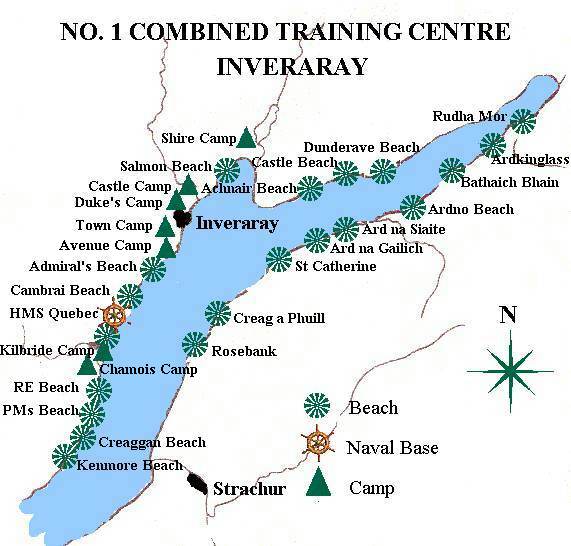
[Map courtesy of Google Map Data 2017].
Around 250,000
service personnel from the Allied Nations passed through the training
centre from 1940 to 1944, of which up to 15,000 were billeted in the
area at any one time. They subsequently put their training into effect
in Norway, North Africa, Sicily, Italy, the East Mediterranean, France,
Holland, Burma and even Madagascar. The training provided at Inveraray made all
these historical events possible, including D Day.
The navy base, HMS Quebec,
was part of the No 1 Combined Training Centre. The name was chosen because of
Captain Wolfe's Combined Operation
to capture the Abraham Heights at Quebec.
Churchill and his planners
knew that an entirely new approach was required to reinvade enemy occupied
Europe. There were no convenient ports to disembark the hundreds of thousands of troops
with all their supplies, vehicles and equipment. Furthermore, any beaches thought suitable
for a landing, would be heavily defended.
The
reinvasion of Europe would need a well trained and equipped
amphibious invasion force, of overwhelming strength. It required to draw on the best
resources and practices of the three services, working closely together as a
unified force. For the amphibious phase of the operation, the training task was
Herculean in the numbers to be trained, the diversity of the
training and the design and procurement of specialised equipment.
 Over
50 Combined Operations
shore bases and establishments were set up, mainly in the west of Scotland and the south of England.
For operations further east, the Middle East Combined Training Centre was set up
on the Bitter Lakes in Egypt. This was, arguably, the largest training programme
in human history. Over
50 Combined Operations
shore bases and establishments were set up, mainly in the west of Scotland and the south of England.
For operations further east, the Middle East Combined Training Centre was set up
on the Bitter Lakes in Egypt. This was, arguably, the largest training programme
in human history.
[Map of the No 1 Combined Training Centre, Inveraray].
Setting Up
'CTC
Inveraray', as it was commonly called, was set up in October 1940, to provide
training for commandos, brigade groups in the assault role,
formations in follow up and building up, port operating companies, squadrons of
the RAF Regiment and the RAF Servicing Commandos.
In respect of training directly concerned with amphibious landings, it was
a time of experimentation, innovation, evaluation and development,
as lessons were learned in the course of training and feedback from operations. To an extent, the training manual
was being rewritten as they went along.
Over the years, the
training provision was adapted and new training
establishments were
opened elsewhere to meet specific needs. One such
was the provision of RN Beach Signals/Section training. At the instigation of
Mountbatten, the Combined Signals School (CSS) was formed at HMS Quebec on
November 1, 1941. This was a very early example of a Combined
Unit, where it was possible to see personnel from all three
services parading together and reporting to a Signals Duty Officer, who could be
from any one of the three services! The CSS taught signalling procedures and assisted in the
 development of new
techniques and methods. They were also involved in early forms of
navigational aids, involving radio and other devices, designed to help
landing parties locate their designated landing beaches. In 1942, the school
moved to HMS Dundonald 2 at Troon in Ayrshire. development of new
techniques and methods. They were also involved in early forms of
navigational aids, involving radio and other devices, designed to help
landing parties locate their designated landing beaches. In 1942, the school
moved to HMS Dundonald 2 at Troon in Ayrshire.
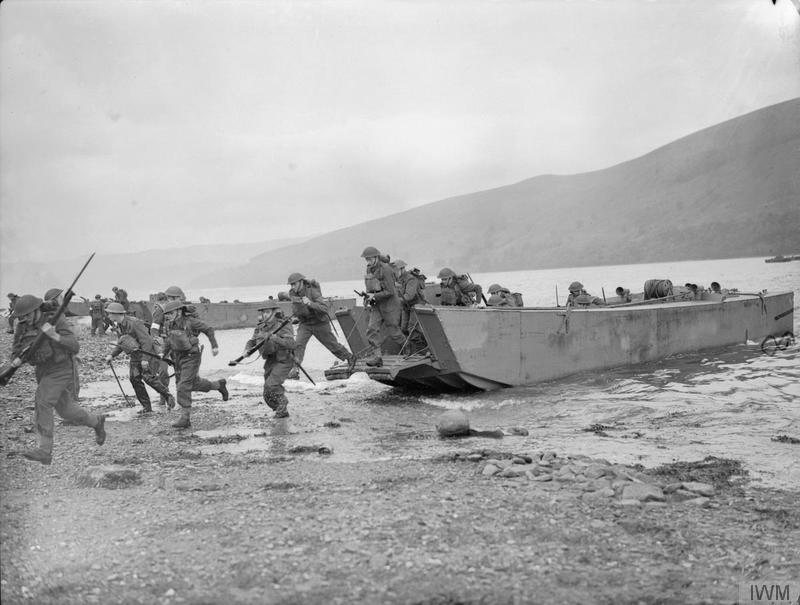
[Photo; troops practicing a beach
landing
from an LCA (Landing Craft Assault) on Loch Fyne.
© IWM (H 14572)].
Organisation
Army
The
Army presence comprised four Wings viz; Brigade Group, Army Tank, RE (Tn) & REME.
The Army Tank and RE (tn) Wings provided training for their own personnel. They
were allocated craft, accommodation and lecture rooms according to their needs
and availability. Their participation in training exercises was independent of the
Brigade Group Wing.
The Royal Navy
 The
Royal Navy presence at Inveraray took the form of a Naval Staff, under a Captain
RN, working directly to the Commandant of the CTC. A few miles to the south, lay HMS Quebec,
which was also commanded by a Naval Captain who, by
virtue of his seniority, was also Naval Officer in Charge (NOIC), Inveraray.
HMS Quebec’s primary role was to provide and maintain craft for training
operations and to accommodate personnel drafted in for the training of units at
the CTC. The
Royal Navy presence at Inveraray took the form of a Naval Staff, under a Captain
RN, working directly to the Commandant of the CTC. A few miles to the south, lay HMS Quebec,
which was also commanded by a Naval Captain who, by
virtue of his seniority, was also Naval Officer in Charge (NOIC), Inveraray.
HMS Quebec’s primary role was to provide and maintain craft for training
operations and to accommodate personnel drafted in for the training of units at
the CTC.
HMS Quebec I was the major naval component at the No 1 CTC,
while HMS Quebec II was located in the Hollywood Hotel, Largs, where training for staff officers was
provided on Combined Operations.
The courses were held from July 1943 to March 1944. A total of 1158 officers
completed the intensive course including 153 from the Royal Navy and Marines,
379 from the British Army, 122 from the Canadian Army, 351 from the RAF and 153
Allied. Click here for more
information.
The RAF
 The Air Section comprised two RAF officers on the staff of the Training Centre Commandant.
In addition, the CTC could draw on the services of 614 Squadron RAF to provide aircraft for
training purposes but their RAF mainstay was 516 Squadron
based at RAF Dundonald in Ayrshire,
which was
attached to the Combined Operations Command. At the end of each intake's
training, mock landings took place under realistic war conditions. 516 Squadron
strafed the landing beaches on low level attacks and provided smoke cover, while
landings were in progress. Mortar shells fired from nearby positions and small
arms fire completed the hazardous effects. The Air Section comprised two RAF officers on the staff of the Training Centre Commandant.
In addition, the CTC could draw on the services of 614 Squadron RAF to provide aircraft for
training purposes but their RAF mainstay was 516 Squadron
based at RAF Dundonald in Ayrshire,
which was
attached to the Combined Operations Command. At the end of each intake's
training, mock landings took place under realistic war conditions. 516 Squadron
strafed the landing beaches on low level attacks and provided smoke cover, while
landings were in progress. Mortar shells fired from nearby positions and small
arms fire completed the hazardous effects.
Below is a
typical report from the Air Section of the No 1 Combined Training Centre
for March 1944. The report is presented as typed, except for the addition
of photographs. It provides an insight into the role of the RAF at the
training centre.
OPERATIONS
(B) At various times
during the month No 516 (Combined Operations) Squadron, R.A.F, Dundonald
co-operated with Fighter, Smoke and Bomber Aircraft on the following exercises:-
Exercises "Newton Bay"
- Saturday 1st April, 1944, (Assault Exercises with live ammunition - zero0700
hours and 18.30 hours).
Exercises "Newton Bay"
- Sunday 16th April, 1944, (Assault Exercises with live ammunition - Zero 17.30
hours).
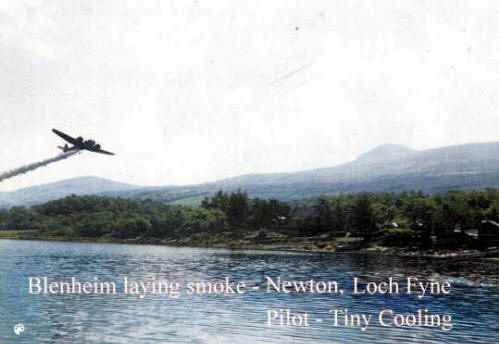 Purpose of Exercise
"Newton Bay". Purpose of Exercise
"Newton Bay".
Exercise "Newton Bay"
is an Assault Exercise using live ammunition supported by artillery, tanks and
aircraft, the latter providing smoke screens, bomber support and fighter bomber
support. (Photo of Hurricanes 'attacking' Newton Bay).
Exercise "Airshow" due
to take place on Tuesday 18th April, 1944 had to be cancelled owing to adverse
weather conditions.
Aircraft on five
occasions for various exercises had to be cancelled owing to unfavourable
weather conditions. The Forward Air Link Control was again provided from the
R.A.F. Seaplane Tender No. 1533stationed at this Combined Training Centre.
During the month the
Air Staff Officer (S/Ldr. J. Huggan) gave lectures on the Air Aspect of Combined
Operations on nine occasions to the following:-
No. 2831 A.A. Squadron, R.A.F. Regiment. Officers ONLY, T.A.F. Lecture.
No. 2848 A.A. Squadron, R.A.F. Regiment. Officers ONLY. T.A.F. Lecture.
6 Battalion, The Cameronians (Scottish Rifles).
7 Manchester, M.M.G.
7 Battalion, The Cameronians (Scottish Rifles).
4/5 Royal Scottish Fusiliers.
6 Battalion, The Cameronians. Inf. Bde. RASC. Coy
(C) No.12 course for
the Royal Air Force Regiment in Combined Operations was held at this Combined
Operations Training Centre on the following dates:-
No 18 Course. No. 2831 A.A. Squadron and No. 2848 A.A. Squadron - April 11th -
April18th 1944.
The Strength of the units attending were as follows:-
No. 2831 A.A. Squadron - 8 Officers - 148 Other Ranks.
No. 2848 A.A. Squadron - 7 Officers - 155 Other Ranks.
The programme was carried out in full and a copy is attached as Appendix "A"
together with copies of Exercise "ERK" and Exercise "PRUNE" attached as Appendix
"B". A separate report on Course No. 12 was issued under this Air Section's
letter CTC1/3/21/44 dated the 18tyh April, 1944, and a copy is attached as
Appendix "C".
 ADMINISTRATION. ADMINISTRATION.
(D) The following
Officers visited the Air Section of this Combined Training Centre, during the
course of the month:- Colonel C.F.O.G. Forbes, Chief Inspector or the R.A.F. Regiment Depot, GRANTHAM,
attended No.18 Course for the R.A.F. Regiment as a Spectator Officer, but was
unfortunately admitted to the Military Hospital Inveraray on the 14th April,
1944. Colonel E.A. Shipton, O.B.E, M.C, T.D, (G.D.O.1. Headquarters, No.x22 Group)
attended course No.12 for the Royal Air Force Regiment as a Spectator Officer.
Major Parkinson (Headquarters No. 22 Group) attended course No.12 for the R.A.F.
Regiment and took over the duties of C.R.A.F.R. for the course and took charge
of the Wing on the Exercises. Wing Commander B.G.F. Drinkwater, Senior Air Staff Officer, No.105 Wg.
Flight Lieutenant D. Rymer, Flight Commander No. 516 (C.O.) Squadron visited the
Air Section of this Combined Training Centre. Squadron Leader Reeves, Officer Commanding No. 516 Squadron, visited the Air
Section of this Combined Training Centre, on the 29th April, 1944 for the
purpose of attending a Briefing Conference for Exercise "Newton Bay".
Flying Officer C. Wren, Aircraft Recognition Instructor, Air Section, Combined
Signals School, H.M.S. Dundonald II, visited the Air Section of this Combined
Training Centre , on the 15th April, 1944, in order to give Aircraft Recognition
Lectures to the personnel of No. 2831 and No. 2848 A.A. Squadrons, R.A.F.
Regiment attending No. 12 course. Flight Sergeant Avery and two other ranks from Air Ministry Unit, London,
attended No. 12 Course for the purpose of waterproofing the vehicles. (See
special report CTCI//3/44 dated 17th April 1944).
[Photo
above; HMS Quebec with Loch
Fyne in background. © IWM (A 29892)].
PERSONNEL.
(A) Flight Lieutenant W. Ward, R.A.F.R. was on temporary duty at this
Combined Training Centre, from the 8th April, 1944 to the 23rd April, 1944, for
Instructors Duties, in order to take over the command of No.12 R.A.F. Regiment
Course.
 GENERAL. GENERAL.
With the exception of No.12 Course for the R.A.F. Regiment, the work carried out
by this Air Section was to a great extent Army Liaison. On the 24th April, 1944,
the First Brigade of the 52nd Division, arrived for Combined Training , the
course will last for approximately three weeks and will be followed by similar
courses for the other Brigades.
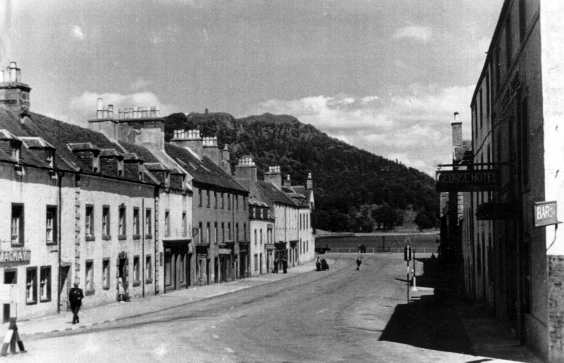
[Photo right; Inveraray main street in the
1940s].
Owing to the shortage of staff, the Army provided specialist instructors for
No.12 Course which assisted us in handling the course in a satisfactory manner.
Signed (J Huggan),
Squadron Leader,
Air Section,
C.T.C. Inveraray.
What the Trainees Thought
Inveraray today is a popular tourist area of
Scotland but the weather can be harsh, particularly in the winter. The table
below shows training was provided
throughout the year, so any individual's experience would be affected by the
timing of his training.
However, there was more than the weather to complain about, as the poem
immediately below shows. It was circulated around the Royal Engineers in Chamois
Camp, although it's thought that similar poems were written about many other
remote locations, only the name being changed.
Ode to
Inveraray
This bloody place is a bloody cuss
No bloody tram, no bloody bus
And do they care for bloody us?
In bloody Inveraray
The bloody films are bloody old
The bloody seats are bloody sold
Can't get in for bloody gold
In bloody Inveraray
It bloody pours, it bloody rains
No bloody kerbs, no bloody drains
Ain't no-one got no brains
In bloody Inveraray?
Everything's so bloody dear
A bloody bob for a bloody beer
And is it good? no bloody fear
In bloody Inveraray
All bloody work no bloody games
No bloody fun with bloody dames
Wouldn't even tell their names
In bloody Inveraray
Enough of this ere bloody rhyme
Everything's just a waste of time
Next week'll be just "T" sime
In bloody Inveraray.
 There was, however, entertainment at HMS
Quebec as Alan Findlay confirms; "My brother, Ian Findlay served in the
Royal Navy during the 2nd world war. He was an engineer all his life and was
a Petty Officer Artificer serving at Inveraray and Gosport. He was a
musician and played the violin. The two photographs are of concerts at HMS
Quebec. The first one shows the Quebec concert party in September 1943
entitled 'Navy Mixture;' my brother is forth from the right back row. The
second photo is the same concert party on 21st March 1944 entitled 'Smile a
While'. There was, however, entertainment at HMS
Quebec as Alan Findlay confirms; "My brother, Ian Findlay served in the
Royal Navy during the 2nd world war. He was an engineer all his life and was
a Petty Officer Artificer serving at Inveraray and Gosport. He was a
musician and played the violin. The two photographs are of concerts at HMS
Quebec. The first one shows the Quebec concert party in September 1943
entitled 'Navy Mixture;' my brother is forth from the right back row. The
second photo is the same concert party on 21st March 1944 entitled 'Smile a
While'.
Trainees
Intakes
As units left the area, on completion of their
training, others arrived to take their place. Below, is a record taken from
the
 diary
of a local resident. It's probably not a complete record or accurate in
every detail but it gives a sense of the turnover of trainees involved.
[Courtesy of the Combined Operation Association's 'Bulldozer' Newsletter]. diary
of a local resident. It's probably not a complete record or accurate in
every detail but it gives a sense of the turnover of trainees involved.
[Courtesy of the Combined Operation Association's 'Bulldozer' Newsletter].
[1941]
April
- Royal
Engineers.
May
- Special Services (Commandos).
Jun
- Argyll
& Sutherland Highlanders; Royal Scots Fusiliers.
Jul
- East Lancashire Regiment; Royal Welsh Fusiliers.
Aug
- Royal Artillery; Royal Scots Fusiliers; Royal Welsh Fusiliers;
Canadian Troops; Royal West Kent Regiment; Royal East Kent Regiment.
Sep
- Royal Army Service Corps.
Oct
- Royal
Pioneer Corps; Royal West Kent Regiment.
Nov
- London Fusiliers.
Dec
- Roy al
West Kent Regiment; The Black Watch.
[1942]
Jan
- Royal Surry Regiment; Northamptonshire Regiment.
Feb
- Lancashire
Fusiliers.
Mar
- East
Surrey Regiment; Bedfordshire Regiment; Royal Northumberland
Fusiliers.
Apr
-
East Surrey Regiment; Royal Pioneer Corps; Royal Artillery.
May
- South Lanarkshire Regiment; East Yorkshire Regiment; Suffolk
Regiment.
Jun
- King's Own
Scottish Borderers; Royal Ulster Rifles; Lincolnshire Regiment.
Jul
-
King's Shropshire Light Infantry; Sherwood Foresters; Duke of
Wellington's Regiment.
Aug
-
Duke of Wellington's Regiment; American Troops.
Sep
-
American Troops.
Oct
-
Royal West Kent Regiment; Black Watch; Royal Army Service Corp;
Kings Shropshire Light Infantry.
Nov
-
Duke of Cornwall's Light Infantry; Black Watch; Royal Marines.
Dec
-
Duke of Cornwall's Light Infantry; Royal Regiment (North
Lancashire); Canadian Troops.
[1943]
Jan
- Canadian Troops.
Feb
- Canadian Troops; French Canadian Troops.
Mar
-
French Canadian Troops; South Lancashire Regiment; Suffolk
Regiment; East Yorkshire Regiment.
Apr
-
Royal Ulster Rifles; King's Own Scottish Borderers; Canadian
Troops.
May
-
Canadian Troops; French Canadian Troops; Seaforth Highlanders of
Canada; Norfolk Regiment.
Jun
-
Norfolk Regiment; King's Shropshire Light Infantry; Middlesex
Regiment; Somerset Light Infantry.
July
-
Lincolnshire Regiment; King's Own Scottish Borderers.
Aug
- Canadian
Troops; Irish Guards.
Sept
-
Oct
-
Nov
-
Dec
-
[1944]
Jan
- French Canadian Troops; Monmouthshire Regiment.
Feb
- North Staffordshire Regiment; Argyll & Sutherland Highlanders;
Seaforth Highlanders of Canada; East Yorkshire Regiment.
Mar
- Hampshire Regiment; Green Howards; South Wales Borderers;
Gloucester Regiment.
Apr
-
Royal Air Force; Queens Own Cameron Highlanders.
May
- King's Own Scottish Borderers.
Jun
- Glasgow Highlanders; Norwegian Troops; Royal Engineers.
The Closure of HMS Quebec
[Courtesy
of the Combined Operations 'Bulldozer' of 1946].
H.M.S. Quebec has been added to the list of
those ships and establishments for which 'no further requirement exists,' and we
commence 'paying off' on 1st June, 1946. In actual fact the great
exodus has already started and a steady stream of personnel, craft and ships is
constantly moving southwards.
It seems fitting that Quebec should not be
allowed pass without recording a brief summary of its history and achievements.
A large percentage of both naval and military personnel who took part, both in
the smaller combined operations, which preceded it and in the main assaults on
Europe, were trained at this base. Quebec has also, throughout its
history, been actively associated with our Corps activities in various spheres,
and many Royal Marines have 'passed through.
 H.M.S. Quebec is a Combined Operations
establishment, situated on the upper reaches of Loch Fyne, Argyllshire, some two
miles from Inveraray. The base derived its name from the historical operations
which resulted in the
capture of Quebec in 1759. Roads in
the establishment were named after Admiral Saunders and Admiral Holmes, both of
whom had distinguished themselves in this operation. The foreshore was named
"The Caronage," the name given to that part of the beach where old-time sailors
careened their ships. H.M.S. Quebec is a Combined Operations
establishment, situated on the upper reaches of Loch Fyne, Argyllshire, some two
miles from Inveraray. The base derived its name from the historical operations
which resulted in the
capture of Quebec in 1759. Roads in
the establishment were named after Admiral Saunders and Admiral Holmes, both of
whom had distinguished themselves in this operation. The foreshore was named
"The Caronage," the name given to that part of the beach where old-time sailors
careened their ships.
[Photo; Let's not forget the WRNS
without whom the No1 CTC could not have functioned. Here we see them relaxing in
their recreation room at HMS QUEBEC. On the walls are pictures and posters
depicting life in the Colonies. © IWM (A 15156)].
Commissioned on the 1st May, 1941, the
main functions of the base were to train and accommodate naval landing craft
crews, to accommodate officers and men in "pool" awaiting draft and such crews
as were used in combined training by C.T.C., Inveraray.
The base was also to have extensive repair and
storage facilities and to carry the pay accounts of some thousands of Combined
Operations ratings. The usual growing pains were experienced in opening the
camp, which first consisted of twelve wooden huts, the necessary galleys, pay
offices and a small canteen. The huts were built on stilts, as the ground was
wet and boggy and not, as at the present time, well drained. The situation on
the shores of Loch Fyne was extremely practical as well as being picturesque. A
steel pier was erected and this could be used at any state of the tide by
landing craft. A gently sloping beach, with protection from all but S.W. gales,
ensured the easy handling of craft for repair and maintenance.
Some 450 officers and men were in camp by the middle
of May, 1941, and work went on apace in further construction. Engineering
workshops, boat slips, the Wrennery and a well fitted sick bay were completed.
Training, which had up to that time been carried out from various ships moored
in the Loch, now settled down to a steady cycle, twelve officers and 150 seamen
arriving from H.M.S. Northney every fortnight. Flotillas were
commissioned for the Lofoten, Vaagso and Spitzbergen raids and both day and
night training was carried on by these crews operating with the C.T.C.
A rifle range and assault course were built on the
rising ground behind the camp and the whole area resounded to Lewis, tommy-gun
and rifle fire and grenade explosions. Newton, an almost uninhabited spot on the
opposite side of the Loch, was now being used as a training ground for assault
landings, and Quebec supplied craft and crews to work with Major Landing
Craft Flotillas and the military units in both day and night operations.
 Life in camp was rigorous, and the base staff were
fully extended in the work of maintaining the craft and in accommodating and
administering the continual flow of trainees and others passing through the
base. The W.R.N.S. were with us from the very day Quebec first
commissioned, and they now began to descend upon us in large numbers,
infiltrating with great success into all departments. Some of the duties which
this wonderful Service took upon itself were transport drivers, cooks, stewards,
writers, communication ratings, electrical ratings, messengers, generator
watch-keepers, ship’s mechanics and duty boats’ crews. Some also specialised in
painting and welding. This influx of the fair sex not only relieved a hard
pressed base staff and permitted the release of personnel for sea service, but
added considerably to the amenity possibilities. Life in camp was rigorous, and the base staff were
fully extended in the work of maintaining the craft and in accommodating and
administering the continual flow of trainees and others passing through the
base. The W.R.N.S. were with us from the very day Quebec first
commissioned, and they now began to descend upon us in large numbers,
infiltrating with great success into all departments. Some of the duties which
this wonderful Service took upon itself were transport drivers, cooks, stewards,
writers, communication ratings, electrical ratings, messengers, generator
watch-keepers, ship’s mechanics and duty boats’ crews. Some also specialised in
painting and welding. This influx of the fair sex not only relieved a hard
pressed base staff and permitted the release of personnel for sea service, but
added considerably to the amenity possibilities.
[Photo;
tank commanders and their crews practicing a beach landing from a TLC (Tank
Landing Craft) on Loch Fyne.
© IWM (H 14572)].
In 1941 the Rt. Hon. Winston Churchill paid a visit
to the base and gave one of his typically fighting speeches before he left.
H.M. The King, accompanied by the C.C.O. ( Admiral
Lord Keyes ), also visited
Quebec and inspected the ship’s company. A touch of colour was lent to
this memorable visit by the dress of the Lascars (sailors from the East Indies)
of Winchester Castle, who mustered with several contingents from ships in
harbour.
Local facilities for recreation have always been
meagre in the extreme. Long leave in those early days was not to be thought of.
Short leave was restricted to the village of Inveraray, which possessed few
facilities for catering to the requirements of such a vast number of Navy, Army
and Air Force personnel as were now camped around its environs. The local ladies
ran a W.V.S. which did yeoman service through the whole of the war period.
Dances, whist drives etc. organised by the various Services and local people,
helped enormously to keep up morale and provide some essential distraction from
the unending training programmes. Periodical leave was not organised until the
beginning of 1942, and as all liberty men had to travel by a skeleton service of
buses between Inveraray and Glasgow, numbers had to be kept to a bare minimum.
Later, when things got more into swing, a regular service of R.N. transport,
assisted by the Army M.T. Pool, was run to and from the railhead at Arrochar, 27
miles distant, and regular leave has since been granted every three months.
 Much could be written about the activities of
various Flotillas and special parties who passed through the base, not
forgetting the Canadians who eventually took part in the historic Dieppe raid,
but space does not permit. Much could be written about the activities of
various Flotillas and special parties who passed through the base, not
forgetting the Canadians who eventually took part in the historic Dieppe raid,
but space does not permit.
[Photo; Accommodation ship,
HMS Ettrick off Inveraray].
Visits were paid to the base in 1942 by H.R.H. The
Duke of Gloucester, H.R.H. The Duchess of Kent, Admiral Stark of U.S.N., and
several other high ranking officers of the various Services. One memory,
however, of all personnel, who knew Quebec, will always predominate over
others… the weather. Rain, rain and yet more rain. Some of the older
inhabitants, it is rumoured, had to be whisked away quickly when it was found
that their feet had started to become "webbed." Yet, bad as the weather could
be, it seldom was bad enough to prevent training, which went on unhindered by
enemy activities or from any other cause. Early in 1942 the numbers of personnel
passing through so increased that it was necessary to take over Chamois Camp and
several "lines" in the Army Town Camp at Inveraray. Later, it became necessary
to use two accommodation ships, the Northland and the Southland, which were
moored just off the Camp Pier.
In 1943 several outstanding incidents occurred. The
camp cinema was opened by Miss Evelyn Laye, whose visit to Quebec was
greatly appreciated. Her wish that many happy hours would be spent by us in that
same building has certainly been fulfilled. In the same month a large section of
the training was transferred to Dartmouth, and in August the same year
H.M.S.Copra, which was now dealing with 5,000 accounts, deserted the safety
of Argyll for the blitz area of London. That year marked he peak of Quebec’s
activities. The Junior Officers’ Club was instituted and opened, visits to us
were paid by Mr. A.V. Alexander, the First Lord of the Admiralty, and several
other notable people and high ranking officers. Late in 1943, we also received
our first H.M. Flotillas and under the eyes of the experienced naval landing
craft personnel the Royals began to infiltrate into Quebec’s life. The
advent
of the Royal Marines was welcomed in the camp, as this infused a keen and
friendly rivalry in both work and sports which has continued to this day.
 Visits by H.M. The King of Norway and Crown Prince
Olaf and several high-ranking officers, inspections and real solid hard work
marked 1944-45, and much more valuable training was accomplished. The social and
recreational side of camp life was further extended. Association football,
rugby, and in the summer, cricket and sports meetings were held. Indoor
entertainment was provided by dances, regular cinema performances, socials,
whist drives and boxing meetings, and the Quebec network of wireless
programmes was instituted. Visits by H.M. The King of Norway and Crown Prince
Olaf and several high-ranking officers, inspections and real solid hard work
marked 1944-45, and much more valuable training was accomplished. The social and
recreational side of camp life was further extended. Association football,
rugby, and in the summer, cricket and sports meetings were held. Indoor
entertainment was provided by dances, regular cinema performances, socials,
whist drives and boxing meetings, and the Quebec network of wireless
programmes was instituted.
[Photo; Marines jungle training in August 1945 at the No1 CTC at
Inveraray and HMS Quebec. Training by Royal Marine staff under the guidance of
the Royal Marine Eastern Warfare School, Brockhurst, Hants. A patrol crossing a
ravine by rope and wire bridge. © IWM (A 30139)].
The invasions of North Africa, Sicily, Salerno and,
later, N. France, were all followed with profound interest at Quebec,
where so many crews were taking part in these operations had received their
basic training. The close of hostilities against Germany found Quebec a
highly organised, efficient and smooth working base, with a record of solid if
unspectacular achievement behind it.
VE-Day was celebrated, therefore, in the full
realisation of work well done. Training still continued, however, until well
after VJ- Day, which in due time was also celebrated in becoming fashion.
In October, 1945, the duties of Commanding Officer,
H.M.S. Quebec, and N.O.I.C., Inveraray, were amalgamated and the command was
passed to a Royal Marine officer, Lt. Col. W. F. Edds, O.B.E., R.M.
And now Quebec is paying off! The Loch is
still dotted with a large number of ships and craft, but these are going and in
a short while Loch Fyne will settle down to her old-time peaceful quiet and
Quebec and her many activities will be but distant memories.
 HMS Quebec - Then and Now HMS Quebec - Then and Now
Photos below, courtesy of Stuart Kidd, who runs an
interesting website about Inveraray at
www.visit-inveraray.co.uk writes...
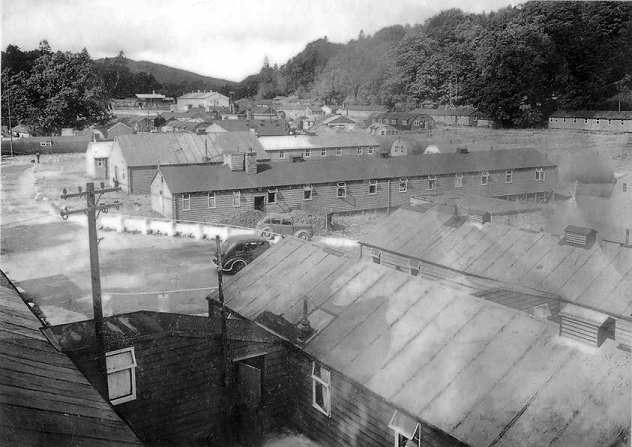
I have attached two photos of HMS Quebec at Inveraray. The first one,
taken in the 40's, shows the Quebec camp looking south, with the drill
hall/cinema in the centre background. I believe in the foreground are the
hospital buildings. The second photo, I took in late 2003. I tried to take it
from a similar position and you can see that the drill hall is still there in
the centre background. Today it is used as a recreation hall for various games
and sports.
Further Reading
There are around 300 books listed on
our 'Combined Operations Books' page. They, or any
other books you know about, can be purchased on-line from the
Advanced Book Exchange (ABE). Their search banner link, on our
'Books' page, checks the shelves of
 thousands of book shops world-wide. Just type in, or copy and paste the
title of your choice, or use the 'keyword' box for book suggestions.
There's no obligation to buy, no registration and no passwords. Book
recommendations are welcome. thousands of book shops world-wide. Just type in, or copy and paste the
title of your choice, or use the 'keyword' box for book suggestions.
There's no obligation to buy, no registration and no passwords. Book
recommendations are welcome.
Elsewhere on this
website;
The
wartime reminiscences
of local residents.
A report by
a Canadian war artist who observed training exercises at the No1 CTC.
An
often humorous account of landing craft training at Inveraray.
Correspondence
Polish Artillery
Training Centre, Inveraray.
I'm a grandson of a Polish soldier,
Stanisław Kaczmarek,
who served in the1st Polish Armoured
Division
 during WW2 under British command.
While in Guildford, Surrey, he married my
grandmother Irena, who served in the Women's Auxiliary Service, 2nd Polish Corps
in Italy. The Combined Operations
Training Centre near Inveraray, later accommodated the Polish Artillery Training
Centre. during WW2 under British command.
While in Guildford, Surrey, he married my
grandmother Irena, who served in the Women's Auxiliary Service, 2nd Polish Corps
in Italy. The Combined Operations
Training Centre near Inveraray, later accommodated the Polish Artillery Training
Centre.
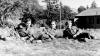
[Photos courtesy of
Tomasz Szular. Right; Front Street
with the watchtower in the background and left below, relaxing in one of the
camps, possibly Duke's or Castle.
 In
1946, my grandfather was a cadet corporal. After spending some time in the
Polish Resettlement Corp at
Witley Camp, Surrey. He returned to Poland in 1947. In
1946, my grandfather was a cadet corporal. After spending some time in the
Polish Resettlement Corp at
Witley Camp, Surrey. He returned to Poland in 1947.
Please
feel free to add the information to your website if you wish.
Tomasz.
 Inveraray. During WWII both my parents served (and met)
at the Combined Operations Establishment in Inveraray. My father had been in
the RN since 1934, when he joined as a boy seamen. From my father, I remember
that he was once apprehended on leave in Sheffield by a vigilant policeman
who did not recognise his "mixed" uniform. Inveraray. During WWII both my parents served (and met)
at the Combined Operations Establishment in Inveraray. My father had been in
the RN since 1934, when he joined as a boy seamen. From my father, I remember
that he was once apprehended on leave in Sheffield by a vigilant policeman
who did not recognise his "mixed" uniform.
My mother was a P.O. in the WRNS -
presumably in the Accounts Office at HMS Quebec. Among her papers I found
this photo, which I remember her saying was taken at Inveraray sometime
prior to 1944 when she left the service. She was then Olive Ann Elisabeth
Smith. She's the middle one of the three Wrens. I assume the photo is of the
members of the Accounts Department where she was employed, perhaps the
wooden building behind them housed their
office... but this is speculation. Does anyone recognise the surroundings or
the people in the photo? Click on the photo to enlarge it.
If you can help please contact Chris on the
e-mail link opposite.
After reading the web pages of 'Combined Operations' I recall a tale told
to me a few years ago while visiting the
Muckleburgh Collection Museum in
North Norfolk. I spoke to its founder, the late Berry Savory, who told me that
he had served at Inveraray Castle in WW2 as part of a training facility prior
to D-Day. One of the reasons for choosing this location was its distance from
German airfields - it was beyond the range of all aircraft they then had to
carry out a mission and return to base.
One day they heard a droning in the sky and the consensus was that it was a
German aircraft. The military authorities contacted London and were told to,
'dig in'. London was asked, 'With what?' The reply was, 'We are sending the
necessary equipment.' Some time later a very large lorry consignment of
standard pick heads arrived but there were no handles. London was asked,
'Where are the handles?' Reply, 'We will send some'. Berry laughingly recalled
that the handles never did arrive, but, if they had, hand held picks would
have made little impression on the rocky terrain around Loch Fyne!
The plane apparently crashed somewhere in the Midlands after running out of
fuel. It had obviously become hopelessly lost during its mission. Berry was
sure that somewhere in the vicinity of the castle is a large pile of badly
rusting pick heads!
Harvey Gooch.

In
1992, on a training beach at
Gortenfern, Kentra on the Ardnamurchan peninsula, evidence of
assault landing training activity was found in the form of mortar shell
casings and 303 bullets dated 1942. Peace and tranquillity have long since
returned to this beautiful location, and today, little or nothing of all
this activity remains to be seen.

Commemorations
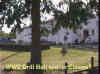
Subject - HMS Quebec a RN base situated amidst the No 1 Combined
Training Centre training beaches and camps. Location - a few miles
south of Inveraray, Scotland on the A83. Turn into the Argyll Caravan Site.
Other info -
plaque is
fixed to the door of a WW2 building (opposite) which now serves as the caravan
site reception office.
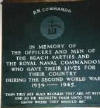
Subject - RN Commandos.
Location. The Memorial Plaques on the left are situated in Ardentinny
Church on Loch Long in Scotland close to where the RN Commandos training
base camp at HMS Armadillo was located. Other Info. These men
often went ashore in the early stages of a landing.
Acknowledgments
This page about the No 1 Combined Training Centre,
Inveraray was prepared by Geoff Slee, initially from research material by Phill C Jones.
|