|
Operation Anklet -
Lofoten Islands 2nd Raid.
26/27th December 1941

Background
Operation Anklet, the second Lofoten Islands
raid, was a diversion in support of a much larger action at Vaagso,
over 300 miles to the south, on
the Norwegian coast.
There was no opposition to the landing but a near miss
from a German bomber convinced the planners that air support would be
provided on future operations.
[Map
courtesy of Google Map Data 2017].
The Lofoten Islands lie off the Norwegian coast about 100 miles north of the Arctic Circle. In appearance and
size, their rugged terrain resembles the Outer Hebrides, off the north west coast of Scotland. The
Islands were selected by Combined Operations HQ as a relatively safe,
diversionary target to coincide with the main Vaagso raid,
some 300 miles south.
Plans & Preparation
Since the first Lofoten
Raid in March 1941, the German forces in Norway had been strengthened, including
air cover, much as Churchill had hoped for and expected. For very little effort
on the part of the Allies, Germany had redeployed tens of thousands of additional
troops, waiting for an invasion or major raid that never happened. Feints and
concurrent raids were now a
legitimate
 tactic to divert attention, confuse the enemy and to promote the idea
that Norway was a serious
option for the launch of an invasion of mainland Europe from the UK. tactic to divert attention, confuse the enemy and to promote the idea
that Norway was a serious
option for the launch of an invasion of mainland Europe from the UK.
[Photo; Rear Admiral L H K Hamilton, DSO, who was in
command of naval operations. © IWM (A 6822)].
Action
300 men from No 12
Commando, with some members of the Royal Norwegian Army, under the command of
Lieutenant-Colonel S S Harrison, landed at 06.00 hours on Boxing Day. The
planners had timed the raid in the expectation that the German garrison
would be caught off guard. This was especially likely after the Christmas
festivities of the day before.
Photos
below courtesy of
Capt OB 'Mickey' Rooney's family.
_small.jpg)
Scapa Flow in the Orkney Islands.
_small.jpg)
En route to Norway.
_small.jpg)
Cruiser Arethusa on escort
duty to Norway.
_small.jpg)
Sorvagen. Landed on Quay.
_small.jpg)
Vorge Fjord.
_small.jpg)
Surveying craft sent from admiralty to pick up captured documents.
 The landings were unopposed as the men
of 12 Commando, wearing white hooded overalls, entered two harbours of Reine and Moskeneson,
on
the east side of the island of Moskenesoy. The towns
were soon occupied and a small number of German prisoners and quislings were taken, including those manning the wireless
station at Glaapen. The landings were unopposed as the men
of 12 Commando, wearing white hooded overalls, entered two harbours of Reine and Moskeneson,
on
the east side of the island of Moskenesoy. The towns
were soon occupied and a small number of German prisoners and quislings were taken, including those manning the wireless
station at Glaapen.
A large supply of French chocolates and cigarettes was found and distributed to grateful locals. However, there was concern
about reprisals and many locals wanted the British forces to stay.
[Map courtesy of Google Map Data 2017].
Admiral Hamilton, on his Cruiser
HMS Arethusa, with 8 destroyers in support, was tempted to extend his stay, since, at these latitudes, there was no sunrise
from the 10th December to 3rd January. Attack from the air seemed most
unlikely, however, a bomb dropped by a German seaplane on the 27th, fell
close to the cruiser, causing Harrison to
withdraw, having successfully completed the mission.
Outcome
Two radio transmitters were
demolished, several small German boats captured and a few Germans and quislings
taken prisoner. Sea communications in the area would be disrupted for some time. The raid had served
its purpose, with all men and equipment safely returned. However, this was the last time such a raid was undertaken without
air support. The nature of this form of warfare was changing, as both sides assimilated past experiences into future planning.
 Summary of Action Summary of Action
Allied Forces: Sea - HMS Arethusa & 8 Destroyers. Land
- 300 men from No 12 Commando.
Axis Forces: Land - Local German Garrison.
[Photo; Troops returning from shore in
landing craft personnel (ramped) on their return from the Lofoten islands,
Norway, where they were landed to blow up the oil tanks. Smoke can be seen
rising from the shore. © IWM (A 3321)].
Outcome (Positive): A unopposed diversionary raid. Two radio transmitters demolished. Capture of
several small German boats, Germans and quislings.
Outcome (Negative): None.
Further Reading
There are around 300 books listed on
our 'Combined Operations Books' page. They, or any
other books you know about, can be purchased on-line from the
Advanced Book Exchange (ABE). Their search banner link, on our 'Books' page, checks the shelves of
thousands of book shops world-wide. Just type in, or copy and paste the
title of your choice, or use the 'keyword' box for book suggestions.
There's no obligation to buy, no registration and no passwords.
The Vaagso Raid; The Commando Attack That Changed The Course of World War II
by Joseph H. Devins.
Commandos and Rangers of World War 2 by James D. Ladd. Published in 1978 by MacDonald & Jane's. ISBN 0 356 08432 9
%20TBC%20Miller%20RNVR.jpg) Commandos 1940 - 1946 by Charles Messenger. Published by William Kimber, London 1985. ISBN 0 7183 0553 1 Commandos 1940 - 1946 by Charles Messenger. Published by William Kimber, London 1985. ISBN 0 7183 0553 1
The Watery Maze by Bernard Fergusson published 1961 by Collins.
Correspondence
My father, Sub Lt (Sp) TBC Miller RNVR (photo
opposite), took part in Operation Anklet in December
1941. He left us some secret papers about it. He was a Sub-Lieutenant in Naval
Intelligence attached to Admiral Hamilton of the cruiser HMS Arethusa. He
led twelve Norwegian (sailors or resistance?) in a fishing boat and captured four armed Germans in Soorvagen
and two Norwegian collaborators. He was very upset at having to arrest the
Norwegians in their homes because it was Christmas time and one of
 the wives
took something from her Christmas tree and gave it to her husband before he was
taken away. I do not know what happened to these men but I hope they were
cared for. I expect that they were taken to England for questioning and were
probably released after the war. the wives
took something from her Christmas tree and gave it to her husband before he was
taken away. I do not know what happened to these men but I hope they were
cared for. I expect that they were taken to England for questioning and were
probably released after the war.
The removal of the Germans made it easier for Major
Torrence and his commandos to destroy the Radio Transmitter on Skomvaer Island.
My father was awarded the Distinguished Service Cross for his action and we have
the medal, his report to Flag Officer, Force J (Admiral Hamilton) and his
uniform.
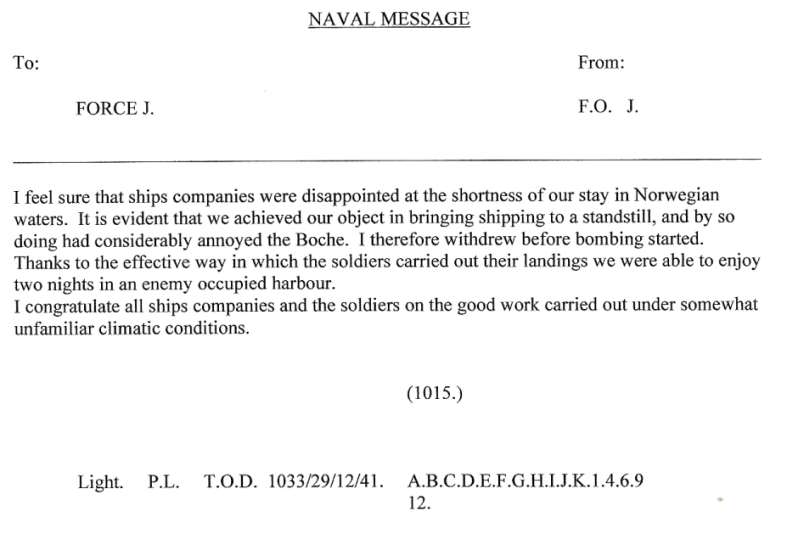
See signal from Flag Officer, Force J
(Admiral Hamilton) on cruiser HMS Arethusa, to all his officers after the
operation.
William Miller
|


.jpg)
.jpg)
.jpg)
.jpg)
.jpg)
.jpg)