|
Operation Chariot - St. Nazaire, 28th March 1942.
The aim was to deny dry dock facilities
to the German battleship, Tirpitz.

Background
Operation Chariot was an audacious Combined
Operation raid on the port of St Nazaire in German occupied France. Packed with
tons of high explosives, the destroyer, HMS Campbeltown, was rammed into the gates of the only dry
dock capable of servicing the German battleship Tirpitz. Such was the damage,
the dry dock was rendered unusable for the remainder of the war.
[Photo; Aerial reconnaissance photograph of the docks at St Nazaire taken
before the operation. The dry dock is slightly above the centre of photo. © IWM
(C 2351)].
In the second week of January 1942, the powerful German battleship, Tirpitz, moved from the
Baltic, through the Kiel canal and north to Trondheim on the Norwegian coast.
From there, it had the potential to break out into the North
Atlantic and to wreak havoc on allied Atlantic convoys. C in C Home Fleet, Admiral Tovey,
opined that to sink the Tirpitz would be
"of incomparably greater importance to the conduct of the war than the safety of any convoy." Churchill shared this view, commenting that
"the entire naval situation throughout the world would be altered."
Four
separate attempts to bomb the Tirpitz failed, with the loss of 12 aircraft. A different strategy was required.
The Germans needed dry-dock facilities
on the Atlantic coast, before the battleship could be deployed effectively
against allied convoys and the only suitable port was St. Nazaire. It lay on the north bank of the River Loire about 6
miles from the river mouth, which itself was about 6 miles wide.
The
Planning Division in the Admiralty, conceived the idea to destroy the lock gate at St Nazaire
which would render the dry dock unusable. The idea was picked up by Captain Charles Lambe (who became
First Sea Lord from 1959 to 1960). He took the idea to Mountbatten, head of
Combined Operations - the first outside client for COHQ.
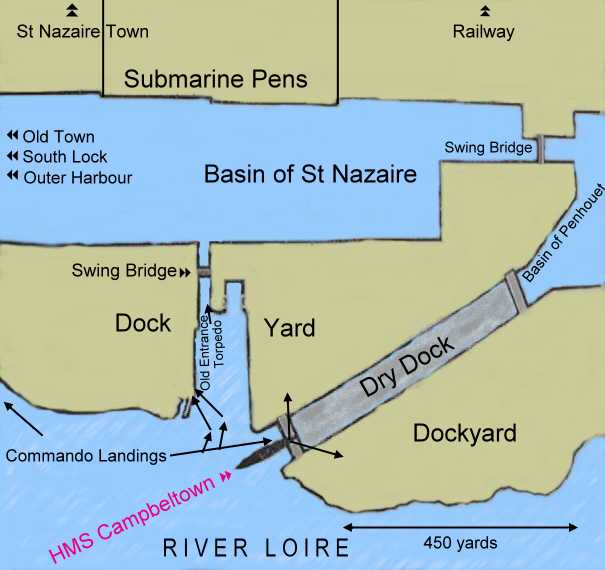
The target area was
bordered by the River Loire, the waters of the outer harbour and the Basin of St Nazaire
- a total area of less than one square mile. The heavy concentration of
enemy defensive positions and troops in the area strongly reflected the
importance of the port facilities to them. It was, arguably, the most heavily
defended place along the whole of the German occupied Atlantic coast. In this confined space there were power
stations, pumping stations, warehouses, lock installations and the old town of St Nazaire. Denying the Germans use of the dry dock would effectively neutralize the threat
the Tirpitz posed.
Planning & Preparation
 The estuary was a complex mixture of mud flats and channels.
A frontal assault would, therefore, need a
shallow draught vessel running on a high tide. Although heavily defended, the
Germans were unlikely to have considered an attack across the mud flats and
shoals. Meticulous planning followed and advice sought on the vagaries of tides
and winds, which included studying French nautical charts and tables up to 100
years old! The estuary was a complex mixture of mud flats and channels.
A frontal assault would, therefore, need a
shallow draught vessel running on a high tide. Although heavily defended, the
Germans were unlikely to have considered an attack across the mud flats and
shoals. Meticulous planning followed and advice sought on the vagaries of tides
and winds, which included studying French nautical charts and tables up to 100
years old!
[Map courtesy of Google Map Data 2017].
The outline plan
was simple. The selected vessel, packed with high explosives in the bow with
troops and crew in protected areas, would ram the outer lock gate at speed and
become firmly stuck there. They would then disembark and take cover behind a nearby air-raid shelter. The ship would then blow up destroying the gate.
A Motor Torpedo Boat would
then approach to fire especially designed torpedoes at the inner gate which would collapse under pressure when the tide went out,
damaging the submarines berthed in their protected pens. The troops and crew would then destroy as many dockyard targets
as they could and withdraw in fast
motor launches which had followed them in. All this was to be achieved under cover of an air raid.
The planners, themselves,
had reservations about the withdrawal phase which was difficult to predict since
much depended on the element of surprise and the effectiveness of the opposing
forces. However, the risks were less than the potential rewards. Outside the planning circle, the Naval C in C Plymouth,
thought the vessel would bounce off the gate, a view he maintained against the advice of the engineer who built
it. He also thought that anyone
within half a mile of the explosion would be killed.
Mountbatten conceded the point
about the destructive power of the explosion and delayed action fuses were to be fitted to allow time for the troops and crew to evacuate the
area. However, on the question of the use of a boat to ram the lock gate, he
held firm. It was also decided to spread the raiding force between the
main ship and the supporting motor launches, simply to avoid the total loss of the force in the event of disaster befalling the main ship.
HMS Campbeltown, an American lend-lease destroyer (USS Buchanan),
was chosen to lead the operation. Her interior was stripped out, the bridge was armour-plated and additional protection provided for the Commandos she would carry. The
accompanying motor launches (MLs), were to carry 150 Commandos. The boats were fitted with two Oerlikon
20mm guns and additional fuel tanks to increase their range. As the needs of the
raid were reassessed, the ML fleet was increased to 10 and then to 14. Only one motor
gun boat (MGB) was available - MGB 314, a C-Class Fairmile, commanded by Lt. Dunstan Curtis. She would lead the attack
with motor torpedo boat (MTB) 74 in reserve. This was equipped with unproven flying torpedoes to breach the dry dock gates if the Campbeltown
failed to reach its target.
Action
 The fleet sailed from Falmouth at 3 pm on the 26th of March. MGB 314,
was at the head with two escort destroyers flanking
the MLs and HMS Campbeltown. South west of Ushant, they came
across a U-Boat and damaged it. They departed the area on a false
course which the submarine duly reported to their command and control
HQ. Five German torpedo boats left St Nazaire to engage the vessels
but in entirely the wrong direction. They were still at sea during the
raid. The fleet sailed from Falmouth at 3 pm on the 26th of March. MGB 314,
was at the head with two escort destroyers flanking
the MLs and HMS Campbeltown. South west of Ushant, they came
across a U-Boat and damaged it. They departed the area on a false
course which the submarine duly reported to their command and control
HQ. Five German torpedo boats left St Nazaire to engage the vessels
but in entirely the wrong direction. They were still at sea during the
raid.
Around midnight
on the 27/28th March, the raiders saw bomb flashes and tracers light
the sky. The diversionary bombing air raid had started but it lacked
accuracy due to low cloud causing an alert in the town and its
approaches, rather than the intended effect of keeping the German
forces in their bunkers. The bombers had been briefed to target only
specific military installations to avoid civilian casualties. Those
who failed to identify their targets, did not drop their bombs.
Each boat flew the German flag to confuse the enemy and
delay identification. Submarine, HMS Sturgeon, provided the exact
position for entry to the estuary from which the raiding force was to
make its run up
the estuary. The Campbeltown crept through at 5 knots, touching bottom twice. At 0120 hours, search lights illuminated the entire fleet
but, for a short time, the Germans were reluctant to open fire possibly because of confusion caused by spoof signals and a general
disbelief that such an audacious raid could be
undertaken. The German flags were then replaced with White Ensigns when
the fleet was still two miles from its target. The Germans responded
with intense shelling and gun fire during the final 15 minutes of the run in, during which half the men aboard the MLs
were either killed or
wounded.
 The Campbeltown cleared the estuary and increased speed to
break through the torpedo
barrier and into the dock gate. The MLs were all but stopped, only two succeeded in landing their full complement of Commandos. Other MLs approached the landing zones, but were forced to re-embark their Commandos in the face of very heavy fire from 20mm cannons. The Campbeltown cleared the estuary and increased speed to
break through the torpedo
barrier and into the dock gate. The MLs were all but stopped, only two succeeded in landing their full complement of Commandos. Other MLs approached the landing zones, but were forced to re-embark their Commandos in the face of very heavy fire from 20mm cannons.
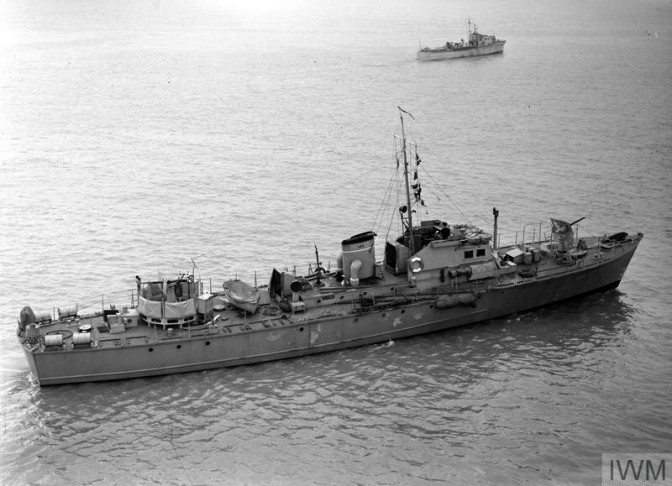
[Photo; A motor launch (ML) of the type which took part in the raid
on St Nazaire. Sixteen MLs were assigned to the force to carry commandos
and demolition parties into St Nazaire. Their frail wooden hulls offered
scant protection and only three of the craft survived the operation. © IWM
(A 13626A)].
On
shore fighting was ferocious and close quartered. At 0134 hours, Campbeltown was successfully driven at speed into the dock gates just 4 minutes behind schedule. Most of her crew
were taken aboard MGB 314 while MTB 74 deployed her delayed action
torpedoes in the foundations of the old entrance dock gate.
Captain Ryder, CO of the Naval forces, went ashore and satisfied himself that Campbeltown was both scuttled and embedded in the loch gate. At 0230 hours, Ryder
decided to withdraw. By this time, more than half of his craft had been destroyed and the remainder were riddled.... if he didn't withdraw soon, he
would lose them all.
MTB 74, departed the area
of action to rendezvous with British destroyers in the open sea off the Loire.
She carried 26 men on board and was accompanied by 7 other
craft. She stopped to pick up two more survivors, but was hit by accurate shelling from
shore batteries. Only 3 of the 34 aboard survived.
The remaining craft met the 5 German torpedo boats
returning from their fruitless mission. In further enemy fire, more craft were
destroyed or scuttled and their crews transferred to the remaining craft. Of the
18 coastal craft, which set out from Falmouth, only four returned. [Photos below
taken in 2005 by Graham Francis. They show major landmarks largely unchanged
since 1942].

South loch gate showing the final stage
of HMS
Campbeltown's one way journey.

South loch gate where HMS Campbeltown's
bow was lodged.

View of south loch gate
from the north gate... the space denied to the Tirpitz.

The approaches to the old
entrance to the Basin of St Nazaire. It is quite narrow and not
very long.

The south side of the old
entrance where Commando units disembarked.

The old entrance loch
gates, which were torpedoed in the action.

Beyond the old entrance
loch gates is the swing bridge over which the Commandos from the Campbeltown
retreated.

The steps on the south side
of the approaches to the old entrance used by the Commandos as a
drop off point. The heavily defended submarine pens are in the
background.

The submarine pens from
where the Commandos came under heavy enemy fire.

The 'Bridge of memories'
over which the Commandos attempted to escape. View looking back
towards the old town and the area north of the Mole

The Old Mole... scene of
much bloody fighting.

The Old Mole lighthouse.
Outcome
 The delayed action fuses detonated the high explosives in the Campbeltown's
hold at noon on the 28th. Forty German officers were aboard at the time and 400
other ranks were nearby on the quay. All were killed in the blast. The dock
gates were destroyed and were not repaired until after the war. The delayed action fuses detonated the high explosives in the Campbeltown's
hold at noon on the 28th. Forty German officers were aboard at the time and 400
other ranks were nearby on the quay. All were killed in the blast. The dock
gates were destroyed and were not repaired until after the war.
On the evening of the 29th
the delayed torpedoes were activated causing further damage and German
casualties. Regrettably many needless French casualties were caused by jittery
German soldiers who believed that the raiders were still in their midst.
Of the 241 Commandos who took part, 59 were posted as killed or missing and 109 captured. 85 Royal Navy
personnel were killed or missing and a further 20+ captured. Many others were wounded. 5 other ranks returned to England via Spain.
The Tirptitz was never able to leave Norwegian waters for want of a safe haven on the Atlantic coast. The value of the shipping saved in terms of
men, armaments and food, can only be guessed at but it was a very significant contribution to the Allied cause.
The air raid had hindered, rather than helped the amphibious raid on St Nazaire. The experience had regrettable consequences
5 months later when a planned bombing raid on
Dieppe, was dispensed with.
 Awards gained during the Raid Awards gained during the Raid
VCs
Captain Robert Edward Dudley Ryder, RN.
For great gallantry in the attack on St. Nazaire. He
commanded a force of small unprotected ships in an attack on a heavily defended port and led HMS Campbeltown in under
intense fire from short range weapons at point blank range.
[Photo; Aerial
reconnaissance photograph taken after HMS Campbeltown exploded.
The remains of the destroyer can be seen lying in the centre of the
dry dock.© IWM (C 3317A)].
Though the main object of the expedition had been accomplished in the
beaching of Campbeltown, he remained on the spot conducting operations, evacuating men from Campbeltown and dealing with
strong points and close range weapons while exposed to heavy fire for one hour and sixteen minutes, and did not withdraw till it was
certain that his ship could be of no use in rescuing any of the Commando Troops who were still ashore. That his motor boat, now full of
dead and wounded, should have survived and should have been able to withdraw through an intense barrage of close range fire was almost
a miracle.
Lieutenant-Commander Stephen Halden Beattie, RN, HMS Campbeltown. For great gallantry
and determination in the attack on St. Nazaire in command of HMS Campbeltown. Under intense fire directed at the bridge
from point blank range of about 100 yards, and in the face of the blinding glare of many searchlights, he steamed her into the lock
gates and beached and scuttled her in the correct position. This Victoria Cross is awarded to Lieutenant-Commander Beattie in
recognition not only of his own valour but also of that of the unnamed officers and men of a very gallant ship's company, many of whom
have not returned.
 Able Seaman William Alfred Savage, RN. For great gallantry, skill and devotion to duty as
gun-layer of the pom-pom in a motor gun-boat in the St. Nazaire raid.
Completely exposed, and under heavy fire he engaged positions ashore
with cool and steady accuracy. On the way out of the harbour he kept
up the same vigorous and accurate fire against the attacking ships,
until he was killed at his gun. This Victoria Cross is awarded in
recognition not only of the gallantry and devotion to duty of Able
Seaman Savage, but also of the valour shown by many others, unnamed,
in Motor Launches, Motor Gun Boats and Motor Torpedo Boats, who
gallantly carried out their duty in entirely exposed positions against
enemy fire at very close range.
[Photo courtesy of Martin Harley]. Able Seaman William Alfred Savage, RN. For great gallantry, skill and devotion to duty as
gun-layer of the pom-pom in a motor gun-boat in the St. Nazaire raid.
Completely exposed, and under heavy fire he engaged positions ashore
with cool and steady accuracy. On the way out of the harbour he kept
up the same vigorous and accurate fire against the attacking ships,
until he was killed at his gun. This Victoria Cross is awarded in
recognition not only of the gallantry and devotion to duty of Able
Seaman Savage, but also of the valour shown by many others, unnamed,
in Motor Launches, Motor Gun Boats and Motor Torpedo Boats, who
gallantly carried out their duty in entirely exposed positions against
enemy fire at very close range.
[Photo courtesy of Martin Harley].
 Sergeant Thomas Frank Durrant, RE. Sergeant Durrant,
attached to No.1 Commando, was
in the Royal Engineers. On 27th March 1942 at St Nazaire he was in
charge of a Lewis gun on HM Motor Launch 306 which came under heavy
fire during the raid, and although he had no protection and was
wounded in several places he continued to fire until the launch was
boarded and the survivors were taken prisoner. He died of his wounds
the next day. [Photo courtesy of Graham
Francis,] Sergeant Thomas Frank Durrant, RE. Sergeant Durrant,
attached to No.1 Commando, was
in the Royal Engineers. On 27th March 1942 at St Nazaire he was in
charge of a Lewis gun on HM Motor Launch 306 which came under heavy
fire during the raid, and although he had no protection and was
wounded in several places he continued to fire until the launch was
boarded and the survivors were taken prisoner. He died of his wounds
the next day. [Photo courtesy of Graham
Francis,]
Lieutenant Colonel Augustus Charles Newman. The Essex Regiment was attached to No.2 Commando.
During the St Nazaire raid on 27th March 1942, Lieutenant-Colonel
Newman was in charge of the military forces and was one of the first
ashore, leading his men and directing operations without regard for
his own safety. The troops fought well under his command and held
superior numbers of the enemy at bay until the demolition parties had
done their jobs. Newman then attempted to fight through into open
country and did not surrender until all the ammunition was exhausted
when he was then taken prisoner.
Other awards
Other awards that were granted after the St. Nazaire Raid were: 4 DSO; 17 DSC; 11 MC; 4 CGM; 5 DCM;
24 DSM and 15 MM. Another 51 men were mentioned in dispatches, 22 of
them posthumously.
Summary of Action
Allied Forces: Sea - HMS
Campbeltown, MTBs, MGBs & 8 MLs; Land - Nos. 1, 2, 3, 4, 5, 9, & 12 Commando.
Axis Forces: Sea - Shore defence batteries; Land
- Shore defence units.
Outcome (positive) - Dry dock facility at St Nazaire disabled for the remainder of the war.
Outcome (negative) - Heavy losses - see text.
 Memorial Memorial
St Nazaire, France. The memorial and the 12 pounder gun
taken from HMS Campbeltown, are situated side by side at Place du
Commando at the eastern end of Boulevard President Wilson.
Other Info -
The inscription below the gun reads 'Canon du destroyer Campbeltown
qui percuta le caisson sud de la
 forme joubert Commando Anglais du 28 Mars
1942.'
Click here
for more information on Operation Chariot. [Photos right courtesy of
Graham Francis]. forme joubert Commando Anglais du 28 Mars
1942.'
Click here
for more information on Operation Chariot. [Photos right courtesy of
Graham Francis].
Further Reading
 There are around 300 books listed on
our 'Combined Operations Books' page. They, or any
other books you know about, can be purchased on-line from the
Advanced Book Exchange (ABE). Their search banner link, on our 'Books' page, checks the shelves of
thousands of book shops world-wide. Just type in, or copy and paste the
title of your choice, or use the 'keyword' box for book suggestions.
There's no obligation to buy, no registration and no passwords. There are around 300 books listed on
our 'Combined Operations Books' page. They, or any
other books you know about, can be purchased on-line from the
Advanced Book Exchange (ABE). Their search banner link, on our 'Books' page, checks the shelves of
thousands of book shops world-wide. Just type in, or copy and paste the
title of your choice, or use the 'keyword' box for book suggestions.
There's no obligation to buy, no registration and no passwords.
Operation Chariot: The
Raid on St. Nazaire by
Jon Cooksey.
(Elite Forces
Operations Series) Pen & Sword, 2005, 128pp. B/w & Coloured illustrations throughout.
Paperback. ISBN 1844151166
The Greatest Raid Of All - C E Lucas Phillips, Pan Books1958. ISBN
0-330-48070-7._small.jpg)
 Saint-Nazaire. Operation Chariot -
1942 written by James G Dorrian
and published in 2006 by Pen and Sword as part of their 'Battleground' series. It is designed for both
'armchair visitors' and for those who intend to visit the port. The
guide is highly illustrated, with 224 pages, 20 maps and drawings and
more than 150 photographs. Dimensions - 8 1/2 " by 5 1/4".
Soft-back. ISBN 1844153347 - cover price £12.99 but can be found at
£9.99. Saint-Nazaire. Operation Chariot -
1942 written by James G Dorrian
and published in 2006 by Pen and Sword as part of their 'Battleground' series. It is designed for both
'armchair visitors' and for those who intend to visit the port. The
guide is highly illustrated, with 224 pages, 20 maps and drawings and
more than 150 photographs. Dimensions - 8 1/2 " by 5 1/4".
Soft-back. ISBN 1844153347 - cover price £12.99 but can be found at
£9.99.
Storming St Nazaire - The Dock Busting Raid by James G Dorrian.
Published 1998 and more recently in paperback by Leo Cooper (an
imprint of Pen & Sword Books). 304 pages £14.95. ISBN 08052 807 0.
St Nazaire Commando
- by Stuart Chant-Sempill. Published by John Murray, 1985. ISBN 0-7195-4211-1.
St
Nazaire 1942: The Great Commando Raid -
by Ken Ford. Published
Osprey 2001. ISBN 978-18417619.
Into the
Jaws of Death; The True Story of the Raid on Saint-Nazaire -
by Robert Lyman. Published
Quercus 2013. ISBN 978-1-78206-447-3.
Commando
- by Sally Duggan.
Published Channel 4 Books 2001. ISBN 0-7522-6143-6.
Raid sur
Saint-Nazaire 28 mars 1942 Operation Chariot -
by
Luc Braeuer & Bernard Petitjean. 2012. ISBN 9-782-84497-224-8
The Raid
on St. Nazaire - by
Yves Buffetaut.
Objectif Saint-Nazaire -
by J Gille & JP Lucas. Published by Presse Ocean 1990.
St. Nazaire to
Shepperton - by Ralph Bateson. Published Highedge Historical Society 1996.
List the
Bugle: Reminiscences of an Irish Soldier -
by Corran Purdon. Published Greystone Books 1993.
WWII -
Britian's Most Daring Special Operations Raiders -
by Ross Kemp. Published by Century 2012. ISBN 978-1780890555.
The
Destroyer Campbeltown Anatomy of the Ship -
by Al Ross. Published
Conway Maritime Press. 1990.
Raid on
St Nazaire - by
David Mason. Published Ballantine Books. 1970.
Turned
Towards the Sun - by
Michael Burn. Published by Michael Russel 2003. ISBN 978-0859553087.
Commando Attack
by Gordon Holman. Published by Hodder & Stoughton
1942/44.
The Attack on St Nazaire - by RED Ryder.
Published by John Murray 1947.
The St Nazaire Society
website and
Facebook page.
Correspondence
Canadians 'on loan' to the RN who took part in Operation
Chariot.
Sirs,
The participation of
four Canadian officers in this important and exceedingly hazardous
operation remains largely unknown, even within RCN circles. A
mention on your web page would give them some welcome public recognition
as participants in the raid on loan to the RN. They were;
Surgeon Lt W.
James (“Jock”) Winthrope (O-??), RCNVR. Killed while trying to escape
downriver in ML 177. He was HMS Campbeltown’s only medical
officer. Born in 1912, he was from Saskatoon, Saskatchewan, Canada. He
gained a medical degree from the University of Toronto in 1936 and
volunteered for service in October 1941.
A/Lt Graham M.
Baker (O- ??), RCNVR. Killed while trying to land on the Old Mole from
ML 447. He was from Toronto, Ontario and had been attending Oxford
University on the outbreak of WW2. He volunteered in 1940 as Ordinary
Seaman “Raleighites” via HMS Raleigh and was commissioned a year
later.
Lt D. Lloyd
Davies (O-18310), RCNVR. Volunteered in 1940. 1st Lt. of ML-262 which
was sunk by German 88 fire. He was wounded and became a POW to the war’s
end. Rescued by the 8th Army in April ‘45, he became RCN Regular Force,
retiring in 1961. Before the war, he studied Business & Finance at McGill
University, Montreal. From Montreal.
Lt John E.
O’Rourke, (O ??), RCNVR. Cdr Ryder’s Signals Officer in MTB 74. He was
the only Canadian to return safely to UK shores that fateful day. He was
an early WW2 “Raleighite”, joining in 1940. Reportedly from Calgary,
Alberta. He commanded an LCI on D-Day which carried British troops to Gold
Beach. After release at the end of the war, he disappeared from
view. Reportedly moved to British Columbia.
In retirement (after 32 years in the Reserves), I write naval history - 6
books and articles, etc., and serve as a naval historical researcher.
Sincerely,
Fraser M. McKee, CDR, RCNR (ret’d)
Daniel
HEMPSTEAD, No 2 Commando.
I was reading through your
article on the attack on St Nazaire. I noticed that you make special mention
of motor launch 262 (ML 262), which is not surprising as the leading
Lieutenant was awarded the Victoria Cross. Sergeant Stanley Hempstead, Essex
regiment, was one of many commandos that took part in this raid. He was
attached to the No.2 Commando and was aboard the ML 262. He was unfortunately
killed in the raid but was one of the many that contributed to the relative
victory of the operation, and his name can be seen on the memorial pictures
above. At the
following link you'll find details on him and I hope that you would be able to
add this to your Combined Ops website only because the others in that
group were also listed:
www.commandoveterans.org/Hempstead2Commando (Copy & Paste).
Kind regards
Daniel Hempstead (2/18)
ML 262.
Leading
Seaman Stafford MCKEOWN, D/SSX 26259, missing 21 year old, married
just 2 weeks. His name is recorded on the St Nazaire Memorial, one
of 105.
Other ML 262 crew members who died that night:
GOUGH, Ronald G, Motor Mechanic, C/MX 76180,
missing.
HILLS, Kenneth I, Ty/Sub Lieutenant, RNVR, killed.
HOLLANDS, Frederick R W, Stoker 1c, C/KX 120816, missing.
JONES, George J, Able Seaman, D/JX 175349, missing.
MARTIN, William J, Ordinary Seaman, P/JX 273919, missing.
WALKER, James D, Able Seaman, C/JX 238901, missing.
Thank you
Brian McBride.
Royal Australian Air Force.
In the spring of 1942, I was a
pilot in 10 squadron, at the time the only active Royal Australian Air Force
unit. On a mission in support of the St Nazaire raid, I was first officer to Graham Pockley, Captain of a '10 squadron' Sunderland. We were based at the Mountbatten
RAF station, Plymouth. From there, we set off to patrol around 5 to 8 miles off
shore during the raid on St Nazaire. Our purpose was to help in the rescue of
survivors. You mention only RAF aircraft in support of the action, but we
patrolled a few miles offshore all the time the attack on St Nazaire took
place. I might add, that having been subject to German bomber attacks on
Plymouth, we cheered each time there were signs of action in and around St Nazaire. Long
ago and far away! Best regards, Rex Senior.
[Rex later returned home to Australia and crewed
the now famous Qantas flights from there to Ceylon (now Sri Lanka) over
areas held by the Japanese. Each flight lasted between 28 and 34 hours
and became known as the flight of the double sunrise].
Hector McIntyre RN.
I was grateful for reading about the St.Nazaire attack 28 March, 1942 on your
website, as my late eldest brother, Hector McIntyre took part in this raid and
was a survivor of it. He was a Leading Seaman on the front escort MGB which was
scuttled. He told us he was on land for sometime that night and spoke to some of
the German soldiers who regretted us going to war with them.
Later in his 4 year service he was selected to be trained as a Naval Officer
and went to the 2 Naval colleges in London, passing out as Sub. Lieut. Hector
McIntyre. He always served with the Light Coastal Forces based in the South East
England. In 1943, during an unsuccessful action off the coast of Holland for
which he had volunteered, he was lost at sea on 28 February 1943. Despite the
best efforts of Lieut Commander Hitchins, his famous Commander, who threw him a
rope to try and get him and his craft home to "Blighty" in freezing weather
conditions, the attempt failed.
I am his only sister, aged 83 now (Nov 2010) and I will
never forget him and his bravery. Before he joined the Royal Navy in 1941 he was
a brilliant journalist working for a Glasgow newspaper. My only regret is that
when my mother's house was cleared, I did not receive any of my brother's
records of actions (he kept a good diary of events).
I know he volunteered for the Royal Navy in 1941
and that he craved action, so he was a very brave young man. There is a
good memorial at Gravesend on Sea where his name is engraved along with others
who "have no grave but the sea".
Mrs Ellen Kerr, Wemyss Bay, Inverclyde on the south
west coast of Scotland.
|




.jpg)