|
Operation Jubilee - The Disastrous
Dieppe Raid.
August 19, 1942.
 Few raids have been subjected to so much scrutiny, analysis and comment as
Operation Jubilee, better known as the Dieppe Raid. It aimed to seize a major
port and to hold it for a short period, while seeking opportunities to gather
intelligence and to demolish
important infrastructure and buildings. The raid would show the UK's
determination to fight on and, if successful, it would boost the morale of the
armed forces and the country. Few raids have been subjected to so much scrutiny, analysis and comment as
Operation Jubilee, better known as the Dieppe Raid. It aimed to seize a major
port and to hold it for a short period, while seeking opportunities to gather
intelligence and to demolish
important infrastructure and buildings. The raid would show the UK's
determination to fight on and, if successful, it would boost the morale of the
armed forces and the country.
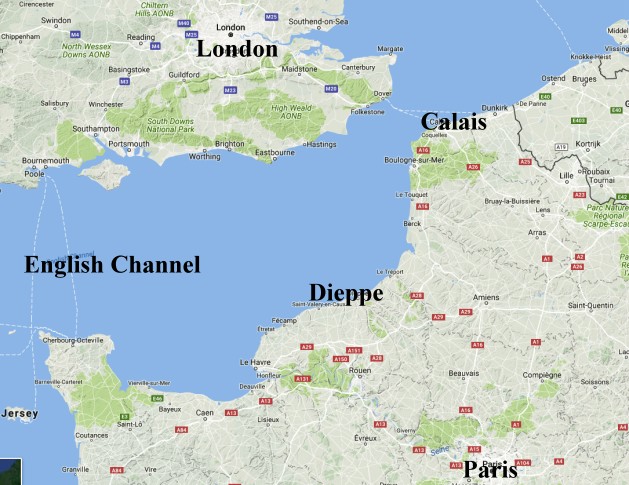
[Map courtesy of Google Map Data 2017].
At the same
time, Mountbatten wanted to test Combined Operations amphibious
landing training, equipment and techniques in a sizeable raid against entrenched German shore
defences. The raid
failed in almost every regard and at a high cost in lives lost, numbers injured
and captured, particularly for the Canadian Forces involved.
In August 2012, a 'History TV' documentary
based on 15years research by David O'Keefe provided fresh insight into other
top secret purposes behind the raid, which casts a different light on the day's
events. More details on this below. In any event, lessons were learned and similar mistakes were
avoided in future amphibious operations, including D-Day.
Background
1942
was the worst year of the war for the Allies. At the time of Operation Jubilee, the UK could not boast a single
victory against the Germans in the field (excluding Commando 'pin-prick' raids) and British and Commonwealth troops in North Africa were being
contained and driven back by the Africa Corps.
In the Far East, the
Japanese were occupying substantial parts of the former British Empire, the
Americans were still feeling their material losses at Pearl Harbour and
struggling to maintain what was left of their Philippine Army and the Russians
were under pressure as Hitler's thrust into
the Caucuses took hold. The immediate outlook was bleak.
The most critical situation
was on the Russian Front, where the German
offensive seemed unstoppable. Stalin called loudly and often for an offensive in
the west to reduce the pressure on his armies and, in truth, a Russian military collapse would be
catastrophic for the whole Allied war effort.
The Russian viewpoint
enjoyed American support, with some American military leaders
favouring action in the Pacific against the Japanese, if no large scale offensive in the
west was possible. The general public also agitated for offensive action in support
OF the beleaguered Russians. Mass rallies
were held in both Trafalgar
Square in London and Madison Square gardens in New York during April, 1942,
which
called for "a second front now!"
There was, therefore,
increasing pressure on Churchill and the British Chiefs of Staff to mount a
significant offensive operation on the Western Front, that would at least discourage Hitler from sending additional reinforcements to the East
Front.
It was against this
menacing background that the Dieppe raid was planned.
Plans & Preparations
Originally
conceived in April 1942 by Combined Operations Headquarters (COHQ), and code named
'Operation Rutter', the Allies planned to conduct a major, division size, raid on
a German held port on the French channel coast and to hold it for the duration
of at least two tides. They would cause the
greatest amount of destruction of enemy facilities and defences before
withdrawing.
 This
original plan was approved by the Chiefs of Staff in May 1942. It included
dropping paratroops inland of the port, prior to a frontal amphibious assault.
However, with the involvement of paratroops, the raid was vulnerable to weather conditions in the area. General Montgomery was to
supply the bulk of the troops from his South Eastern Command but the Canadian
Government pressed for Canadian troops to see some action. The Canadian 2nd
Division, under the command of
Major-General 'Ham' Roberts was, subsequently, selected for the main force. This
original plan was approved by the Chiefs of Staff in May 1942. It included
dropping paratroops inland of the port, prior to a frontal amphibious assault.
However, with the involvement of paratroops, the raid was vulnerable to weather conditions in the area. General Montgomery was to
supply the bulk of the troops from his South Eastern Command but the Canadian
Government pressed for Canadian troops to see some action. The Canadian 2nd
Division, under the command of
Major-General 'Ham' Roberts was, subsequently, selected for the main force.
[Photo; Major-General 'Ham' Roberts].
The 237 vessels, 5,000 Canadians, 1,000 British
and 50 US Rangers assembled in five ports on the south coast of England between
Southampton and Newhaven. In support were 74 squadrons of aircraft, of which 60
were fighter squadrons. Early rehearsals were disastrous and, by the time
they improved, the consistently bad weather caused delay.
Montgomery felt the
security of the operation was compromised, since the troops had been briefed and
German
fighter-bombers had attacked the troopships and the supporting fleet gathered in
the Solent, causing damage to two vessels. On July 7th, the raid was postponed
and the continued unsettled weather conditions just added to the gloom as the
troops and shipping were dispersed.
Had Montgomery not been ordered to Egypt to take
command of the Eighth Army, the continued representations he never made
may have prevailed, as it was, in the weeks ahead, the plan was rejuvenated and
renamed 'Jubilee'.
Although
the original planning had been undertaken by COHQ, an inter-service committee
representing Air, Army and Naval forces contrived to make the operation less
weather dependant by replacing the paratroops with seaborne troops from No 3 and
4 Army Commandos. They also reduced the scale of the planned air bombardment to
minimise the risk of French casualties but, to compensate, provided 8 destroyers
to bombard the shore. There would be 27 Churchill tanks in
support of the main infantry assault. The final plan, accepted by all 3 services
and the Chiefs of Staff, envisaged assault landings at eight separate locations
in the vicinity of Dieppe. The Royal Marine Commando were to land in fast motor
launches after the main landing to destroy the dock and recover documents
thought to be held in a port office.
A raid of this size
involving over 200 vessels, 6000 troops and 3000 naval personnel would allow the
Allies to evaluate the effectiveness of their training, equipment,
communications and strategies. This
amphibious assault landing on a defended coast would be the first undertaken by
the British since
Gallipoli 26 years earlier. There had been changes too in the capability of the
defenders, so it seemed prudent to reflect on the experience of a raid this size
before embarking upon the largest amphibious invasion force in human history,
with consequences to match.
Although they didn't know it at the time, their
intelligence on the enemy forces and the local topography was patchy. The cave-like gun positions in the cliffs on both sides of the main landing beaches were not recognised
on Allied air reconnaissance photographs and the suitability of the beaches in
terms of gradient, surface and sub surface for heavy tanks was assessed by
examining holiday snapshots and postcards. Furthermore, the
Germans were aware of Allied interest in Dieppe, because of increased radio chatter, the
concentration of landing craft and their own spy networks.
 Commando
forces were to land in pre-dawn darkness; No 3 Commando approximately eight miles east of Dieppe to silence the coastal battery near Berneval,
No 4 Commando and 50 US Rangers to neutralize the coastal battery near Varengeville,
six miles west of Dieppe. In
both cases they would make two landings to effect a pincer movement on the
batteries, which each had a cadre of over a hundred. Both of these gun
positions could easily range on assault ships positioned off Dieppe, so
their neutralisation was important. Commando
forces were to land in pre-dawn darkness; No 3 Commando approximately eight miles east of Dieppe to silence the coastal battery near Berneval,
No 4 Commando and 50 US Rangers to neutralize the coastal battery near Varengeville,
six miles west of Dieppe. In
both cases they would make two landings to effect a pincer movement on the
batteries, which each had a cadre of over a hundred. Both of these gun
positions could easily range on assault ships positioned off Dieppe, so
their neutralisation was important.
An assault
force (see map for composition) would land at four separate locations, immediately to the east of Dieppe at Puys and immediately west at Pourville,
half an hour before the main assault. Their objective was to disable the
guns and machine gun nests on the cliffs that covered the main landing
beaches east and west of the town.
The main assaults on
two beaches in front of the town were scheduled for the early daylight
hours - essentially a frontal assault.
Dieppe was not thought to be heavily defended and with tank support in the
front line, it was anticipated that this force would be sufficient to accomplish the raid's
objectives.
The
Raid
 Operation
Jubilee commenced in the late evening hours of August 18th, 1942. It was a
warm, moonless night as the fleet of vessels headed across the channel. Operation
Jubilee commenced in the late evening hours of August 18th, 1942. It was a
warm, moonless night as the fleet of vessels headed across the channel.
[Photo; Light naval craft covering the landing
during the Combined Operations daylight raid on Dieppe. MGB 321 is nearest
the camera (partly obscured by some sailors in the foreground) whilst
submarine chaser Q 014 can be seen in the middle distance. © IWM (A
11234)].
The presence of a German convoy proceeding to Dieppe from Boulogne had been picked up by Radar stations on the English coast.
Twice, at 1.30 am and
again at 2.30 am on August 19th, they radioed warnings to the naval commander
Captain Hughes-Hallet. These warnings were not acknowledged and the raiding
force took no evasive action.
 The main assault troops were convoyed in
large mother ships, with their LCPs (Landing Craft Personnel) hanging from davits
ready to be lowered into the water a few miles off shore. Most of the
Commandos travelled independently in their own LCPs which held about 20 men
each, while LCTs (Landing Craft Tanks) transported the tanks. The main assault troops were convoyed in
large mother ships, with their LCPs (Landing Craft Personnel) hanging from davits
ready to be lowered into the water a few miles off shore. Most of the
Commandos travelled independently in their own LCPs which held about 20 men
each, while LCTs (Landing Craft Tanks) transported the tanks.
On passage to
Yellow Beach (Berneval), 3 Commando Group comprised twentyfour LCP(L)s escorted
by one LCF(L), ML 346 and SGB 305. At 03.30hrs, German convoy No. 2437,
comprising five Dutch coastal motor sailing vessels (FRANZ, HYDRA, IRIS,
OSTFLANDREN and SPES), en route to Dieppe from Boulogne, escorted by
anti-submarine chasers UJs 1411, 1404 and minesweeper M 4015, where sighted.
Several vessels in front of them fired star-shells, which lit up the Group 5
vessels carrying 3 Commando. At 03.47hrs, the opposing escort forces opened fire
and during the battle the other vessels from both sides scattered, during which
LCP(L)s 081 and 157 were lost and SGB 308 was immobilised and guns disabled. 40%
of the crew were wounded.
ML346 tried to
close on SGB 308 but was driven back by enemy gunfire. LCF(L) 1, which was armed
with two 4" Mk V guns and three 20mm Oerlikon cannons, concentrated its gunfire
on UJ 1404. It was soon ablaze, steering damaged and guns silenced.
Subsequently, ML 346 & LCF(L) 1 combined to drive off the German boats, but not
before they reported to Army Group D on the landing craft then three miles from
Dieppe. Whilst the gun battle ensued, the destroyers HMS BROCKESBY and ORP
SLAZAK, which had noticed the engagement, did not intervene in the skirmish
because their commanders incorrectly assumed that the landing craft had come
under fire from the shore batteries.
Only 18 Commandos
landed on time at their planned landing points, which removed any prospect
of an all out attack. They resorted to sniping, which proved quite
effective in keeping the German gunners occupied but they were eventually
forced to withdraw in the face of superior German forces. The battery was
sufficiently restrained that, as far as is known, no vessel was sunk by
its gunfire.
No
4 Commando executed an almost flawless operation and, in hard fighting, they
overran and neutralized the coastal battery on the western flank. Commando Captain Pat Porteous
was awarded the Victoria Cross for his part in this hard fought battle.
At Puy, the Royal Regiment of Canada
suffered grievous losses, when only 60 out of 543 men were recovered from
the beach and to the west of Dieppe, only a few men from the South
Saskatchewan Regiment reached their objective. The Queen's Own Cameron
Highlanders of Canada penetrated the furthest inland but were forced back
with the arrival of German reinforcements.
The
main assault landings by the Essex Scottish Regiment and the Royal
Hamilton Light Infantry immediately encountered
fierce opposition from an alerted and prepared
enemy. The original heavy air bombing attack had been removed from the plan and
a protective smoke screen was blown clear of the beach by
a southerly breeze. Nine tanks scheduled to land with the first infantry assault
were late due to navigational errors and when tanks did land many lost their
tracks, as they bogged down in the deep shingle, leaving them vulnerable to
anti-tank fire. Thirteen tanks left the beach area but were stopped by
concrete road blocks and did not reach the town.
Intelligence gathering had failed to
identify numerous gun and machine gun positions in caves dug into the high cliffs overlooking the landing beaches or that the port was strongly defended by experienced German troops.
 The supporting bombardment by
destroyers and a low level strafing attack by 5 squadrons of
Hurricanes did not suppress the German
defences. Commander Harry Leslie, RNVR recalled the failure of the support ships
to depress their guns sufficiently to hit the German positions at either end of
the bay. His flotilla of MLs supported the landing craft and for his part in towing damaged LVPs offshore
to safety in very hazardous conditions, he was awarded the DSC. The supporting bombardment by
destroyers and a low level strafing attack by 5 squadrons of
Hurricanes did not suppress the German
defences. Commander Harry Leslie, RNVR recalled the failure of the support ships
to depress their guns sufficiently to hit the German positions at either end of
the bay. His flotilla of MLs supported the landing craft and for his part in towing damaged LVPs offshore
to safety in very hazardous conditions, he was awarded the DSC.
[Photo; left - Cameron Highlanders of
Canada].
All these factors contributed to the mowing down of the initial assault of
infantry and engineers. Without covering fire, the enfilading fire onto
the landing beaches was unrestricted. Subsequent assault waves piled into
the first and were subjected to similar treatment.
A few groups of
Canadian infantry broke into the town but only confused and misleading
reports reached the force commander, Major-General Roberts, aboard his
headquarters ship. It was some time before the commanders afloat realised
the disastrous situation on the beaches, unfortunately only after the
floating reserve had been sent into the carnage. At 9.40 am, the signal to
withdraw " Vanquish 1100 hours" was sent to all the assault forces. The
evacuation of the surviving troops added many more casualties amongst the
naval officers and ratings manning the landing craft and the
troops trying to reach them.
The
Outcome
 Almost 4,000
Canadian and British had been killed, wounded or taken prisoner. The Canadians
lost two thirds of their force, with 907 dead or later to die from their wounds. Major-General
Roberts unfairly became the official scapegoat and was never to command troops
in the field again. Almost 4,000
Canadian and British had been killed, wounded or taken prisoner. The Canadians
lost two thirds of their force, with 907 dead or later to die from their wounds. Major-General
Roberts unfairly became the official scapegoat and was never to command troops
in the field again.
[Photo; Some of the Canadian troops resting on board a
destroyer after the Combined Operations daylight raid on Dieppe. The strain of
the operation can be seen on their faces. © IWM (A 11218)].
Year after year, on August
19th, a small box arrived in the post for him. Its contents, a small piece of
stale cake - a cruel reminder of his attempt to boost morale at the pre-raid
briefing "Don't worry boys. It will be a piece of cake!"
What went wrong?
-
there were few less suited locations on the French coast for an assault landing. The tall cliffs in the area of the main landing
beaches were perfect for
enfilade fire on the assault troops and the deep beach shale was
absolutely unsuited to heavy vehicles including tanks.
-
the intelligence
available was inaccurate incomplete and misleading. The information on
the German defences, troop levels and beach conditions was hopelessly
out of date. It's been suggested that more up to date information on
some aspects was available through ULTRA (the top
secret breaking of the German Enigma codes) but was never asked for or
passed on.
-
the
assault was viable only when certain conditions of time and tide
prevailed. These conditions (high tide at or near dawn) were as well
known to the German forces as they were to the British planners. It
was not surprising, that during these periods of potential threat,
German forces would be on heightened alert. Despite this, the plan
depended on tactical surprise. Was it an error to believe that the
Germans were unaware of these factors?
-
post
war post-mortems have often focused on the changes to the original
plan in general and the withdrawal of the bombing force in particular.
It's arguable that these changes by themselves were not the
overwhelming decisive factor. Bombing was not a precision tool at the
time of Dieppe, when pin point accuracy was needed to keep German
defenders running for cover. It's conceivable therefore that a much
heavier weight of offshore bombardment was needed than was provided.
If heavier capital ships had been present, they could have kept the
defenders heads down until the troops were within a few metres of the
beach.
-
the
plan was heavily dependent on the critical timing of its various
components - there was little or no room for error or delay anywhere
without adverse knock-on consequences. The effect of this weakness was
compounded by poor communications, which failed to update senior
officers of progress in time to take appropriate remedial action.
Lessons
Learned
 The
capture of a usable port early in any large scale invasion
of enemy occupied territory was ideal for the immense
logistics involved in keeping the supply chain open.
However, such an objective was fraught with difficulties, hence the
long held emphasis on landing directly on to unimproved
landing beaches. The experience of
Dieppe reinforced the wisdom of this view and it became the
inspiration behind the development of
Mulberry Harbours and
the Pipe Line Under the Ocean
(PLUTO) and many other special initiatives that
contributed to the success of subsequent major landings in
North Africa, Sicily, Italy, Normandy, Southern France and
Walcheren. The
capture of a usable port early in any large scale invasion
of enemy occupied territory was ideal for the immense
logistics involved in keeping the supply chain open.
However, such an objective was fraught with difficulties, hence the
long held emphasis on landing directly on to unimproved
landing beaches. The experience of
Dieppe reinforced the wisdom of this view and it became the
inspiration behind the development of
Mulberry Harbours and
the Pipe Line Under the Ocean
(PLUTO) and many other special initiatives that
contributed to the success of subsequent major landings in
North Africa, Sicily, Italy, Normandy, Southern France and
Walcheren.
[Photo; German soldiers
inspect the wreckage on the landing beach].
The need for
reliable intelligence on the strength and disposition of the
defending forces and the topography on and around the
landing beaches was clearly paramount. Lt Commander Nigel Clogstoun-Willmott,
RN, who had undertaken beach reconnaissance trials in the
Mediterranean, was recalled to the UK in the summer of 1942
to set up training programmes for the
Combined Operations Pilotage Parties
(COPPs). Beach reconnaissance became an integral part
of
the planning process for the
invasion of North Africa
in early November 1942 and in all future major landings.
Consideration of the
supporting role of vessels at sea produced numerous landing
craft adaptations such as:
Landing Craft Gun LCG, described by the BBC on
D-Day as 'mini battleships', with their 4.7 inch guns and
other armaments operating inshore; Landing
Craft Flack, LCF, to provide anti-aircraft cover
over the landing area;
Landing Craft
Tank (Rocket), LCT (R), for the initial bombardment of
the beaches in advance
of troops landing and Landing Craft Assault (Hedgerow), LCA
(HR), that could lob volleys of spigot bombs onto the beach
area, primarily to detonate hidden enemy mines.
The need for troop commanders
afloat to be aware of the on-going progress of the invading
force was essential for well considered and justifiable
decisions on, for example, the commitment of reserves or a
timely and well organised strategic withdrawal.
The need
for landing craft
to be armoured against small arms fire was now considered an
imperative to reduce casualties on the approaches to the landing
beaches.
to reduce casualties on the approaches to the landing
beaches.
[Photo; Canadian POWs in Dieppe. In the middle/left of the photo is John Machuk
of the Queen's Own Cameron Highlanders of Winnipeg giving a
wounded soldier the support of his arm].
Who knows how
many lives were saved in later amphibious landings, particularly Normandy, as a
result of the casualties at Dieppe? This failed assault had ramifications for
the German forces too. Their confidence grew in their ability to withstand an
invading force and they came to believe that the inevitable Allied invasion
would include an area with good port facilities. They subsequently concentrated
on providing stronger defences around the main ports to the detriment of open
beach locations.
In this context, Albert Speer, former Nazi minister of armaments, admitted
at the Nuremberg trials that the Germans' costly, two-year effort to
construct Atlantic defences had been 'brought to nothing because of an
idea of simple genius' - the Mulberry Harbours.
The Dieppe raid carried
with it a high cost but the lessons learned inspired and accelerated many
initiatives that contributed to the success of subsequent landings.
    
Sketches by
B J Mullen of 4 Commando courtesy of Frank Sidebottom. His late father in
law, Ben Clifton, served alongside the artist. Left to Right; Zero Hour, Through
the German Minefield, Withdraw from Beach, Rescue of US Airman in Channel and
Ben Clifton of 4 Commando, Ex York & Lancaster Regiment.
The outcome would almost certainly have been very different had General Roberts'
resources included those the Dieppe experience may have encouraged to be
developed, particularly the LCT(R) and the LCG.
A
Veteran Recalls
%20Les%20Ellis%202003.jpg) At a ceremony held in November 2003
to award Corporal Leslie Ellis a commemorative Dieppe medallion for his
part in the Dieppe raid, he recalled that he landed with the Royals at Puys...
"some say it was a dress rehearsal for the invasion (of Normandy) and some say
it was a whim of the top echelon. History says the Germans were waiting for us
and we didn't have a chance after that. We were all well-trained, we did what we
were trained to do. We were proud to have done it, we were soldiers ... we did
what we were expected to do." At a ceremony held in November 2003
to award Corporal Leslie Ellis a commemorative Dieppe medallion for his
part in the Dieppe raid, he recalled that he landed with the Royals at Puys...
"some say it was a dress rehearsal for the invasion (of Normandy) and some say
it was a whim of the top echelon. History says the Germans were waiting for us
and we didn't have a chance after that. We were all well-trained, we did what we
were trained to do. We were proud to have done it, we were soldiers ... we did
what we were expected to do."
The impact of that major battle may
still be debated but what remains certain is that the Canadian soldiers were
brave and there was "a feeling of pride" to serve with them. "They were a great
bunch of people. I was fortunate that I got over the (beach) wall and got back
with a few injuries and the Good Lord spared me. It all happened so fast." He
had made it behind enemy lines but as the power of the German ambush became
clear Canadian soldiers were forced to retreat.
When Ellis ran back to shore, he found
the landing craft already weighed down with injured soldiers and he knew that if
he stayed at Dieppe he would either die from enemy fire or be taken prisoner of
war. So he decided to swim in the hope that he might be rescued. "There was no
sense for me to get on that boat, so I took off my clothes and swam. I was
heading for England!" A soldier in a row-boat finally found him but he doesn't
remember being pulled out of the water. "I woke up in an anti-aircraft naval
boat." he recalled.
Ellis received the DCM (Distinguished
Conduct Medal) for his bravery. His citation as printed in The London Gazette of
October 2, 1942, read
The NCO landed with the first wave
at Puys, during the operation in the Dieppe 19 Aug 42. After a gap was blown in
the wire on the sea-wall, L/Cpl Ellis passed through the gap and proceeded up
the hill to the right; He immobilized booby traps, explored a recently abandoned
enemy post, and arriving at the top, engaged an enemy post east of the beach.
Finding himself alone, and seeing the second wave coming in, he returned to the
wall to guide them forward. Coming across a comrade paralyzed in both legs he
dragged him nearly back to the wall. Here the wounded man was killed and L/Cpl
Ellis himself wounded. He succeeded in crossing the wall and was evacuated as a casualty. L/Cpl Ellis in this action
displayed the greatest initiative, skill and devotion to duty.
Medals

Canadian Award.
The Dieppe Bar is awarded to those who participated in the Dieppe Raid on
August 19, 1942, and is worn on the Canadian Volunteer Service Medal ribbon.
A silver bar, to be attached to
the ribbon of the Canadian Volunteer Service Medal (CVSM), has been designed
featuring the word DIEPPE in raised letters on a pebbled background. Above
this, the bar bears an anchor surmounted by an eagle and a Thompson
sub-machine gun. The design was created in consultation with the Dieppe
Veterans and Prisoners of War Association.
Further Reading
There are around 300 books listed on
our 'Combined Operations Books' page. They, or any
other books you know about, can be purchased on-line from the
Advanced Book Exchange (ABE). Their search banner link, on our 'Books' page, checks the shelves of
thousands of book shops world-wide. Just type in, or copy and paste the
title of your choice, or use the 'keyword' box for book suggestions.
There's no obligation to buy, no registration and no passwords.
Considering the loss of life at Dieppe there was little good came of it except
lessons learned. However so successful was the raid by No 4 Commando that a
training manual, based upon their experiences, was published for the benefit of
future operations.
Vindication of ‘Ham’ Roberts? Under
General John Hamilton ‘Ham’ Roberts' watch, nearly 1,000 men died in just six
hours. He lived out his days in the Channel Islands and never sought to justify
his decisions or otherwise to defend himself. "But there's more to the story as
we learn about that ultra-secret raid" writes historian and author David
O’Keefe, "and it suggests that he was made a scapegoat." Read this well written
and plausible new
perspective on Operation Jubilee.
Watch Michael
Moore's musical tribute to the 6000 men who took part in the raid.
The Commandos at Dieppe: Rehearsal
for D Day by Will Fowler. Published by Harper Collins 2000. ISBN 0 00
711125 8. Detailed account of the successful destruction of the Hess Battery by
No 4 Commando commanded by Lord Lovat.
Dieppe:
Tragedy to Triumph, Brigadier General Denis Whitaker and Shelagh Whitaker,
1992, ISBN 0-07-551385-4 (Denis Whitaker was an infantry captain who landed on
the main beaches at Dieppe. One of the most authoritative books on the subject).
Dieppe, the
Shame and the Glory by Terence Robertson published by Pan 1965. 500 pages.
Dieppe
Revisited - a Documentary Investigation by John P Campbell. Published by
Frank Cass & Co Ltd.,1993. ISBN 0 71 463496 4.
Dieppe
(through the lens of the German war photographer) by Hugh Henry. Published
by Battle of Britain Prints International Ltd. ISBN 0 90 09176 2.
Mountbatten
and the Dieppe Raid by Brian Loring Villa. Published by Oxford University
Press 1994. ISBN 0 19 541061 0.
Clash by
Night by Derek Mills-Roberts. Published by William Kimber, London 1957.
Storm from
the Sea by Peter Young. Published by William Kimber, London 1959.
Rendezvous
at Dieppe by Earnest Langford. Published by Harbour, Madeira Park, BC 1992.
Dieppe at
Dawn by R W Thomson. Published by Hutchinson, London 1956.
The Price
of Victory by R W Thomson. Published by Constable, London 1960.
Raiders
from the Sea by Contre-Amiral Lepotier. Published by William Kimber, London
1954.
Dieppe 1942
- The Jubilee Disaster by Ronald Atkin. Published by MacMillan, London 1980.
Dress
Rehearsal - The Story of Dieppe by Quentin Reynolds. Published by Random
House, New York 1942.
We Led the
Way: Darby's Rangers by William O Darby. Published by Presidio Press 1980.
Dieppe: the
Dawn of Decision by Jacques Mordal, Paris, France 1962. English translation
by Souvenir Press, London 1963. (Authentic account drawing on many German and
French documents.)
DIEPPE:
August 19 by Eric Maguire. Published by Jonathon Cape, London, 1963
Destined to Survive: A Dieppe Veteran's Story by Jack A Poolton.
Dundurn Press, Toronto, 1998. 7¾" - 9¾". Personal reminiscences of a
Canadian Soldier taken prisoner at Dieppe in World War II. 144pp, photo
illustrated. ISBN:
155002311X /
1-55002-311-X)
Hard Tears & Soft Laughter
by James W Lauder.
When the last ships left the beaches of Dieppe on the 19th of August, 1942, more
than 2700 dead and wounded were left behind. 1,949 Canadians were captured. Of
these, 586 were wounded, and all spent the remainder of the war as prisoners of
war. Approximately 180 of the injured survivors were sent to the POW hospital in
the village of Obermassfeld, Thuringen, Germany. James William Lauder, of the
Canadian Essex Scottish Regiment, was one of those men. He was twenty-four years
old. “Hard Tears and Soft Laughter” is his story.
Correspondence
Enigma, the
encounter with German/Dutch Convoy 2437 by Group 5 (3 and 10 Commandos) and the
loss of LCP(L)s 081 and 157 - an appeal for information
My father, Waterman
II/Sgt Len Cater (RASC), skippered a small boat at Dieppe. He sometimes
reminisced about his comrades, even crying when hearing the tune ‘Die Tannenbaum’
(a.k.a. The Red Flag) which he said ‘poor old Fritz’, a German-speaking friend
of his, whistled on their way across the Channel. Their boat was sunk. Len was
rescued after several hours, but he never heard of any of the others on board
again. He died in 1980, an embittered man but father of four, of collapsed lungs
following decades fighting chronic bronchule asthma brought on by his injuries.
I’ve often wondered
if any of his comrades survived. Enquiries at the National Archive and the
Allied Special Forces Memorial Grove (where Len and his comrades are
commemorated in Memorial 20, Garden 2, beside the Dieppe Raid Memorial) have
suggested that ‘Fritz’ might have been a member of 10 Commando, and their boat
might have been sunk out in the Channel rather than inshore (where rescue hours
later might have been prevented by the shore batteries). In this case, it seems
likely they were with Group 5, the flotilla of LCP(L)s, gun boats and other
vessels taking 3 Commando in to land at Berneval. I have seen the loss of two
small boats (LCP(L)s 081 and 157) mentioned on this page (but nowhere else so
far!) and I have read an account of the action by the German POWs rescued from
one of the German convoy’s escorts (UJ1404), who claimed to have ‘sunk one or
two small boats at a range of a mile” with their 88mm gun.
Len Cater, as an
NCO, is not named in any of the RASC War Diaries (he was with 247 Company in the
Mediterranean after leaving hospital in January 1943) and is mentioned by name
only once in archives I have seen, when the CO of 247 Coy requested his return
to the RASC as soon as he was released from 99 General Hospital in Woolwich.
Like most of his generation, he said little about his role in WW2 and almost
nothing about Dieppe.
I would like to
trace who was in those LCP(L)s – Len? – and if possible who ‘Fritz’ actually
was. Perhaps he was a German-speaking member of the French 10 Commando personnel
attached to 3 Commando, or an ethnic German with X Troop – the latter seems
unlikely, as none were officially attached to 3 Commando. In any case, Len seems
to have trained with ‘Fritz’ for long enough for a strong friendship to form
between them. I hope it might be possible to inform any descendants of Fritz or
the others about the Memorial to their forebears, which can now be seen at ASFMG
in the National Arboretum.
This is made more
difficult by the fact that only the dead or missing are listed on the official
‘Roll of Honour’ – presumably listed so their officers could write to
next-of-kin afterwards. Survivors, such as Len, were not listed. The lack of
likely ‘Fritz’ candidates on the lists suggests he may have survived. There is a
second RASC NCO (Cpl Thomas Gerrard) listed as killed on the way to Berneval
with 3Cdo, but I’m not sure if he was skipper of the other LCP(L). Enquiries at
the National Archive are hampered by continuing secrecy around Dieppe in general
and Enigma-related ‘pinch’ operations in particular – as the clash with the
convoy in the Channel may have been.
If
anybody has information or possible sources of information, please contact me
through the email button link opposite.
Thank you and best
wishes,
John Cater
'Operation Jubilee – Royal Navy
Landing Craft Crews
Dear Geoff,
I'm a historian looking for any information about the early days of Combined
Operations in 1941-42. I'm interested in hearing from veterans, their families
and friends or anyone with knowledge about the men who crewed landing craft
during the Dieppe Raid. I'm also interested in the experiences of sick berth
attendants, gunners and Royal Marines involved in the landings on 19 August
1942.
If
you have any memories, diaries, ship's logs, documents, letters, stories, names,
photographs or information about Royal Naval personnel training with Landing
Craft generally and those involved in Operation Jubilee in particular, I'd love
to hear from you. No information is too little or inconsequential. Clíck on the e-mail icon opposite to reply.
Many
thanks in anticipation.
Phil Mills
The Enigma Connection.
One of Churchill's greatest concerns during the war was the
submarine menace particularly in the Atlantic. It had the potential to bring
the UK to its knees, as merchant ships carrying vital war supplies and food
were sunk. However, the British ability to decipher the enemy's "enigma"
encoded radio transmissions gave the Allies a considerable advantage in the
battle of the Atlantic.
In early 1942 this advantage was lost when the Germans
changed from a 3 "rotor" system in their "Enigma" encoders to a 4 rotor
system. Not surprisingly, Allied shipping losses increased dramatically and
were fast approaching the tipping point, where they would exceed the capacity
to replace them. It was, therefore, an imperative to crack the new encoding
machines, since failure to do so could quite possibly lose the war. British
Intelligence was desperate to get their hands on any encoding material,
particularly those concerning enemy naval traffic.
Against this background, the History TV channel documentary
"Dieppe Uncovered" (Aug 2012) puts forward the proposal that the Dieppe raid
was a "pinch" operation i.e the whole purpose of the operation was to steal or
"pinch" the latest code books and machines from the German Naval HQ in Dieppe
or German ships in Dieppe harbour. It further maintains that Mountbatten was
persuaded by Ian Fleming (James Bond author) who, at that time, was directly
under the Chief of British Naval Intelligence.
On Fleming's suggestion, a small "Commando" unit, AU 30
(assault unit 30), comprising a few select Commandos dedicated to looting any
secret material found on raids, was formed in April 1942. A surviving member
of this unit recalled that their orders were to attack the German Naval HQ in
Dieppe and, in his words, to "kill Germans". The lieutenant in charge on the
day had the street address of the German Naval HQ with orders to remove any
secret material and to deliver it to Commander Ian Fleming, who would be
waiting offshore during the raid.
AU30 was temporarily attached to the Royal Marine
Commandos on
board "The Locust" as they attempted to enter the harbour. However, they were
driven off by heavy defensive fire, so transferred to small boats for a second
attempt to land on a nearby beach. Once again they were beaten back.
Of the outcome of this raid there is no doubt, but the big
question the documentary raises is whether or not Operation Jubilee was a
cover for the "pinch" operation described above or was it just an adjunct to
the raid? The documentary's explanation of the attack plan on the town and
harbour can certainly be viewed as being in support of the "pinch" while other
more conventional reasons were simply promulgated to disguise this fact and to
deceive the enemy.
The possibility that the Canadian sacrifices had
a nobler justification than the "whim" of senior commanding officers may
provide some small comfort for the veterans and their families.
George H Pitt
Acknowledgments
 Operation Jubilee, the raid on Dieppe was
substantially based on the work of
George H Pitt of Canada with the addition of
photographs and comment by Geoff Slee. Operation Jubilee, the raid on Dieppe was
substantially based on the work of
George H Pitt of Canada with the addition of
photographs and comment by Geoff Slee.
|