|
PLUTO - Pipeline Under the Ocean
21 Fuel
Pipelines Under the English Channel to France
in WW2.

Background
PLUTO, the
WW2 Pipeline Under the Ocean (the English Channel really), was designed to
supply fuel from storage tanks in southern England to the Allied armies in
France, without which any territorial gains would soon be lost. This page tells
the story of the planning, development, testing and installation of the 21
pipelines and their contribution to the war effort.
[Photo;
In the main control room at Dungeness. Captain J F
Hutchings, RN, Senior Naval Officer Commanding Force "PLUTO" explaining the workings of the control panel which monitored the
amount of fuel passing through each pipe line to France.
Captain Hutchings developed the PLUTO concept.
© IWM (A 28818)].
A reliable supply of
fuel for the
advancing Allied forces, following the D-Day landings, was of the highest
priority. Planners knew that the future invasion of Europe would be the largest
amphibious landing in history and without adequate and reliable supplies of
fuel, any advance would at best slow down, and at worst, grind to a halt. A loss
of momentum could jeopardise the whole operation as German forces would have
opportunity to regroup and counter-attack.
Conventional oil tankers
and 'ship to shore' pipelines were in danger of cluttering up the beaches,
obstructing the movement of men, armaments and materials and, in all
circumstances, were subject to the vagaries of the weather and sea conditions.
They were easy targets for the Luftwaffe. The idea of a pipeline under the
English Channel was an innovative solution that stretched the boundaries of
knowledge.
Oil
storage facilities, located near the English Channel, were vulnerable to attack by
the Luftwaffe. To reduce the risk of losses, a network of pipelines was an early
priority and already under construction. The network was
designed to carry fuel from less vulnerable storage and port facilities around Bristol and Liverpool
to the English Channel. This network would later be linked to the planned
pipeline at Shanklin on the Isle of Wight and Dungeness further to the west.
(see map below). The terminals and pumping stations were heavily disguised as
bungalows, gravel pits, garages and even an ice cream shop!
Plans & Preparation
The Combined Operations Experimental
Establishment (COXE pronounced coxy) was involved in many diverse top-secret projects
including the waterproofing of vehicles, the removal of underwater
obstacles on landing beaches and the testing of landing craft under a variety of sea and beach conditions.
To this formidable list was added the supply of petrol to France using underwater pipelines. All
these challenges were borne out of a culture that encouraged bold and
imaginative solutions to intractable problems. Such a culture was
encouraged at the highest level when Churchill ordered Roger Keyes, the then
Director of Combined Operations, and his successors, to think offensively when
many were at the time rightly concerned with the defence of the country.
In the early part of 1942, Geoffrey
Lloyd MP, who was in charge of the UK's fuel policy, met with Mountbatten,
Chief of Combined Operations (CCO) and others to consider the fuel supply issue.
There was no 'off the shelf' solution that did not invite the Luftwaffe to attack
shore installations or slow pipe-laying and support vessels. Lloyd approached
Sir William Fraser CBE Chairman of the Anglo-Iranian Petroleum Corporation.
They picked up on an idea of Mr Hartley, the Chief Engineer of the Anglo-Iranian
Oil Co., to use existing submarine cable technology, minus the core, as the
basic building block of a petrol pipeline. Siemens Brothers & Co Ltd., of
Woolwich, London, who were experienced in the design and manufacture of such
cables, eagerly took up the challenge. Other design work was undertaken by Henlys, Pirelli, Johnson & Phillips, the National Physical Laboratory and the
Post Office. It was a complex task and there were many failures arising from
twists, kinks, bursts and collapse due to external water pressure and other
powerful forces.
Design
Specifications
Early designs envisaged
the creation of a 2 inch bore pipe of hardened lead with 2 layers of 2 mm steel strip reinforced with galvanised steel wire. Sections were 'bench tested', a preliminary design
specification was settled upon, and about 1100 yards were manufactured for
'field' testing. In May 1942, the pipe was laid across the Medway by the Post
Office cable laying ship
Alert and fuel was pumped successfully at a pressure of 600 lbs. per
square inch. From observations and data collected, the programme of
experimentation and modification continued, and by June of 1942, they were ready
for deep water trials that were conducted in the Clyde estuary.
The
Post Office cable ship Iris laid lengths of both Siemens’ and Henleys’ cable in
the Clyde. Both pipelines were completely successful and PLUTO was formally
brought into the plans for the invasion of Europe. The project was deemed
‘strategically important, tactically adventurous, and, from the industrial point
of view, strenuous’.
The Clyde trials showed that it was necessary to maintain an internal pressure
of about one hundred pounds per square inch in the pipeline at all times, even
during manufacture, to prevent distortion or collapse. It was also found
that existing cable ships were not large enough and their loading and laying
gear were not sufficiently powerful and robust for the task.
To tackle the inadequacy of the pipe handling and
laying gear on board the cable ships, the Petroleum and Warfare Department turned
to Johnson and Phillips for a solution. Mr G Whitehead re-designed the gear and
a few merchant ships were converted to pipe-laying duties by stripping out
their interiors, installing larger cylindrical steel tanks and fitting
strengthened special hauling gear, sheaves and guides. These modifications took
account of the fact that
the minimum diameter needed to coil the pipe was ten-feet. The final equipment
was fitted to HMS Holdfast.
 The design, manufacture and testing of
couplings to join sections of pipe together also presented complex problems. The
aim was to achieve leak-free joints in a relatively straightforward process that
was quick to complete and did not require highly qualified engineers and
sophisticated equipment. Siemens were entrusted with the design, testing and
manufacture of the couplings and the training of personnel. The expertise of
lead-burners Frank Stone and his brothers, Albert and Ron, was called upon. They
produced sample joints which were tested and refined until they passed all
tests. They were awarded the contract for the manufacture of the joints and,
working 18 hours per day for 2 years, made 500 joints at Siemens and 800 at Calmens, who had
also been sub-contracted to manufacture some of the pipelines. The design, manufacture and testing of
couplings to join sections of pipe together also presented complex problems. The
aim was to achieve leak-free joints in a relatively straightforward process that
was quick to complete and did not require highly qualified engineers and
sophisticated equipment. Siemens were entrusted with the design, testing and
manufacture of the couplings and the training of personnel. The expertise of
lead-burners Frank Stone and his brothers, Albert and Ron, was called upon. They
produced sample joints which were tested and refined until they passed all
tests. They were awarded the contract for the manufacture of the joints and,
working 18 hours per day for 2 years, made 500 joints at Siemens and 800 at Calmens, who had
also been sub-contracted to manufacture some of the pipelines.
[Map courtesy of Google
Map Data 2017].
Each length of pipe was sealed at both
ends and pressurised during the manufacturing process using 'copper bursting
discs'. Within the coupling, the two pipe ends
were only an inch or so apart and when the full
operating pressure was applied the discs burst
open allowing the free
flow of petrol.
The complexities and commercial scale
of the operation needed specialised knowledge in many disciplines, and suitably
qualified people were drawn in as advisers and experts. One such was John
Augustus Oriel, Chief Chemist of Shell Petroleum Co., Ltd., of London, who was a
Fellow of the Institute of Chemistry GBI. Despite suffering from impaired
vision, as a result of a gassing incident in the 1st World War, he made a
substantial contribution to the PLUTO project.
Hundreds of miles of pipeline were
needed and there were concerns over the supply of lead and the time available
for manufacture. Two senior engineers (Hammick & Ellis) working on the project,
had experience of laying 3" steel pipelines. They recalled that these were also
flexible when laid in long lengths. This was welcome news and a parallel project
was set up to find a second solution using steel pipes.
 For security reasons, the two distinct
systems were known as HAIS, a flexible multi-layered lead-based pipe and
HAMEL a
steel pipe. The former took the initials from Mr Hartley the inventor,
Anglo/Iranian
his employer, and
Siemen the designers &
manufactures, while the latter was derived from Mr Henry Alexander
Hammick, Chief Engineer of the Iraq Petroleum Company Oil and Mr
Ellis, Chief Engineer of the Burmah Oil Company. It was essential in war
time to use terminology that conveyed nothing to the enemy. Furthermore,
the use of the words pipe and pipeline was forbidden, all concerned with the
project being encouraged to think of cables rather than pipes. For security reasons, the two distinct
systems were known as HAIS, a flexible multi-layered lead-based pipe and
HAMEL a
steel pipe. The former took the initials from Mr Hartley the inventor,
Anglo/Iranian
his employer, and
Siemen the designers &
manufactures, while the latter was derived from Mr Henry Alexander
Hammick, Chief Engineer of the Iraq Petroleum Company Oil and Mr
Ellis, Chief Engineer of the Burmah Oil Company. It was essential in war
time to use terminology that conveyed nothing to the enemy. Furthermore,
the use of the words pipe and pipeline was forbidden, all concerned with the
project being encouraged to think of cables rather than pipes.
Both systems had to be capable of
laying down their pipes on the sea bed in a single, continuous, fast procedure. The HAIS
pipe would be coiled on
board the cable laying vessel and fed out as the vessel progressed across the
Channel and the HAMEL pipe would be coiled around huge drums towed behind a
tug-like vessel and fed out as they drum rolled along.
The
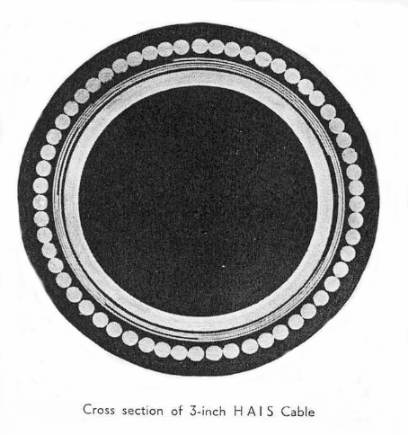
final specification of the HAIS pipeline was for a flexible pipe comprising an
inner lead pipe of 3 inches diameter, two layers of prepared paper tape, 1 layer
of bitumen prepared cotton tape, 4 layers of mild steel tape, jute bedding,
steel armour wires and an outermost la yer of jute servings. Each mile of pipe
used 24 tons of lead, 7.5 tons of steel tape and 15 tons of steel armour
wire and smaller amounts of lighter materials. The external diameter of the pipe
was 4.5 inches. yer of jute servings. Each mile of pipe
used 24 tons of lead, 7.5 tons of steel tape and 15 tons of steel armour
wire and smaller amounts of lighter materials. The external diameter of the pipe
was 4.5 inches.
Detailed specification; lead tube
internal bore 3.05 ins, minimum thickness 0.175 ins coated with petroleum
residue compound, two layers of 10 mm prepared tape two ins wide, one layer of
bitumen prepared cotton tape 2.25 ins wide applied with slight overlap, four
layers of unvarnished cold rolled mild steel strip 2 ins wide by .022 ins thick,
coating of petroleum residue compound, one serving of tarred jute yarn, 57
galvanised mild steel wires each 0.192 ins and separately compounded, coating of
compound, two servings of tarred jute yarn compound between layers and overall
and finally a coating of whitewash. The outside diameter was about 4.5 ins,
maximum bursting pressure was 4,350 lbs/sq in, weight per mile approximately 47
tons - 54.25 tons when filled with pressurised water.
Pipeline
Manufacture
One company, with a huge
involvement in the manufacture of the HAIS pipeline, was W T Henley of
Gravesend [for information about the firm who supplied the machinery visit
PLUTO Machinery.]
The
massive scale of the project is conveyed by Henley's consumption of 8,000 tons of
lead, 5,600 tons of steel wire and strip and large quantities of other
materials. Transporting and handling these exceptionally heavy cargoes, under
war conditions, was an enormous task in which the close cooperation of
suppliers was paramount in making these vital supplies available.
The cable was
usually manufactured in continuous lengths of 40 miles, weighing 2000 tons.
The weight of the cable, pressurised with water for laying, was around 67 tons
per nautical mile. In regular use it could operate safely at a pressure of
1,500 lbs per square inch and was tested to destruction at a pressure of 3,500
lbs per square inch, leaving a considerable safety margin.
Glovers Cables, located
in Manchester's Trafford Park Industrial Estate, took delivery of the first
purpose built HAIS pipeline manufacturing machine, followed later by a second.
The remaining four were delivered to a cable firm on the Thames. There was
speculation that the Glovers machines produced a hollow high voltage
electrical cable minus its core of electrical conductors. The machines
produced the cable in unprecedented lengths that required an overhead
conveyor, with cable hauling units, to deliver the completed pipes directly to cable-ships,
berthed on the Manchester Ship Canal alongside Trafford Park, or to be
stored in huge coils alongside the canal wharf for later shipment. The structures required to do
this formed an unmistakable local landmark that extended from the end of
Glovers works to the canal.
 Also
involved in the production was British Insulated Callender's Cables (BICC) of
Erith, Kent, England and USA firms General Electric, Phelps-Dodge, Okonite
Callenders and General Cable. Of the 710 miles of PLUTO pipeline manufactured,
140 came from the USA. Also
involved in the production was British Insulated Callender's Cables (BICC) of
Erith, Kent, England and USA firms General Electric, Phelps-Dodge, Okonite
Callenders and General Cable. Of the 710 miles of PLUTO pipeline manufactured,
140 came from the USA.
[Photo;
Laying the pipeline: A 'conundrum', loaded with a HAMEL steel
pipe, is ready to be towed across the Channel. As the conundrum spun in the
water the pipe uncoiled. © IWM (T 54)].
The manufacture
of the Hamel steel pipes was a very different process. At Stewarts & Lloyds of
Corby, Northamptonshire, England, machines were designed to manufacture, cut and weld the lengths of steel pipes
with exacting quality control measures to ensure reliable operation under
pressure on the seabed of the English Channel. S & L at Corby had the leading
role, although some tubes were supplied from their Tollcross works in Glasgow.
There is an excellent Ministry of Information film about Stewarts & Lloyd's
role in the PLUTO project at
https://www.youtube..com/watch?v=_N1UHU3z44U.
In his 1952 book,
A History of Phelps Dodge,
Richard Glass Cleland describes the scene; "Special machinery was designed,
built and installed to perform all manufacturing operations simultaneously.
Armouring and covering machines, each stretching over a distance of one
hundred and sixty feet, applied all the many separate layers of protective
coverings in a single continuous operation, thus producing the pipeline in the
required lengths and at high speed. A specially designed superstructure ninety
feet high then carried the pipe to large outdoor platforms where it was coiled
preparatory to loading into especially converted cargo ships alongside the
plant docks. One such coil, 50 miles long, weighed about 4000 tons - a weight
greater than the tonnage of two United States destroyers. In order to prevent
the coiled pipe from being crushed by its own weight, it was kept filled with
water at all times.
One
hundred and sixty-two days after Phelps Dodge Copper Products Corporation had
took on its unique assignment, the specially built plant shipped the last foot
of its quota. Shortly thereafter, this 'made in Yonkers' pipeline, was
supplying vital fuel to the Allied armoured Divisions driving toward Germany."
Pipe-Laying
Operations
 With the specification settled, a large
scale trial was set up. For this, the cable laying ship 'London' was taken into
service as HMS Holdfast under the command of Commander Treby-Heale OBE
RNR. Its task was to run a pipeline between the Queen's Dock in Swansea and
Watermouth, near Ilfracombe, some 45 miles away. Two specially fitted LCTs ran
2000 yards of the pipeline from each shore - the one at Swansea connected to a
pumping station and the other to receiving tanks at Watermouth. The free ends
were buoyed and a few days later, on December 27th 1942, the Holdfast
recovered the Swansea end, joined it up to the main pipeline on board (HAIS
pipes coiled on large drums), and steamed at 4 to 5 knots towards Watermouth
laying the pipeline as she went. With the specification settled, a large
scale trial was set up. For this, the cable laying ship 'London' was taken into
service as HMS Holdfast under the command of Commander Treby-Heale OBE
RNR. Its task was to run a pipeline between the Queen's Dock in Swansea and
Watermouth, near Ilfracombe, some 45 miles away. Two specially fitted LCTs ran
2000 yards of the pipeline from each shore - the one at Swansea connected to a
pumping station and the other to receiving tanks at Watermouth. The free ends
were buoyed and a few days later, on December 27th 1942, the Holdfast
recovered the Swansea end, joined it up to the main pipeline on board (HAIS
pipes coiled on large drums), and steamed at 4 to 5 knots towards Watermouth
laying the pipeline as she went.
[Photo; General view of the rubberised HAIS pipe being relayed
from the hold to stern. © IWM (A 28807)].
The importance of this trial was manifest in the list of those
monitoring its progress - Mr Hartley and Mr Tombs of Anglo-Iranian Oil, Mr
Colby of Iraq Petroleum, Mr Betson of the Post Office, Commander Hardy of the
Admiralty and Mr Whitehead of Johnson and Phillips, who had designed the pipe
handling equipment.
Some
setbacks followed. It took much longer than expected to effect a good joint, the
pipeline was damaged, and a tanker dragged her anchor and severed the line. It
was 100 days before pumping began at a rate of 1500 gallons per hour. It was a
modest beginning but would eventually lead to 1,000,000 gallons per day being
pumped across the channel.
Production of the 3"
pipe started at Woolwich in September 1943 and a number of lengths had been
completed a year later, one of which was 40 miles long and weighing 2,200 tons.
Many
regarded PLUTO as yet another wild fantasy of C.O.H.Q. Concerns were alleviated
to some extent by the concurrent use of 'Tombola', a conventional tanker with
the ability to pump oil to the
shore for storage. This was set up at Port-en-Bessin and at Ste. Honorine two
miles further to the west and was fully operational by June 14 1944. [Photos below courtesy of the US
National Archives
and the US Military History Institute.]

    
Photos l to r; 1. Operation Pluto 'Minor' initially pumped
fuel from tankers a mile or so off-shore. 2. When Port en Bessin fell to the Allies, fuel
was pumped directly from berthed tankers. 3. From the harbour two six inch lines, with
booster pumps, carried motor vehicle and aviation fuel to the US tank farm
at Mont-Cauvin, near Etreham, for British and American forces. 4. In addition to the two lines from Port en
Bessin there were two from Sainte Honorine des Pertes. They joined up at
Mont Cauvin where German prisoners filled jerry-cans for use in the field.
5. The main line from Port en Bessin was routed
alongside the D6 road to Escures passed the area where the
British/Commonwealth Bayeux cemetery now lies. 6. Steel can still be seen
in the western harbour wall today, and possibly some pipes in the harbour, at
low-tide.
The
main 'Pipeline Under the Ocean' operation was initially based at Cherbourg. The
pipe laying process, over the 70 miles from the Isle of Wight to the Cherbourg
peninsula, took as little as 10 hours.
However, on the approaches to the beach, there was an unforeseen difficulty
beyond the knowledge, skills and experience of the individuals concerned. 
[Photo; pipelines arriving on the Isle of Wight from Hampshire courtesy of
John Farthing].
The HAIS pipe had to be pulled up the beach at Cherbourg but engineers calculated
that the power required was way beyond the limit of winches available to
them. There was, however a most unlikely solution from an earlier age as
information taken from a 1965 article by Captain J.F. Hutchings explains.
"It
appears that a naval officer charged with the task of getting the pipelines
across the Channel was having difficulties getting the pipes ashore. The
officer recalled a boyhood memory of watching two steam powered ploughing
engines at work. A phone call to the Ministry of Agriculture & Fisheries
resulted in six (sic) engines being allocated to the PLUTO project. It appears
that two engines went to the Isle of
 Wight, one each to Sandown and Thorpes Bay, one
to Lepe at the entrance to Beaulieu River on the mainland opposite Cowes, one
to the PLUTO training exercise area at Hengistbury Head near Bournemouth and
one, to France, which was given the name STEVE - a Fowler class BB1 with works
No 15220, built in 1918. The engine's modified hauling drum exerted a 14-ton
pull to bring the pipes ashore." Wight, one each to Sandown and Thorpes Bay, one
to Lepe at the entrance to Beaulieu River on the mainland opposite Cowes, one
to the PLUTO training exercise area at Hengistbury Head near Bournemouth and
one, to France, which was given the name STEVE - a Fowler class BB1 with works
No 15220, built in 1918. The engine's modified hauling drum exerted a 14-ton
pull to bring the pipes ashore."
[Photo; The crew of HMS SANCROFT
cheer at the successful completion of the final pipeline. © IWM (A
28812)].
By
the time the two HAIS flexible pipelines and the two HAMEL steel pipelines to
Cherbourg were
pumping petrol, the Allied armies were moving west towards Paris and Belgium. 11
new HAIS pipelines and 6 HAMEL
pipelines were laid in a swept channel two miles wide between Dungeness and Ambleteuse near Boulogne
to shorten the supply route.
In all, about 500 miles
of pipeline were laid across the English Channel in an average laying time, over the 30 mile stretch, of
about 5 hours. In January 1945, the system delivered a disappointing 300 tons
but, by March, this had increased to 3000 tons and later still to 4000 tons. This
amounted to over 1,000,000 gallons per day, giving a total of 172,000,000 gallons
delivered up to the end of hostilities. During the operation to lay the
cables, an HQ ship, several cable ships, tugs, trawlers and barges were employed
on this specialised work - a total of 34 vessels with 600 men and officers under
Captain Hutchings.
The 21 pipelines were
vital arteries, which enabled the Allied Air Fleets and Land Forces to maintain
the momentum needed to secure a victory. Moreover, PLUTO obviated the need for
fleets of tankers, sparing their crews the ordeal of concentrated enemy attacks
in congested waters.
Major Vessels Used
Pipe Layers
Empire Ridley (HMS
Latimer)
A standard British
'Empire' ship, type Y1 of 6,838 gross tonnage and 10,000 tons deadweight. Built
by Lithgow Limited of Port Glasgow (No. 939). Launched 21/8/41 and completed in
Nov 41. Taken over by the British Admiralty and converted to a cable laying
vessel for Operation PLUTO in 1943 and renamed HMS Latimer. Returned to
Ministry of War Transport in late summer 1945. Sold to Norway in 1949 and
underwent conversion in Italy and re-sold to new Italian owners and renamed
Acheo. Scrapped in Sakai, Japan in 1964.
Empire Baffin (HMS Sancroft0
Standard British
'Empire' ship type Y1 of 6,978 gross tonnage and 10,000 tons deadweight. Built
by Lithgow Limited of Port Glasgow (No. 957). Launched late August 1941 and
completed in October 1941. Taken over by the British Admiralty and converted to
a cable laying vessel for Operation PLUTO in 1943 and renamed HMS Sancroft.
Returned to the Ministry of War Transport in 1946 and later that year was
renamed S/S Clintonia for the Stag Line of North Shields. In 1960 she was
S/S Aspis of the Faros Shipping Company of London. Scrapped in Yokosuka,
Japan in 1963.
 HMS Holdfast HMS Holdfast
HMS Holdfast was
the first HAIS cable laying ship. She was converted from the Dundee, Perth &
London Shipping Company's coastal passenger ship 'London'. She was built
in 1941 by Hawthorns & Co Ltd of Leith, Scotland and was of 1499 gross
tonnage. Conversion commenced in the summer of
1942
and was completed later the same year.
[Photo; HMS Holdfast
football team 1943/44 with names on thumbnail below].
HMS Algerian
A ship of 2315 gross
tonnage converted for the purpose of pipe laying. She was formally the S/S
Algerian of Messrs Ellerman & Papayanni Lines Ltd.
 All the above
conversions were carried out by Green and Silley Weir Ltd,. London and all cable
handling machinery was by Messrs Johnson & Phillips. All the above
conversions were carried out by Green and Silley Weir Ltd,. London and all cable
handling machinery was by Messrs Johnson & Phillips.
Inshore
Craft
Inshore craft comprised
the coastal motor barges Brittanic, Oceanic and Runic and
the twin screw barges Goldbell and Goldrift.
Hopper Barge
W24 was a 725 gross
tonnage dockyard hopper barge which became HMS Persepone when taken over
by the Admiralty to undertake experimental work on the HAMEL steel pipes. She
was converted at Portsmouth in 1943 when a cable drum of 48 feet
diameter was positioned in her hold and mounted on trunnions on the main deck. In
operation steel pipe was fed through the open hopper doors in the bottom of the
vessel. She was the forerunner of the floating 'CONUN' drums which, when
employed in the Force, became known as HMS Conundrum!
Conun Drums
Following successful
trials with a large prototype in early 1944, five 'conuns' were
commissioned to a modified design. The new drums, of 30 feet diameter, were
fabricated in Scunthorpe, erected in Tilbury Docks and launched into the Thames.
Each of the conuns weighed in at 250 tons and had a combined capacity to carry
up to 60 nautical miles of HAMEL pipes.
Tugs
HMRT Bustler -
3200 indicated horsepower ahead.
HMRT Marauder -
3000 indicated horsepower ahead.
HMRT Danube V a
smaller craft astern of the two above to facilitate steering of the tow.
The
Salvage Fleet
S/S Empire Ridley
as per PLUTO Fleet
S/S Empire Taw as
per HMS Holdfast of the PLUTO Fleet.
S/S Empire Tignes
was a tanker of 407 gross tonnage built in 1943 for the German Navy. Prize 1945.
It was converted to recover HAMEL steel pipes by Marine Contractors of
Southampton. It was sold in 1949 to Risdon, Beazley & Co and became Topmast No
15. Sold to Dutch buyers in 1953 and in 1959 became an inland waterways tank
barge.
S/S Wrangler was
a Mark III Tank Landing Craft converted by Marine Contractors Ltd. to recover
HAMEL steel pipes and to undertake general salvage work
M/V Redeemer was
an ex Navy wooden hulled motor fishing vessel built in 1940. It served as tender
to the recovery ships.
When the PLUTO project was finally disbanded in
1945, its Senior Naval Officer Commanding Force PLUTO, Captain J F Hutchings,
wrote a letter of appreciation and good wishes to his men. This particular copy
was received by Charlie Bradshaw, who served aboard HMS Latimer for a
couple of years or so. Charlie passed away in 2016 and always spoke fondly of
his time on the Latimer.
  Land Based
Operations UK Land Based
Operations UK
These
1943/44 photos of the pumping station at Dungeness, Kent, were supplied by Gordon Stirling.
 In
order; 1. Beachside bungalows used as pumping stations. 2. Half way through the conversion.
3. Following camouflage. 4. A Mather and Platt pump in one of the
bungalows. 5. The pumping control room. 6. PLUTO pump station installation team (see
correspondence below). In
order; 1. Beachside bungalows used as pumping stations. 2. Half way through the conversion.
3. Following camouflage. 4. A Mather and Platt pump in one of the
bungalows. 5. The pumping control room. 6. PLUTO pump station installation team (see
correspondence below).

Most of the innovative work was on the design,
development and testing of the submerged pipelines. However, this does not
diminish the scale or importance of the land based preparatory
work, particularly in southern England. The engineers, scientists and Army
personnel
 provided storage tanks, a
pipeline distribution network and pumping stations, where the pipelines entered
the English Channel. The army, in the guise of the Royal Engineers,
Royal Army Service Corp, Pioneer Corp and the Royal Canadian Engineers were
all involved in laying the pipelines over land. provided storage tanks, a
pipeline distribution network and pumping stations, where the pipelines entered
the English Channel. The army, in the guise of the Royal Engineers,
Royal Army Service Corp, Pioneer Corp and the Royal Canadian Engineers were
all involved in laying the pipelines over land.

Land Based
Operations Mainland Europe
Stan Mould writes... My father, Captain Hubert Alfred Hill Mould, Officer Commanding the No 1 Welding Platoon, Royal Engineers, worked on the western HAMEL steel pipelines from Cherbourg and the eastern pipelines from Calais to Emmerich. The cartoon sketches below record their progress in a humorous yet informative way. On that journey, he met my mother
 at Aalst, just south of Eindhoven, where the platoon were billeted for some time pending the Allies push into Germany. They married in June 1945 and returned to the UK in time for her birthday the following month. at Aalst, just south of Eindhoven, where the platoon were billeted for some time pending the Allies push into Germany. They married in June 1945 and returned to the UK in time for her birthday the following month.
[In this colourised photo of the No 1 Welding Platoon of the
Royal Engineers, the colour of the uniforms may not be accurate. The
Commanding Officer, seated front row, is
Captain Hubert Alfred Hill Mould.]
Operation Wellhit, the battle for the liberation of Boulogne, commenced on the 17th November, 1944 and was completed by the 22nd. The way was then clear for the 17 PLUTO pipelines from Dungeness to be laid down and for construction of the land lines that would eventually extend to Emmerich in Germany, 250 miles (410k) to the north east. The cartoon style sketches of the recruitment, training and
operations of the No 1 Welding
Platoon, Royal Engineers, provide a light-hearted and
humorous insight into memorable events during their 17 months of service on the
PLUTO pipeline project. The significance of the D Day + references and the
scattering of place names, apparently out of sequence, remain ambiguous.
       
1. Western Map including Cherbourg & Port en Bressin.
2. Front cover of booklet.
3. Recruitment &
Training. Tendring is a district in NE Essex, clearly of some significance.
4. Arrival at Port en Bessin
in Normandy. Confined for a while, 1st recce under battle conditions. Place
names mentioned - Marquise, Lier, Aalst, Glendringen and Cleve (Kleve?)
5. The
daily grind - places mentioned Arromanches, Antwerp and Materborn.
6. HQ -
places mentioned - Bayeux, Linth, Aalst & Materborn.
7. Celebrations at Eeklo,
Belguim in the summer of 1945. Job done, hostilities over, home and demob
imminent. The wedding bells are a symbol of Captain Mould's marriage.
8. Eastern
map including Calais, Antwerp and Aalst.
Further Reading
On This Website;
PLUTO in Fawley,
PLUTO - the Salvage
Operation
PLUTO Pipe
Manufacture
There are around 300 books listed on
our 'Combined Operations Books' page. They, or any
other books you know about, can be purchased on-line from the
Advanced Book Exchange (ABE). Their search banner link, on our 'Books' page, checks the shelves of
thousands of book shops world-wide. Just type in, or copy and paste the
title of your choice, or use the 'keyword' box for book suggestions.
There's no obligation to buy, no registration and no passwords.
Other Sources;
Stewart & Lloyd
Film of their manufacturing process - https://www.youtube.com/watch?v=FIYS_9EI5j0
PLUTO
- World War 11's Best-Kept Secret by Bob Knight, Harry Smith & Barry
Barnett. Published in 1998 by Bexley Council. Softback, 34 pages with many
illustrations about the involvement of The Callender Cable Co.
PLUTO - Pipe-line under the Ocean
by Adrian Searle. Publisher Shanklin Chine, 12 Pomona Road, Shanklin, Isle of
Wight PO37 6PF. ISBN 0 9525876 0
(Description of book. To
many in WWII, it seemed a preposterous idea - an undersea pipeline laid across
the bed of the Channel to carry fuel to the Normandy beaches. It was carried out
in absolute secrecy and, according to Eisenhower, it was "second in daring only
to the artificial 'Mulberry' Harbours.' The extraordinary project, & the
millions of gallons of fuel it carried, helped to ensure that the Allied armies
could break out after D-Day. 126pp, photos, ills, maps).
National Archive, Kew, London
Some
records on PLUTO are available to be viewed (personal callers or paid
researchers only - NOT available on line). You may find others by visiting
their Online Catalogue. Copies of documents can be ordered on line.
Acknowledgements
This account is based
on information provided by Capt. FA Roughton MBE, who was involved in the laying
down of the pipelines and their salvage after the war. Capt Roughton died
on the 11th March 2013 at the age of 100. We are grateful to him for the legacy
he left behind about PLUTO, for the benefit of future generations.
The technical data about, and images of, the HAIS
flexible pipeline are from an article written by Mr EA Beavis, BSc, AIMEE published in Seimens
Brothers Engineering Bulletin No 224 dated January 1946.
Places
to Visit
1) The Shanklin Chine on
the Isle of Wight is a beautiful place in its own right but for those with a
special interest in the 'Pipeline Under the Ocean' it harbours something of a
surprise. Here is an extract from the Shanklin Chine website.
"During the war the
Chine was taken over and used as an assault course by the Commandos whose HQ was
at Upper Chine School. 40 Royal Marine Commando trained there in preparation for
the Dieppe raid in 1942. A plaque to their memory was dedicated on 6th June
1984, the 40th Anniversary of D-Day.
PLUTO also ran through
the Chine and there are still 65 yards of the pipe remaining. PLUTO, one of the
great secret successes of the war, was the idea of Lord Mountbatten. During the
Normandy invasion in 1944, forked pipelines from the Chine and Sandown carried
petrol 65 miles under the Channel to Cherbourg, the first taking only ten hours
to lay. The pipelines delivered 56,000 gallons a day until the Allies advanced
so far that the line was transferred to Dungeness in Kent. There a million
gallons daily were piped to Boulogne and eventually as far as the Rhine. A
cross-section of the actual pipe can be seen in the Heritage Centre, together
with a video of the story of PLUTO and other exhibits.
2) On the other side of
the channel at Port en Bessin
you can still see remnants of PLUTO.
Nigel Stewart, an official Normandy Guide writes; "The remnants can be
seen at low tide in the left-hand western harbour of Port-en-Bessin. Drive into
the harbour and walk down to the causeway on the front. The remnants are there,
easily visible. For those travelling independently the Port of Bessin is due
north of Bayeux."
Correspondence
_small.jpg) Dear
Geoff, Dear
Geoff,
I came across your website whilst gently looking for information on the
‘Pluto’ project. I used to work in the 1970’s at the Pirelli General cable
company in Eastleigh Hampshire which I understand was one of the
manufacturing sites of the pipe. No doubt Pirelli’s expertise in producing
lead sheathed power cables was of significant interest at the time. I myself
worked at that factory many years later although it has since been
completely demolished and a housing estate built on it - such is modern
life, but at least one of the roads in the new estate is named after the
Pluto project, so at least the historical point will be left for future
generations to ‘Google’!
_small.jpg) As
we do not live too far away we sometimes visit Lepe Beach and walk along to
where a ‘caravan’ of caissons were built and launched in preparation for
D-Day. The surrounding geography seems to be largely loose shale etc and
much of the Beach area will eventually be washed away - I do hope the local
authorities will make a photographic record the area. As
we do not live too far away we sometimes visit Lepe Beach and walk along to
where a ‘caravan’ of caissons were built and launched in preparation for
D-Day. The surrounding geography seems to be largely loose shale etc and
much of the Beach area will eventually be washed away - I do hope the local
authorities will make a photographic record the area.
My point, in a roundabout way, is to enquire if you are aware that erosion
of a small cliff area on Lepe Beach has revealed a section of (one?) of the
Pluto pipelines where it left Lepe Beach and eventually originally made its
way across the Solent to the Isle of Wight? This ‘find’ was confirmed to me
by a local county council ‘ranger’ familiar with the beach area and
recognised the significance of the find. As someone who used to work with
high voltage power cables I should not be too surprised how closely it
matches a power cable but of course its completely hollow!
I enclose a photo of the pipe as it now emerges from the cliff face. If it
is of interest to your website I will happily re-visit it and take some
additional photographs in close up etc.
For the avoidance of doubt you are welcome to use any of these photographs
on your website.
Kindest regards
Michael Bailey
HMS Holdfast
Geoff,
I respond to your section on PLUTO.
After 3 years RN national service on a armed merchant cruiser in the
North Atlantic and Indian Oceans my father retrained as torpedoman-electrician
at Chatham in 1943 and one Saturday answered a pipe for a volunteer for
a posting to dodge barrack cleaning chores. All they would tell, besides
that the ship Holdfast was that it was all secret. He made his mind up
to volunteer when he met the man just off Holdfast who filled in that
ship was Admiralty Cable Service crewed by a mixture of RN & Merchant
Navy who for the sake of harmony all got RN rum & tobacco issues plus
civilian overtime allowances & danger money. Arriving on board he found
he had no "abandon ship" Station allocated. He was told the ship had
demolition charges because of secrecy. His job as electrician was to
wait till last to detonate them, then see what was nearest.
He was John Hardstaff, most usually know
by his middle name, Phillip. You feature him as goalkeeper in a photo of
Holdfast's football team. For a small ship, their footballers punched
above their weight. They had only 11 men who claimed any skill, but had
a specialist for each position and did quite nicely out of bets against
larger ships until word got around.
Roles tended to evolve on board where
they were pushing the boundaries of cable technology. Dad became the
ship's toolmaker devising gadgets to make the human side of the heavy
work possible and easier and served all through preparing, laying and
beginning salvage of HAIS pipelines, getting demobbed a bit after the
end of hostilities.
HAIS pipes could not approach France
until their landing beaches were secure, so Holdfast was an available
cable vessel to deputise for cable ship Monarch which was unable to
connect underwater communications cables to lines from shore at
Arromaches because an American destroyer captain thought she might have
been an E-boat. Dad as electricity "buoy jumper" wants to take credit
for providing phone communication to the invading armies and easing the
burden on wireless.
When Holdfast was the only British ship
in the captured American port of Cherbourg she had to contribute to
Shore Patrol. Dad ended up patrolling 10 miles inland with an American
Military Police corporal and his uniform was a talking point with the
hospitable French. They were so hospitable that the calvados-fuelled
drive back to Cherbourg was his scariest moment of the war.
He was sent walking west from Cherbourg
to scout what might be needed to bring HAIS ashore. A little way out a
German soldier rode towards him on a motorcycle, dismounted and
surrendered. Dad sent him on towards an American outpost, then had a go
on the motorbike. This attracted fire from Germans a couple of
kilometers ahead and as the Americans returned fire he withdrew keeping
his head down.
He recalled the ploughing engine
pulling the pipe ashore. He recalled an American opinion the day before
that "a mobile winch powerful enough hasn't been invented yet."
He and his shipmates were a supremely
fit and strong body of workers. The machinery could only do so much and
considerable muscle was needed handling the continuous, water-filled
pipeline when loading the cable tanks in London or laying it at sea.
They were hugely in demand to deliver beer for the local brewery in the
East End
As electrician he never succeeded in
his greatest challenge on Holdfast which was to stop the captain's
electric shaver from going faulty and blowing the ship's fuses. The
captain, of course, kept to a safety razor at sea.
With my regards and appreciation,
Paul Hardstaff
Dudmaston Estate
Did you know that the PLUTO
pipeline runs through the Dudmaston estate,
a 17th-century country house in the care of the National Trust in the Severn
Valley, Shropshire,
England?
The pipeline was an
ingenious way of providing fuel to troops operating in France during the
Second World War. In all, over 700 miles of pipe were laid under the English
Channel during 1944 to support Operation Overlord, the Allied invasion of
Normandy in June 1944. An estimated 172 million gallons of oil were supplied
during the landings — all underwater and under the Germans’ noses.
Sections of the pipe were
re-laid and re-aligned in 1978, with the National Trust and Lady Labouchere
making sure that no damage was done to the land or property.
Ann Sadler
Room Guide and Research
Volunteer
Hi Geoff
From 1966 I worked in the Department of Research & Technical Development at
Stewarts & Lloyds in Corby. The chief metallurgist for the company (which had
many offshoots in England, Wales and Scotland) was at the 'top of the tree' in
the development of the steel pipeline. He was instrumental in the selection of
the most suitable steel composition along with the correct properties for its
use. His name was Paul Whittaker, a very quiet and reserved man. I have
never seen any credit for what he contributed to the PLUTO project without
which the main 'pipes' could not have been manufactured and successfully
deployed.
John Richards
 Dear
Geoff, Dear
Geoff,
My great grandfather, Joseph Gray, was a war artist in WW1
and a camouflage officer in WW2. He invented a kind of camouflage material
called steel wool that was used to cover some of the storage tanks and pipes
of PLUTO.
[Photo; Steel wool in use camouflaging two infantrymen. 11
November 1940 © IWM (H 5464).]
Joe served in WW1 in the Black Watch and
after he was invalided out became war artist to the Graphic newspaper. During
the thirties, his growing anxiety about the power of the Luftwaffe and the
threat of an aerial assault, prompted him to write a book about camouflage. He
begin searching for a tough new camouflage material that could mimic the
effect of vegetation and be rolled over sites of importance to disguise and
hide them. He was recruited by the Royal Engineers to work on the concealment
of War Office sites and Royal Ordinance factories and the like. By 1939 he had
developed a new steel wool camouflage material - a sample of which can be
found in the Imperial War Museum.
Steel wool was tough and durable and could be
painted any colour to match the vegetation and was widely used when concealing
the pipes and tanks for Pluto on the Isle of Wight. It also made a good canopy
to hide men at work. Eugene Mollo and Ashley Havinden worked together on the
Isle of Wight camouflaging all the sites, with help from Peregrine Churchill,
nephew of the PM. Peregrine was an engineer by training and an adviser to the
Air Ministry on camouflage and with Mollo became quite the expert on making
large scale static covers - for which he favoured steel wool. Although steel
wool was expensive compared to basic camouflage nets, is was longer-lasting
and really ideal for the Pluto sites.
Best wishes,
Mary Horlock
[Mary has written a book about her great
grandfather called "Joseph Gray's Camouflage" which includes a chapter on
PLUTO. Antony Gormley writes ‘This beautiful and moving book tells the story
of an artist who became skilled in painting as a way of hiding things in plain
sight, and who ultimately hid even himself from the world. It shows how
painting can reveal truth and at the same time disguise it. Gripping and
sharp, it is a brilliant exposure of creativity in the arena of death’
Hardcover: 352 pages; Publisher: Unbound (22 Mar. 2018); Language: English;
ISBN-10: 1783524685 & ISBN-13: 978-1783524686.]
Corby's Contribution to PLUTO
Dear Geoff,
I have just
completed a major education project focused on the Corby end of the PLUTO
operation. This is intended to better inform 10-17 year olds and was made with
help from 30 young people from Corby. They built a model Conundrum which is
now in the Heritage centre at Corby. The also made 12 downloadable podcasts
each covering aspects of PLUTO, Bambi & Dumbo etc.
The video
material draws heavily on the 1946 film ‘Job 99’ but also has much newly shot
HD images of the Isle of Wight artefacts.
Though
intended for young people I hope it may also be of interest to some of your
members. Access is FREE and all podcasts may be downloaded to keep.
All the best
Paul (5/08)
Recollections of Veteran
Philip
Greengrass.
I served on HMS Latimer and recall
the first pipeline run from Shanklin to near Cherbourg. We had an escort
corvette which anchored just astern as we arrived at the raft just under the
cliffs on to which we flaked down the remaining pipe. Unfortunately, the
corvette on heaving up anchor, fouled the pipe we had just laid, causing some
damage.
Later on, the last pipe we laid
between Dungeness and Boulogne, began to disintegrate and the operation was
abandoned. Latimer sustained some very minor damage while berthed in KG Dock
as a V2 rocket hit the entrance lock gates nearby.
Latimer, formerly Ridley, recalls
the Archbishop and Chaplain who were burned at the stake in the reign of Queen
Mary, and I think HMS Sancroft was named after the Archbishop who crowned
James 2nd but refused to crown William and Mary. He was pensioned off.
For what it’s worth, I was an OS
at the time, ex Merchant Navy deck boy. I took to seafaring, post war, and, as
a Master Mariner, eventually Trinity House Pilot, London District. Now retired
aged 90.
My best wishes.
Philip Greengrass.
Charles, Samuel or Edwin
Lawrence. My granddad served on the Empire Ridley and was involved with
the Pluto pipeline. He was presented with a piece of the pipeline but it was
sold by his 2nd wife and family. I was just wondering if anyone had any
information on my granddad and his role with the Pluto line. We have no photos
or information.
I wonder if
their is a list of crew members anywhere. I know there was a captain Ingham
(not sure of the spelling) on his ship. Thank you for all your help. (Please
contact us in the first instance.)
Sandie
The Power of the PLUTO
Pumps. David writes, In 1982 I had the offer from a CEGB
transmission engineer to ascend the north transmission tower (you call them
pylons!) of the West Thurrock to Dartford 275 Kv Thames crossing. He informed
me that PLUTO pumps were installed at the base, they were the ones capable of
pumping water to such a great height to clean the insulators from the deposits
from the adjoining power station chimney (West Thurrock, now demolished) . I
understand they were replaced, but sadly, no longer needed.
This provides us with an
insight into the quality of the design and manufacture of the pumps. These
towers are several hundred feet tall and when in use the pumps were 40 years
old! [Ed.]
Photo of Dungeness Pump-house (6
above). I believe the man on the extreme right of photo numbered 6 is my
uncle jack who died in 1967. He previously worked for Pratts/Esso in their
tank and pump departments. His name was John Benjamin Patrick Geary. In WW1
he served as a Lewis gunner in the East Surries in France, gaining the
Distinguished Conduct Medal in 1918.
John Parker
 21st Century PLUTO 21st Century PLUTO
I was born in Campbells Street, Renfrew in
1936 and grew up hearing the riveting from Simon's Lobnitz who built some of
the unique vessels for Normandy.
I first heard about PLUTO when I was an
apprentice fitter with Barclay Curle & Co, Ship Repair Yard, Scotstoun West,
Glasgow, 1952-57. Years later, while driving in Los Angeles to work on the
Hughes Glomar Explorer, I heard about the Fluor Daniel reel barge in Houma,
Louisiana where they were wrapping 10 inch steel pipes on a 54 ft diameter
drum. I was amazed to hear that the bending was done cold.
I n time I became Project Engineer on the
Santa Fe International Inc project "Apache" and was responsible for
developing a concept to lay 24 inch pipes using an arrangement of towers on
a ship. This proved to be too complex so I made a desk top model, proved the
analysis was wrong, stripped out the towers and produced the Apache as it is
today. n time I became Project Engineer on the
Santa Fe International Inc project "Apache" and was responsible for
developing a concept to lay 24 inch pipes using an arrangement of towers on
a ship. This proved to be too complex so I made a desk top model, proved the
analysis was wrong, stripped out the towers and produced the Apache as it is
today.
The Apache was not accepted until the 80s
when the oil price collapsed and CRINE, (Cost Reduction In the New Era), was
introduced in the UK. Since then the Apche has laid seven billion dollars of
pipe and has been copied many times. The original is now owned by French
Technip. Even when people saw the Apache working they said it damaged the
pipe! Apache carries 2000 tons of pipe while my Sidewinder design carries
10,000 tons.
Without the knowledge gained during the
PLUTO project, these modern solutions to laying pipes on the seabed might
never have been created.
Craig Lang BSc (Eng) PE
 Pumping
Station at Dungeness. I read with interest the detailed information on the
Pluto project. It was due to his involvement with Pluto that my father David
Stirling (photo opposite) came to meet many people previously employed in the
oil industry and subsequently spent the rest of his working career with Iraq
Petroleum finishing as senior inspection engineer. Pumping
Station at Dungeness. I read with interest the detailed information on the
Pluto project. It was due to his involvement with Pluto that my father David
Stirling (photo opposite) came to meet many people previously employed in the
oil industry and subsequently spent the rest of his working career with Iraq
Petroleum finishing as senior inspection engineer.
He was a draughtsman/design
engineer working for Frank Pearn and Co in Manchester who were contracted to
supply the pumping equipment to be used at Dungeness and the Isle of Wight.
The pumps were installed in bungalows in a pre-war holiday camp at Dungeness
which were buried under tons of pebbles. During the build-up to D-day my
father was in a reserved occupation, attending meetings in London as the Pluto
project gathered momentum. To the horror of my mother early in 1944 he
returned from one such meeting as a member of the armed forces. He was sent on
a month’s intense training in North Wales and was then posted to Dungeness as
Captain Stirling to join the team putting together the project in Dungeness
and the Isle of Wight.
My father and other members
of the team were billeted in a row of ex-coastguard cottages at Littlestone.
The one my father occupied called ‘Flag Cottage’ was the property of a lady
called Annie Roper.
I remember seeing
photographs of the huge empty reels that looked like ‘’cotton bobbins’’
abandoned on the beach and of the massive array of pipe-work leading from the
pumping houses. These were taken later in the war when the risk from the
Luftwaffe had presumably diminished.
My father remained with
this unit and achieved the rank of Major before his demob in 1946. This was
due to pressure from his old employer on the war office to release him, to get
back to work. For them it eventually proved in vain as Iraq Petroleum soon
offered him a post and he remained there until his retirement in 1974.
My father considered
himself to be one of the lucky people who benefited from the war. As he said
on a number of occasions, if it had not been for Pluto and the people he met
during that time, he would probably have remained as a design engineer working
on pumps for the rest of his working life. As it was he had a varied and very
interesting career working for Iraq Petroleum.
I trust some of this
information may prove of use in helping to build a complete history of this
clever engineering feat.
Gordon Stirling
 My
grandfather, John Findlater Simpson, who was born in Edinburgh in 1885, was
heavily involved in PLUTO. He moved to Scunthorpe pre 1924 to become the
manager of the gasworks in Dawes Lane Scunthorpe. He was also involved with
founding Orthostyle Engineering works and my family believe that he and
Horace Codd were the brains behind the floating pipe laying buoys used in
Pluto. He never, ever spoke about his involvement in war work but his wife
was sure that his many secretive meetings were all about Pluto. He died in
the early sixties taking his secret to the grave. I attach a photograph of
him taken circa 1940. My
grandfather, John Findlater Simpson, who was born in Edinburgh in 1885, was
heavily involved in PLUTO. He moved to Scunthorpe pre 1924 to become the
manager of the gasworks in Dawes Lane Scunthorpe. He was also involved with
founding Orthostyle Engineering works and my family believe that he and
Horace Codd were the brains behind the floating pipe laying buoys used in
Pluto. He never, ever spoke about his involvement in war work but his wife
was sure that his many secretive meetings were all about Pluto. He died in
the early sixties taking his secret to the grave. I attach a photograph of
him taken circa 1940.
Jill Wallace (Simpson)
[If anyone knows of John
F Simpson's involvement in the PLUTO project please
contact us.]
 PLUTO Markers - Isle of
Wight PLUTO Markers - Isle of
Wight
I've been resident on the
Isle of Wight for some 55 years and a few years ago I was shown a PLUTO
marker. These were placed in hedgerows to locate the position of the pipeline
below as it ran alongside roads, tracks, paths or a field boundaries. Their
purpose was to alert anyone digging in the area of the presence of the
pipeline.
 With
my curiosity kindled I set out to locate more of these markers and to plot the
course of the pipeline across the Island from Thorness Bay, where the 20 or so
feeder pipelines arrived after crossing the Solent from Lepe in Hampshire (1st
photo). The pipes where fed into a manifold (2nd photo) with a single larger
outlet pipe for the land crossing of the Isle of Wight to Shanklin where
multiple pipelines left England for France. With
my curiosity kindled I set out to locate more of these markers and to plot the
course of the pipeline across the Island from Thorness Bay, where the 20 or so
feeder pipelines arrived after crossing the Solent from Lepe in Hampshire (1st
photo). The pipes where fed into a manifold (2nd photo) with a single larger
outlet pipe for the land crossing of the Isle of Wight to Shanklin where
multiple pipelines left England for France.
I found 42 markers some in
a very poor state after 60 plus years while others were in surprisingly good
condition. (Remaining 3 photos).
 From a distance the markers could be mistaken
for styles no doubt a deliberate ploy to avoid detection from the air. Each
comprised two concrete posts with rectangular holes to receive up to 4
horizontal oak slats. From a distance the markers could be mistaken
for styles no doubt a deliberate ploy to avoid detection from the air. Each
comprised two concrete posts with rectangular holes to receive up to 4
horizontal oak slats.
There is a PLUTO pump on
display at the Bembridge
Heritage Centre and I believe another one has been found and it is expected
to be
similarly restored and put on display at Sandown. There were pumping
stations on both Shanklin and Sandown seafronts close to where the pipes
entered the Channel.
John Farthing.
 [John wrote a book entitled
'Where PLUTO Crossed the Path' describing eighteen walks where markers can be
found adjacent to rights of way. A few copies may still be available in local
bookshops.] [John wrote a book entitled
'Where PLUTO Crossed the Path' describing eighteen walks where markers can be
found adjacent to rights of way. A few copies may still be available in local
bookshops.]
PLUTO in Canada!
I have just found your
website. I have always been curious about the piece of PLUTO that I have in my
basement in Canada. My brother, who died last year in England, had another
piece. I was born in Scotland in 1941 and did not really see my father, Jack
Sloss, until about 1944. Although he did not talk about the war (having also
served in WW I, being torpedoed by a German submarine when serving on a Royal
Navy/merchant oil tanker), I know from my mother that he took part in the
survey of the sea bottom to map out the best route for PLUTO.
He served on several Post
Office Cable ships – Monarch, Alert and Iris. The older versions of the first
two were sunk by the Germans during the war. My father spent 1945 on Tyneside
supervising the installations of cable equipment in the “new” Monarch. He was
the design engineer for the “new” Alert which was build in Fairfield’s
shipyard on the Clyde in 1958-59. He was chief engineer of the Iris when it
surveyed the Atlantic bottom before laying the cable from Scotland to
Newfoundland in the early 60s. (He also designed the engines for the John
Cabot, the first ice breaking cable ship in the world.)
He apparently met Winston
Churchill at some point during the brainstorming of the design for the PLUTO
cable. This was after silently surveying along the French coast under the
noses of the Germans. I wonder if he may have been on board the Betsie Jane
(see below). I know he spent time on the Isle of Wight and Portsmouth.
Anne
E. Beveridge
Motor Launch Betsie Jane
I am currently restoring a
motor cruiser that was built for Lord Ebbisham by Saunders & Roe IoW in 1938.
I have managed to trace the son of the original skipper, Frank Toogood.
Frank’s son, Peter, has written about the wartime exploits of his father and
“Betsie Jane”.
In his account he mentions
an incident in which his father was ordered to ‘report without a crew to
King’s Stairs Portsmouth there to wait under armed guard until high ranking
officers came aboard with surveyors. He was also given sealed orders “ From
Admiralty via C in C Portsmouth to HM Betsie Jane. You are to proceed to SE of
Wight there to steam at 3-4 knots in a westerly direction approx 1- ½ miles
off the coast and heave to when ordered. Message ends”. Frank later realised
that the surveyors were undertaking an initial survey for the Pluto Pipeline.
Although Betsie Jane’s
involvement in the operation is somewhat miniscule I am searching for any
scrap of evidence to put together a history of Betsie Jane and so any
assistance would be very much appreciated.
 Many
thanks Many
thanks
Paul Rainbird
(6/05) PLUTO. The
son of Lt Col Howard EVERETT CRE 21st Army HQ E & M (PLUTO) RE Companies
548 & 796, has a lot of un-published and detailed information about these
two companies who ran the European pumping complex after D Day [Cherbough to
Germany . He would consider making it available to a serious enquiry. He would
like to hear from any relatives of the Officers and Men
under his father’s command, before and after the pipe line was laid.
Please
e-mail, write or phone Dr Christopher Everett with details, cbga.everett@gmail.com
8 Wetherdown PETERSFIELD GU31 4PN tel 01730203008
| 


.jpg)
.jpg)


