|
Combined Ops
Assault Pilotage Parties.
Clandestine work on potential landing beaches
 Combined
Operations Assault Pilotage Parties risked their lives to gather information about proposed
landing beaches and in-shore waters, usually under the noses of enemy coastal
defences, including land and sea patrols. It was hazardous work of great
importance to the planners. Combined
Operations Assault Pilotage Parties risked their lives to gather information about proposed
landing beaches and in-shore waters, usually under the noses of enemy coastal
defences, including land and sea patrols. It was hazardous work of great
importance to the planners.
[Photo; Two COPPists in a canoe used by them to reach
landing beaches from submarines or boats. © IWM (MH 22716)].
Background
Both by instinct
and training, sailors show
great respect for uncharted and unfamiliar coastal waters and, given the
option, they would choose to give them a wide berth. The natural hazards of
submerged shoals, rocks and unpredictable tides and currents, present a
formidable challenge to those navigating in these waters. When submerged
enemy coastal defences and beach patrols are added to the toxic mix, the dangers and difficulties
are compounded. This was
the scenario which confronted Lt. Commander Nigel Clogstoun-Willmott, RN, as
he pondered a raid on the Greek island of Rhodes in the summer of 1941. He
was to be the navigating officer on the planned raid.
He recalled the
difficulties which his uncle had experienced off Gallipoli in 1915, when the deployment
of battleships was delayed or restricted for fear of enemy mines. Closer inshore, there were
natural and man made obstacles to contend with in waters offering limited
room for manoeuvre... and all under the gaze of enemy gun emplacements with
barrels pointing seaward. Many doubted that a 4000 ton landing craft, needed for a major
raid or landing, would survive these multiple hazards. Willmott fully
appreciated the dangers and risks to landing craft from his experiences in Norwegian waters,
when over half of the Allied ships lost in
1940, foundered on rocks and shoals in coastal waters. To improve the odds in favour of the
amphibious landing forces, many thousands of fully trained navigators were
needed. However, in 1940/41, they were already in short supply and most
suitable training establishments and training resources were given over to
satisfy the RAF's greater need.
As the Lt. Commander surveyed the coastal waters and beaches
of Rhodes from the periscope of a mine laying submarine, he was acutely aware that
the information he was gathering was of limited value. He could not, for
example, confirm the nature and disposition of enemy defensive
positions on and near the landing beaches; he had no knowledge of hidden
sandbars close to the beaches, which could mislead heavily laden troops to
prematurely disembark into deep water believing they had shallow water
all the way to the dry beach; he could not be
certain of the composition of the beaches and thereby their suitability for
the discharge of heavy lorries and tanks onto them. The lack of information
(intelligence) on any one of these aspects would put lives at risk and
missions in jeopardy.
In time, beach reconnaissance would become very
sophisticated and based solidly on observations and the scientific analysis
of data on currents, tides and samples of sand and gravel taken from the
beaches. It was very different from Willmott's early experience of basic
covert beach reconnaissance on Rhodes with
his compass and torch! Others had undertaken similar recces including Lt
Commander Milner-Gibson, RN, who had made 9 reconnaissance visits to beaches
near Boulogne in 1940, prior to a raid.
The Formative Months
Willmott put his ideas into effect by visiting the
beaches of Rhodes but not without internal opposition. Field commanders were fearful
that tell tale traces of such visits would alert the enemy to the
possibility of attack, while the capture of the men and their equipment would
jeopardise months of detailed planning and future operations in the area.
Brigadier Laycock (of Layforce) introduced
Willmott to Roger Courtney of the Special Boat Section (SBS). So the RN Lt
Commander and the Army Captain began the task of laying down the foundations
of what would become the Combined Operations Assault Pilotage Parties.
Courtney instructed Willmott in the use of the frail Folbot canoe and
together they practised swimming ashore, organising sentry duties, foraging
around beaches all without leaving any evidence of their visit or being detected.
 They were very different characters in build and
approach to problems. Willmott, the navigator, was tall, thin, precise and
meticulous in his approach, whereas Courtney was heavily built and
something of an adventurer and improviser when in a tight corner. Each
brought his own knowledge, skills, experience and temperament to the
challenges they faced. They were very different characters in build and
approach to problems. Willmott, the navigator, was tall, thin, precise and
meticulous in his approach, whereas Courtney was heavily built and
something of an adventurer and improviser when in a tight corner. Each
brought his own knowledge, skills, experience and temperament to the
challenges they faced.
[Photo; Robin Harbud
(to the rear) and Sgt Ernest COOKE, Cookie to his friends,
as they manhandle their canoe, used for Combined Operations Pilotage Parties (COPP),
through the forward hatch of a submarine. © IWM (MH 22715)].
They undertook beach recces on Rhodes from
the submarine HMS Triumph. Their Folbot was equipped with their
weapon of choice, the Tommy gun, grenades, infra-red signalling gear and a
flask of coffee laced with brandy. The Folbot was carefully lowered by
ratings from the submarine into the water. The two men rowed the mile and a
half towards the beach and, at about 100 yards, Willmott slipped over the side into the cold water.
From there, he swam ashore and immediately discovered that an area identified
for tank landings was completely unsuitable, because of rocky outcrops. At
one point, as he lay half on the beach and half in the breaking waves, he had
a close brush with enemy sentries. He lay motionless and it was a
considerable relief when the patrolling sentries moved on. In all, he managed
to gather information from 4 locations on the beach and its approaches. He
found a false beach 15 yards from the shore, beyond which was a deep trough.
Without this vital piece of information, disembarking tanks would have disappeared below the waves.
The two did 4 more recces on consecutive nights.
On the first 3, Willmott was the "swimmer" and Courtney the "paddler".
Their roles were reversed on the last night, which could so easily have ended
in disaster. Courtney suffered severe cramp on the beach, while a nearby
agitated dog barked loudly. Willmott brought the Folbot inshore, Tommy gun at the
ready. Courtney was in obvious pain but swam out to meet him and
managed to pull himself on board.
With the German advance into Greece, the
planned raid on Rhodes was abandoned. Courtney returned to his SBS
activities and Willmott returned to his planning duties. Those in authority were,
however, very pleased with the information gathered and back at Combined
Operations HQ (COHQ) in London, beach reconnaissance was integrated into the
planning for the invasion of North Africa (Operation Torch).
Willmott was
recalled to the UK in the summer of 1942 to set up the required training programmes.
The
Training
As was often the case with Combined Operations,
time was at a premium. It was early September 1942 before formal approval
for the training programmes was received. This left just 8 weeks to train
sufficient men for the North Africa landings. With Mountbatten's approval, Willmott recruited Lt Neville McHarg, RN,
and Lt Norman Teacher, RN, to his team. Later they were joined by Roger Courtney's brother, when
the number of landing points was increased. The training was initially based at the yacht club on Hayling
Island and later at the Hollywood Hotel in Largs, Scotland.
The training was substantially based on Willmott's experience
on the beaches of Rhodes and, like the equipment available to them, was rudimentary. However, the
range, quality and functionality of their equipment improved in
the light of operational experience. By 1943, the standard equipment included;
-
a wet suit with watertight fit around
exposed face, reinforced elbows and knees (for crawling), buoyancy control,
various pockets and pouches and rope soled fishermens' boots,
-
chinagraph pencil attached to
the suit by
short line,
-
matt white slate for underwater writing,
-
revolver in holster, which had to be
stripped and cleaned after each sortie,
-
waterproof torch with blue lens,
-
fighting knife in scabbard,
-
weight on line for depth of water
measurement,
-
fishing line on reel attached to 1 ft
brass rod for distance from shore measurements,
-
waterproof small compass,
-
infra-red signal lamp (Morse code),
-
No 36 or similar grenade for use as SUE
(Signal Underwater Explosion),
-
auger tube for taking core samples from
beaches,
-
'bong
stick' - a metal box containing a mechanical hammer operated by a rotating
handle attached to a rod of a fixed length. With the rod in the water, the
sound could be picked up by Asdic from a distance of up to 12 miles. It was
more certain as a homing device than infrared, which could often be obscured
by wave action.
Also occasionally carried, were trowels, flares,
a bandolier of bags for shingle samples, emergency rations and a brandy
flask.
The
Parties
In June 1944, the total number of personnel (all ranks) was 174; HQ
training and Admin 57, parties 1 - 6 & 10 had 12 each = 84 and parties No 7
- 9 had 11 each = 33.
 No 1 COPP undertook beach surveys in the winter months of late
1943 and early 1944. On D-Day, navigators/pilots from this COPP led the
British 1 Corp to Sword and Juno beaches. They used X craft (midget
submarines) to provide the approaching landing craft with navigational markers. Also in
1944, they surveyed the landing beaches in Southern France for Operation
Anvil, later renamed Dragoon. No 1 COPP undertook beach surveys in the winter months of late
1943 and early 1944. On D-Day, navigators/pilots from this COPP led the
British 1 Corp to Sword and Juno beaches. They used X craft (midget
submarines) to provide the approaching landing craft with navigational markers. Also in
1944, they surveyed the landing beaches in Southern France for Operation
Anvil, later renamed Dragoon.
In 1945, under Lt Peter Wild, RN, they saw action in the Far East
while attached
to the Small Operations Group (SOG). They set timed demolition charges and
blew a gap in the anti-boat stakes in the area of the Myebon landings. In
the process of night time recces, the canoes collided with a Japanese boat.
Although the enemy was alerted, they paddled away to safety,
probably being mistaken for natives. Danger was a constant companion for the COPPists during their 15 operations in the Arakan, as they made their way around enemy
sampans, as search lights probed the waterways.
They were waiting for new orders in Madras, when the war in the Far East
ended.
See also Lt Cdr PW Clark's entry on the "They
Also Served" webpage.
N o 2 COPP crewed Landing Craft Navigation (LCNs) in late 1943 as
part of the Normandy surveys. They later moved to the Aegean and Adriatic
Seas under the command of Lt Richard Fyson, RN, where they worked with raiding
forces. o 2 COPP crewed Landing Craft Navigation (LCNs) in late 1943 as
part of the Normandy surveys. They later moved to the Aegean and Adriatic
Seas under the command of Lt Richard Fyson, RN, where they worked with raiding
forces.
No 3 COPP
undertook recces of Sicily's beaches and coastal waters
in February of 1943. Sadly, 3 of their number were lost. In July 1944, they undertook recces in the Arakan, as part of
the Small Operations Group (SOG) (see map above). In March 1945, they
landed at Phuket Island on what was an unsuccessful recce. Later in 1945,
they surveyed the Morib beaches for the planned Malaya landings.
No 4 Copp suffered losses on February 26 and March 9, 1943, while
undertaking recces of Sicilian beaches. As the amphibious war drew to a close in the
west, this party, with others, moved to the Far East attached to SOG. They
operated in the Arakan, often in very difficult conditions.
No 5 Copp
reccied off Syracuse, Sicily, in late June of
1943. They discovered, hitherto unknown gun emplacements tunnelled into the
cliffs and not visible from the air. They laid 3 beacon buoys on D-1, which
were timed to surface just before H hour on July 10. Despite stormy weather,
their canoes were launched and they, together with other COPPists in Motor
Launches, led the British assault force onto the landing beaches, using
signals from the beacons to fix accurate positions.
In July, they undertook further surveys in the Gulf of Gioia, which were not, in
the event, used. In August, they operated in the Salerno area with the Special
Boat Section (SBS). On return to the UK, they reccied the Rhine crossing
point at Wesel the night before the crossing took place on March 23/24,
1945. Although there was no artillery support and the area was illuminated
by a bright moon, they successfully surveyed
the river bank for minefields. They were later shipped out to Asia but were "too late to take part in any
operations."
No 6 Copp
operated in the Mediterranean from April 1943,
surveying Sicilian beaches in June of that year. During the Normandy landings,
they guided in Armoured Vehicle Royal Engineers (AVRE) to their designated
beaches. These tank-like heavy tracked vehicles provided battlefield
engineer support to armoured battle groups by clearing obstacles, bridging
gaps and ploughing through minefields with 'Python'.
[ My Uncle, Victor
Frederick Peter Manning, known as Peter Manning was a Commando during WW2
and also a COPPist. He was part of COPP 6 and trained on Hayling Island.
He took part in Operation Husky in the invasion of Sicily in 1943.
Unfortunately he never returned. It is believed that Sub Lieutenant A G
Sayce and L/Seaman V F P Manning were struck by a glider that fell short,
landing in the sea instead of the mainland. Neither has a known grave.
Peter's fellow COPPists in COPP 6 were Donald Amer, Watson, McKenzie,
Hunter, Peter Wild, Plummer, Sayce, Palmer, Shorty Bowden, Phillips, Gray. I would love to hear from anyone who might have known my uncle or
has any information re the COPPists. Many thanks in anticipation. Joanne
Johnston (9/08)].
Gray. I would love to hear from anyone who might have known my uncle or
has any information re the COPPists. Many thanks in anticipation. Joanne
Johnston (9/08)].
No 7 Copp
was the first party to reach India. They reccied
Akyab Island off Burma in October, 1943 and in
the following March, an island off Sumatra. On return to the western front,
they undertook river recces in NW Europe, as the Allied armies advanced. Most
notable of these was the swimming of the River Elbe in April, 1945, to recce
the crossing point.
No 8 Copp
followed No 7 to India and operated NW of Akyab and
northern Sumatra.
No 9 Copp
crewed a marker boat off Sword beach on D-Day, June 6,
1944, to guide landing and other craft to their designated beach. In 1945,
they saw active service in the Far East attached to the SOG and came under
fire on several occasions.
No 10 Copp
carried out 31 operations between June and November,
1944, in the Medterranean - Anzio, Adriatic Islands, Piraeus and Salonika.
They moved to India in 1945. See 'Correspondence' below.
From the memoirs of Lt Cdr Thomas H Shaw RNR
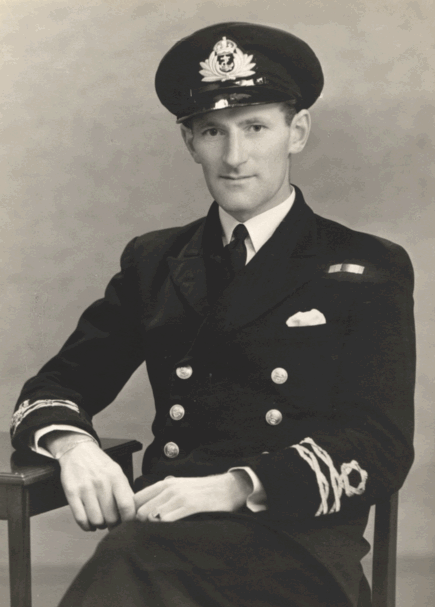 Tom Shaw was the navigating officer of the Infantry Assault ship
HMS Prince Leopold, which had just returned to Gourock following the Vaagso
Raid in Norway. He continues;
"A personal letter from H.M.S. Dryad informed me
that I was being attached to Combined Operations (early 1942) for
navigating duties and would be sent on a special training course, a short
one, in their Pilotage Parties. I thought this was something to do with the
pilotage of vessels but, to my horror, found out that the object of C.O.P.P.
was to land on and survey enemy beaches in advance of any landings.
However well charted these may be, there was always the possibility, that the
beach in question had local obstructions, such as rocks and so on that was
not shown on the ordinary chart. No problem for ordinary navigation but for
landing craft running on to the beach, very important indeed, if they did not
want their bottoms ripped out or severely damaged. In short, a very skilled
and dangerous job and for which I showed no notable enthusiasm! It was all
very well carrying out our training on our own beaches, even these had their
hazards, but no joy on enemy occupied territory, which was mostly heavily
guarded, mined and all carried out in total darkness.
Briefly, each team consisted
of two men, one or both being navigating specialists or experts in other
fields, who were taken close
inshore, usually by submarine. They were dressed like a present day
skin-diver, or frogman, and at the dropping point, paddled to the beach in a folbot and the survey carried out. The folbot
had to be safely secured and the beach covered on foot by walking up and down, probing for any possible
obstructions. All this had to be done quietly and it was not easy to take
notes in the dark, all the while being aware that one may be discovered or
set off a mine. On completion, the folbot was recovered and paddled out to
the pickup position, which in theory meant that the submarine trained an
infra-red signal lamp on a certain bearing. The returning team picked up the
ray, made a similar one in return and got alongside and then on board. All
very well, if both craft knew where each other was and in direct signalling
line with each other but not so hot in practice!
For some strange and unknown reason, Tubby and I were sent
with another team to carry out a survey on what was considered to be a quiet
sector of the French coast. I could have seen the sense in it, if they had
split us up with the more experienced officers but we were to land together
alongside the other craft. The weather and sea conditions were ideal that
night and we had no trouble getting ashore, securing the folbots and
carrying out the survey, also collecting some sand and shingle specimens for
analysis on return. Our return was not quite so smooth, as we lost sight of
our companion craft and, I in front, was not having any luck picking up the
submarine’s signal beam in between bouts of paddling. In short we did not
have a clue as to where anyone was, except Jerry landwards! So much for
accurate navigation.
 We kept paddling on and
spotted our companions just off our bow. A low hail told us they were as
clueless as we were as to our position and were keeping
their fingers crossed. Just then, the whole area was lit up with what
appeared to be a combination of Blackpool illuminations, V.E. and V.J.
polytechnic fireworks! At least it seemed that to me but, in fact, was the
bold boy Tubby, taking advantage of the break in the paddling, endeavouring
to light his pipe! Now a match or even the glow of a cigarette in the
darkness at sea stands out for miles. We kept paddling on and
spotted our companions just off our bow. A low hail told us they were as
clueless as we were as to our position and were keeping
their fingers crossed. Just then, the whole area was lit up with what
appeared to be a combination of Blackpool illuminations, V.E. and V.J.
polytechnic fireworks! At least it seemed that to me but, in fact, was the
bold boy Tubby, taking advantage of the break in the paddling, endeavouring
to light his pipe! Now a match or even the glow of a cigarette in the
darkness at sea stands out for miles.
A
memorial to the Coppists was erected on Hayling
Island and dedicated on September 27, 2012. Visit their website at
www.coppheroes.org for more information.
I expected the whole German Army to
open up on us! However, it had its good uses as the submarine closed on us and
made contact, they having spotted the flare of the match which meant that
they had been keeping a very good look out in the right direction. We got
inboard in no time, had a good stiff drink and off to base. Tubby’s first
words on the way to our quarters after landing was 'have ee got a match,
Tom? Mine be finished!' No comment. A great character. whom I am sorry to
say, died from a heart attack in 1950. "
 Tom Shaw did not do any further operations with COPPS
although he did take part in the Dieppe Raid in August 1942. He was one of
the navigating officers of the Infantry Assault ship HMS Invicta. At the
very last minute, he agreed to replace a landing craft officer who had fallen
sick. Tom landed Canadian soldiers of the South Saskatchewan Regiment on
Pourville Beach (Green Beach). He later made several return landings under
murderous fire to rescue soldiers wounded and trapped on the beach, before
finally being wounded himself by a shell exploding near his landing craft
ramp. Tom Shaw did not do any further operations with COPPS
although he did take part in the Dieppe Raid in August 1942. He was one of
the navigating officers of the Infantry Assault ship HMS Invicta. At the
very last minute, he agreed to replace a landing craft officer who had fallen
sick. Tom landed Canadian soldiers of the South Saskatchewan Regiment on
Pourville Beach (Green Beach). He later made several return landings under
murderous fire to rescue soldiers wounded and trapped on the beach, before
finally being wounded himself by a shell exploding near his landing craft
ramp.
Further Reading
There are around 300 books listed on
our 'Combined Operations Books' page. They, or any
other books you know about, can be purchased on-line from the
Advanced Book Exchange (ABE). Their search banner link, on our 'Books' page, checks the shelves of
thousands of book shops world-wide. Just type in, or copy and paste the
title of your choice, or use the 'keyword' box for book suggestions.
There's no obligation to buy, no registration and no passwords.
www.coppheroes.org
This website contains information on missions,
composition of the COPPs units and biographical details including many
photographs
https://www.coppsurvey.uk/ - A
website under development but already a mine of useful in depth
information.
Survey
by Starlight by Ralph Neville, Hodder &
Sloughton, London, 1949. (Ralph Neville was an alias for Ralph Stanbury, the
commander of COPP Team 5.)
Stealthily by Night by Ian Trenowden, UK.Crecy.1995. 250pp Ills.
Map.
The Secret Invaders by Bill
Strutton and Michael Pearson. Hoddar & Stoughton, 1958. The Secret Invaders
is the story of how the COPPists were
trained and how they carried out the reconnaissance of proposed landing
beaches on enemy occupied territory under the very noses of patrolling
guards.
Correspondence
Lt/Capt Robert James (Bob) Taylor
I'm trying
to track my grandfather's WW2 service since his family know little of what
he did. He only ever said he was in intelligence and that his missions
were top secret. He was an officer in RE and has campaign medals for
France/Germany and also North Africa. We only have vague details that he
was part of a 'recon' team that collected soil samples from the D-Day
beaches prior to Operation Overlord - and that's it!
 I read in
the Times that Major General Logan Scott-Bowden had sadly passed away. His
mission history lead me to read about COPPs, which I now believe my
grandfather served in. The photo opposite shows him second from the
left in the back row. Does anyone recognise the photo, group or
background? It may have nothing to do with COPPs - we simply don't know. I read in
the Times that Major General Logan Scott-Bowden had sadly passed away. His
mission history lead me to read about COPPs, which I now believe my
grandfather served in. The photo opposite shows him second from the
left in the back row. Does anyone recognise the photo, group or
background? It may have nothing to do with COPPs - we simply don't know.
My grandfather was a very outgoing Irish chap. It would help our family greatly
if we knew more about what he did that haunted him so much to his dying day.
Many
thanks,
Simon
Moisy
(LCpl 3 Sqn HAC)
Lieutenant David Brand
This is information on an unlisted coppist, my father, Lieutenant David Brand from
Glasgow, Scotland. He trained at
Hayling Island and served in the Royal
Navy on HMS Nigeria and was in a Combined Operations Pilotage Party
that served in the Middle East. He did not speak about his time during the
war but, as usual, stories leaked out about some of his adventures.
In March 1943, he was part of a 15 man team
doing sea reconnaissance. While on a "Sicily" mission David and Lieutenant
Robert Smith, the expedition leader, surveyed the Gela area on the south
west coast. Due to a storm on completion of their mission, they missed the
rendezvous with their carrier, the Royal Navy submarine P44 United. To avoid
capture, they made an epic 75 mile trip back from Gela to their Malta base
at Valetta in heavy seas and with just one paddle. After 40 hours of
paddling and bailing water every few minutes from their open canoe they
eventually made it back, exhausted. Brand and Smith were awarded the DSC for
their courage but, overall, the operation was not a success. Of the 15 men
that set out, 5 were captured, 5 were lost and only 5 returned to base.
Sadly my father passed away in 1974.
COPP 8 / PO
Gascoigne.
I'm seeking information on
P.O Gascoigne who
served in Copp 8 and also a couple of information sources cited in Ian
Trenowden’s book “Stealthily by Night”. These are Alec Colson’s transcript
of the COPP 8 logbook and his unpublished manuscript about Operation David
(“Double Handle”). In particular I'm interested to know if these documents
are still available to public scrutiny.
Any assistance will be greatly
appreciated
Thank
you in anticipation.
Paul Mille
Commander
Harry Goulding RNR (SSRF & COPP).
My
Grandfather was Commander Harry Goulding RNR assigned to COPPs. He received a DSO with Bar and I
believe he may have been awarded a second bar. He was also a very active
member of SSRF (Small Scale Raiding Force) and may
have been instrumental in setting up this team and being involved in their
operations. We have various documents some marked 'Secret' and 'Most Secret'
and others such as manuals, a newspaper cutting and a 1946 letter to my
father from Laycock. He was a very close friend of Blondi Hassler.
A COPP memorial is being planned for Hayling Island Seafront which has now
passed planning and I am keen to find out more about my grandfather's war
service in these special forces before it is unveiled. If any visitors to
your website have information or can recommend sources of information I'd be
delighted to hear from them.
Many thanks in advance.
Charlie Goulding
Major Jack Crane – COPP 1.
I would like to
hear from anyone who served in Combined Operations Pilotage Parties (COPP),
or from their relatives. My grandfather was Major Jack Crane, Royal
Engineers (277770), who was part of the COPP 1 re-commission that served
in the Far East (Sri Lanka, Burma, India) from November 1944 to September
1945.
I would especially like to hear from anyone related to the other
members of that COPP 1: Lt-Cdr Peter Wild RNVR, Sub-Lt Robin Harbud RNVR,
Sub-Lt Michael Pearson RNVR, Sub-Lt David White, Sergeant E Cook, Petty
Officer EA Fish, Corporal Richey SBS, Sapper Hawkin RE, Leading Seaman
Stewart, Petty Officer A Briggs (P/JX 144952), Leading Stores Assistant FI
Wilkins (P/MX 59960), Lance Corporal RNW Kedge RE (1949872), Able Seaman A
Prior (P/JX 19124).
My grandfather also did a few operations in Burma working within the
COPP 4 re-commission led by Lieutenant DH Mackay.
I would also be interested to hear from anyone who would have been
completing their commando training at around the same time as my
grandfather (around June 1944 to October 1944).
With many thanks in advance.
Rob Crane
Royal Navy Submarine Museum in Gosport, Hampshire.
I am an
ex-submariner and now work part time at the Royal Navy Submarine Museum in
Gosport, Hampshire. I am one of several guides giving tours around a 1947
submarine we have here and answering any questions from our visitors.
At the Museum we have a ' Wall of Remembrance' dedicated to those men who
lost their lives in submarines. We are often asked about the men and the
circumstances of their loss and I'd like to gather information to help us
answer these questions. In particular I'm interested in 5 men who were
aboard HMS Unrivalled between the 4th and 8th March 1943. They
were: Cooper, N.W. Lt RNVR; Burbidge, G.W.
Capt. (Army); Davies, N.E. Lt RN; De Kock, P.D.
Lt SANF and Crossley A.H. Sub Lt SANF.
I am fairly sure that all were COPPists who went ashore on Sicily prior to
the Allied invasion, I have been in touch with South Africa and know about
the two SANF's but understand from my contact there that, in total
there were about eight or ten landed. Some were captured, some shot and
two,
having
missed their pickup submarine, paddled their canoe from Sicily to Malta.
Any information or book references would be greatly appreciated. Many
thanks in anticipation. David Yeomans.
Hayling Island.
I'm chair of a heritage group on Hayling Island
called Discover Hayling charged with raising awareness of our island's
history. We have been going for 3 years and, as I delve deeper into our
past, I'm both fascinated and saddened that locally so little is known of
the COPPs presence here at Hayling Island Sailing Club (HISC). We aim to
remedy that by giving the COPP story on Hayling the prominence it merits.
I'm anxious to speak to any surviving members, or their families, for
information of interest and to create some sort of memorial to the
COPPists on the Hayling seafront. We have had full cooperation from HISC,
but the logistics of their operation precludes a public memorial on the
original site. I would
appreciate your views and help in making contacts.
I have already been fortunate to meet and talk to Logan Scott-Wilmott.
Yours, Robin Walton. [Anyone
with information likely to be of interest to Discover Hayling should
contact Robin on the e-mail link opposite].
10 Copp - Book Publication.
My father George Talbot DSC was in COPP 10 After the war he wrote a
book about his experiences. A copy of the book which is both factual and
amusing about operations such as Anzio, Yugoslavia, Italy and the Greek
Islands has been held in the Imperial War
Museum. As his daughter l am about
to have the book published and would be very interested to hear from any of
the COPP 10 members or their families.
Thank you in anticipation. Jill de Angelis.
Parry Copp.
My father
served in the Royal Navy between 1930 – 37 and 1940 – 45. After serving on
King George V and other ships, he was transferred to Parry COPP on
21/01/44 until end of 1945. Could you tell me what Parry was and what
number COPP it was? I obtained this information from Royal Navy Command
records office. My father’s name was Able Seaman [signaller] William
Charles Marsling NO: JX133969.
Thanking you for your time and
 effort in
advance. I think the web site is pretty brilliant! Steve Marsling [son]
If
you have information please contact Steve on the e-mail link opposite. effort in
advance. I think the web site is pretty brilliant! Steve Marsling [son]
If
you have information please contact Steve on the e-mail link opposite.
|