|
The Small Scale Raiding Force - SSRF.
The Small Scale Raiding Force (SSRF)
was set up during the early 1940s to undertake "pinprick" raids on the coast of Northern France and the
Channel Islands. The raids were designed to gather information and to take
prisoners for interrogation while locally having a demoralising effect on the German
troops. More generally, the unpredictability of the SSRF's operations were designed
to tie up enemy resources that would otherwise
be used on other fronts.
Background
 Following the evacuation of the
Allied Expeditionary Force from Dunkirk in late May early June 1940, there was a
need to create a new battleground until Britain and her allies could return to
the shores of mainland Europe in great numbers. It would take years to equip and train such a
force for a major amphibious landing. Following the evacuation of the
Allied Expeditionary Force from Dunkirk in late May early June 1940, there was a
need to create a new battleground until Britain and her allies could return to
the shores of mainland Europe in great numbers. It would take years to equip and train such a
force for a major amphibious landing.
[Photo; the famous MTB 344 of Beachy Head].
Churchill believed that
in the interim "pinprick" raids against German coastal defences and
installations along the Channel coast of German occupied France would
have a demoralising effect on the enemy forces. The raids would also keep the Germans in a state of nervous vigilance requiring the deployment of purely defensive resources.
One initiative to meet this requirement was the establishment of the Small Scale Raiding Force (SSRF). Operationally it came under Mountbatten, the Chief of Combined Operations (CCO), but control was shared with the Special Operations Executive (SOE).
The SOE was created earlier in 1940
when the tide of war was very much flowing against the British. Popular belief
has it that the SOE was set up following Churchill's famous comment, 'set Europe ablaze,'
but it was Chamberlain who, on the 19th July 1940, put his name to the paper which effectively created
the organisation. The paper declared 'A new organization shall be formed
forthwith to co-ordinate all action, by way of subversion and sabotage, against
the enemy overseas.'
SOE itself regarded this paper as its founding
charter and it gradually established agents in Europe and around the world. They
undertook sabotage and gathered intelligence in liaison with sympathetic foreign
nationals while helping arm and co-ordinate local resistance groups. It was
seriously hazardous work requiring a special breed of men and women. For example ‘F’ section (France) of SOE
is estimated to have lost about 25% of the some 480 agents parachuted into France in the latter part of WWII.
There were many other raiding forces involving Commandos
with naval and air
support in many cases. See the Raids and Landings link on our Index page.
Early Days
In early 1942 the force was founded by Major Gus March-Phillips, DSO, OBE; Major J Geoffrey Appleyard, DSO, MC, and
Captain Graham Hayes, MC.1 They engaged in training the newly formed force at Wareham (Dorset) and later teamed up with Coastal Command's
motor torpedo boats (MTBs).
MTBs were used because they were very fast and relatively quiet when running on
auxiliary engine power only... a combination which minimised detection at sea
and when close to shore.
Success depended on
competence in the use of small boats inshore, particularly the dory - often the
boat of preference. A typical raiding party was around 8 to 10 in
strength, sometimes fewer. The size of the total force is now uncertain but
probably never more than 60
about half of them officers, taken from groups like the Special Boat Service (SBS)
and the SOE itself. The nationals of many countries were recruited... French, Poles, Dutch
and Czechs. Some with German sounding names were given new identities or 'war
names.' Many came from the Pioneer Corps.
In 1941, the
precursor to the SSRF, the ‘Maid Honour Force,’ was under SOE control. It was
named after a Brixham trawler requisitioned by Major Gus March-Phillips. The
trawler was converted for the clandestine transportation of weaponry. Maid Honour
took 30 men to West Africa in August 1941 in an operation, codenamed
‘Postmaster’. They planned to capture a German tanker in harbour on the island
of Fernando Po. The date was January 1942 and although the island was Spanish
territory, therefore officially neutral, the mission went ahead and was
accomplished taking the German tanker and an Italian freighter! The success of
‘Postmaster’ triggered the expansion of the force and its re-designation as the
Small Scale Raiding Force under the Combined Operations Command.
Training
Those selected for SSRF operations were
usually trained in Commando style combat together with aspects of seamanship in
the use of small craft such as Dory's. Some training was undertaken
in the English Lake District but the photo gallery below shows one group on
training exercises on the south coast of England.
[photogallery/photo00027367/real.htm]
Anderson Manor
     Anderson
Manor in Dorset was taken over by the War Dept. during the Second World War as
the headquarters for the Small Scale Raiding Force (SSRF) of 62 Commando. After
the SSRF disbanded in 1943 its wartime role as Station 62 under the Special
Operations Executive (S.O.E.) came to an end. Forty-six years later in 1989 a
service of remembrance was held in the St Michael's Chapel, Anderson attended by
surviving members of the SSRF and family representatives of those who were
killed in action or who had subsequently died. Included in the images above are
details of the ceremony and the Prayer to Combined Operations. Anderson
Manor in Dorset was taken over by the War Dept. during the Second World War as
the headquarters for the Small Scale Raiding Force (SSRF) of 62 Commando. After
the SSRF disbanded in 1943 its wartime role as Station 62 under the Special
Operations Executive (S.O.E.) came to an end. Forty-six years later in 1989 a
service of remembrance was held in the St Michael's Chapel, Anderson attended by
surviving members of the SSRF and family representatives of those who were
killed in action or who had subsequently died. Included in the images above are
details of the ceremony and the Prayer to Combined Operations.
Operation Fahrenheit
No 12 Commando had contributed to a number of SSRF raiding
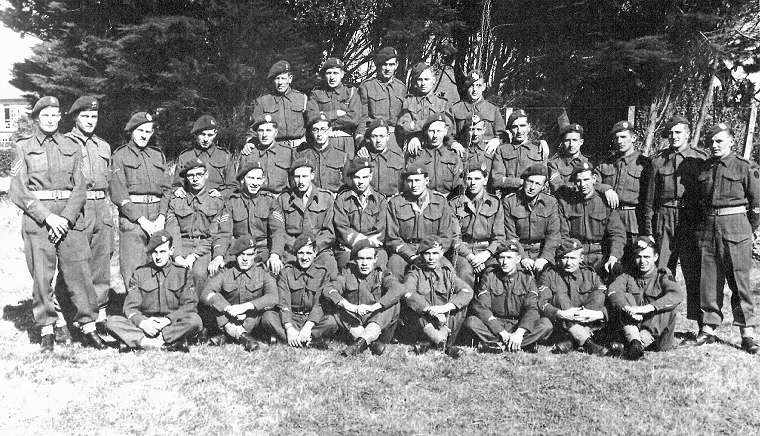
parties. For Operation Fahrenheit it was the turn of Captain O B 'Micky' Rooney
and 6 of his NCOs. The photo shows Captain Rooney
 (seated 2nd row from the front
and 4th from the right) with No 4 Troop at Littlehampton, Sussex. (seated 2nd row from the front
and 4th from the right) with No 4 Troop at Littlehampton, Sussex.
[Front row seated; L/Cpl Rudd, McCreevy, Sime,
Collins Tojo (Gamble), Cpl Crowly (SAS), Cpl Jones (W) and Hay. 2nd Row seated;
Cpl Evans, Sgt McGinty, Lt Peter Cruden (W), Lt Littlejohn (W) MC, Capt Rooney
(broke back),
Lt Clapton MC, Lt Lodwick and Wilson (K) in Normandy. 3rd Row Standing; Sgt Page
(W) L/Cpl Wilmerst, Self (W) ??, Walsh, Byjorklund, Skidmore, Lamb, L/Cpl
McClelland, L/Cpl Connor, Ames, Cpl Burns, Heraty (W), Leach and Boddy. Back Row
elevated; Lynch, Eager, Towse (W), Sgt Boldon and Bolton (W).
Key; W = wounded; K = Killed. In the case of Capt
Rooney he broke his back in August 1944 when his parachute became entangled with
electricity power lines near Metz in northern France. A jeep also hit the lines
and blew up so, with the Germans alerted to their presence, he had little choice
but to release himself from his parachute and drop to the ground].
Peter Kemp, Brian Reynolds and Sergeant Nicholson trained them
for the raid. Kemp found Rooney to be "a powerfully built, self confident
officer" and that apart from pistol shooting and movement at night "he and his
men knew more about the business than I.
The objective of the raid was to capture German servicemen for
interrogation by attacking a signals station at Pointe de Plouezec on the north
Brittany coast. On the night of the 11/12 November 1942 they departed Dartmouth
in MTB 344 under the command of Kemp and correctly identified their target. On
reaching the cliff tops they found the area heavily mined. Rooney and one of his
men checked out the station and a nearby pillbox. The former was protected by
wire and sentries and the latter was unoccupied. The cable from the pillbox was
cut.
Only a frontal assault was possible so, split into 3, they made
their way to within 10 paces of the wire. The sentries could be heard in
conversation. Rooney unscrewed the top of his No 6 grenade which was heard by
the sentries. One gave out a sharp exclamation and drew back the bolt of his
rifle. A blinding flash and tremendous explosion followed immediately. Both
sentries were finished off with Tommy gun fire and Rooney's party moved forward
past an empty guard house to await the emergence of the station's occupants. The
first two were shot but when the others returned fire it was decided to withdraw
before reinforcements arrived. In a larger fire fight it would be difficult to
evacuate any casualties back down the cliff to the beach. The party successfully
re-embarked and returned to Dartmouth.
 Chris Rooney, Captain Rooney's son states "I understand this group,
called "Rooney Force" for the task ahead, were to raid the U boat pens at Brest but
it was called off. I can't put a name to the raid and there seems to be no
official record. I also understand that if a group were trained for a job of
this type they were permitted to design their own badge. The example
opposite was sent to my father in the 1980s by Peter Cruden (third from the
left, 2nd row, seated in the photo above). There may also have been a badge
for Fynn Force." The status of these badges is unknown. If anyone can
shed any light on the subject please let us know using the Contact Us link in
the page banner above. Chris Rooney, Captain Rooney's son states "I understand this group,
called "Rooney Force" for the task ahead, were to raid the U boat pens at Brest but
it was called off. I can't put a name to the raid and there seems to be no
official record. I also understand that if a group were trained for a job of
this type they were permitted to design their own badge. The example
opposite was sent to my father in the 1980s by Peter Cruden (third from the
left, 2nd row, seated in the photo above). There may also have been a badge
for Fynn Force." The status of these badges is unknown. If anyone can
shed any light on the subject please let us know using the Contact Us link in
the page banner above.
Chris Rooney subsequently wrote in Feb
2026 " Some of my father's papers, which recently came to my
attention, shed light on the photo opposite. It pertains to the raid
on the U Boat pens at Lorient and the 'Rooney Force' badge, not
Operation Fahrenheit.
I have never been able to trace
this raid on the pens, as it appears it was never given an
official name.
I enclose
the attachments which clear up the mistake, and also produce
some other interesting information.
  
Freddie Bourne (Courtesy Clay Maxwell
of the LST Club's "Bow Doors" Magazine).
Freddie Bourne served in Motor Torpedo Boats (MTBs) with Britain's Coastal Command Forces during WW2 attacking
German convoys and warships and ferrying commandos to occupied France and the Channel Islands. It is the latter role that is of special interest
to Combined Operations.
Bourne was based at HMS Gosport when he became involved in Coastal Forces. A chance meeting with Lt Roger Thornycroft, of the well known shipbuilding
family, resulted in his association with their small high speed vessels. Experimental types were built in 1942 and numbered 344, 345 and 346. No.
344 was 60 ft long and the other two 45 ft long. All were twin-screwed and powered by Thornycroft petrol engines of 1200 BHP giving a speed of up
to 40 knots. For action against shipping they were armed with two 18" torpedoes.
At this time Bourne was a lieutenant waiting for his first command
which came in the form of MTB 344. The Navy made her available to the SSRF and this began Bourne's involvement with the organisation.
They christened her "The Little Pisser" because of her high power compared
with the motor launches the Navy had offered earlier. For the clandestine missions the MTBs engaged in they
normally sailed at dusk. When they were close to their objective the main engines were cut and the approach made on the auxiliary
engine.
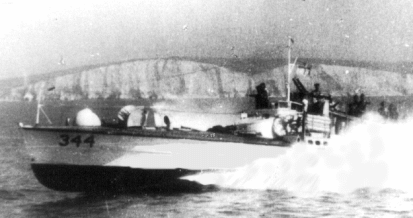 Because of
her relatively small size MTB 344 was difficult to detect by radar. Her armaments comprised two Vickers machine guns either side of the bridge and Lewis guns
aft
of the crew's quarters. Apart from Bourne she had a crew of seven. On the night of September 2/3 1942 MTB 344 was anchored off the Casquets
lighthouse, seven miles west of Alderney, which was being used by the Germans as a radio listening post. Bourne lowered an 18 ft dory from the boat
which then carried 8 raiders to the rocks beneath the lighthouse. When they returned later they had the enemy's code books and seven prisoners - the lighthouse
keepers, radio operators and guards. Because of
her relatively small size MTB 344 was difficult to detect by radar. Her armaments comprised two Vickers machine guns either side of the bridge and Lewis guns
aft
of the crew's quarters. Apart from Bourne she had a crew of seven. On the night of September 2/3 1942 MTB 344 was anchored off the Casquets
lighthouse, seven miles west of Alderney, which was being used by the Germans as a radio listening post. Bourne lowered an 18 ft dory from the boat
which then carried 8 raiders to the rocks beneath the lighthouse. When they returned later they had the enemy's code books and seven prisoners - the lighthouse
keepers, radio operators and guards.
Later that month MTB 344 took part in
Operation Aquatint when raiders landed on a beach in the Baie de la Seine near Cherbourg. On this occasion the raiding party was ambushed by a German patrol
and all
the Commandos were killed. Some were shot in the water as they attempted to swim back to the boat and one of the MTB's engines was put out of
action by a German bullet. Bourne had to flee on half power.
 His next operation was to occupied Sark in the Channel Islands. This raid was to have very
serious, unforeseen consequences for all future 'special forces' operations in enemy held territory. The raiding party landed successfully, evaded a German
patrol and broke into a house belonging to a Mrs
Pittard. She
provided invaluable intelligence including the whereabouts of the enemy garrison - an annex of the Dixcart Hotel. The Commandos killed the guard
posted outside the building and stormed in.
The five soldiers billeted there were taken prisoner but, as they were being escorted to the beach, they began to struggle and scream for help. Unable
to quickly pacify them, and fearful of being discovered, the prisoners were shot regrettably still with their hands tied. As a result Hitler
ordered that any British Commandos captured armed or unarmed, in or out of uniform, should be executed with no exceptions. (See
Glomfjord for information on the first use of
Hitler's
Commando Order). His next operation was to occupied Sark in the Channel Islands. This raid was to have very
serious, unforeseen consequences for all future 'special forces' operations in enemy held territory. The raiding party landed successfully, evaded a German
patrol and broke into a house belonging to a Mrs
Pittard. She
provided invaluable intelligence including the whereabouts of the enemy garrison - an annex of the Dixcart Hotel. The Commandos killed the guard
posted outside the building and stormed in.
The five soldiers billeted there were taken prisoner but, as they were being escorted to the beach, they began to struggle and scream for help. Unable
to quickly pacify them, and fearful of being discovered, the prisoners were shot regrettably still with their hands tied. As a result Hitler
ordered that any British Commandos captured armed or unarmed, in or out of uniform, should be executed with no exceptions. (See
Glomfjord for information on the first use of
Hitler's
Commando Order).
However, a very different account was told to an
American Newspaper in 1945 by Major O B Rooney. He said "We were raiding the
Channel Islands. Our mission was to get prisoners for information. This time we
couldn't find any prisoners . We decided to ask a friendly lady we knew where
the nearest German garrison was. She told us. We found them in bed.
There were six of us and eight of them so we tied
their hands with string and marched them out. One of them, becoming sufficiently
awake to guess they were in the hands of the enemy, tried to escape. One of
our men hit him with his revolver and it went off. He was killed."
In all Bourne and his crew in MTB 344 took part in 17 raids off the north coast of France
and the Channel Islands. He left 344 in May 1943 on appointment to Flotilla 11 at Felixstowe. In January 1943 the SSRF raids were coordinated by
an Auxiliary Operations Group and independent raids in the English Channel ceased. SSRF was later disbanded and for his part in their operations Bourne was awarded the DSC.
Graham Hayes MC
  On the night of 12/13 September 1942, a Goatly,
which was a canvas sided wooden bottomed collapsible
boat, 17ft 6ins (5+m) long with a beam of 4ft 6ins, weighing 2 cwt that could be assembled by two men in 1.5 minutes, dropped Graham Hayes with 9 men at St Honorine
des Pertes near the Cherbourg Peninsula. On the night of 12/13 September 1942, a Goatly,
which was a canvas sided wooden bottomed collapsible
boat, 17ft 6ins (5+m) long with a beam of 4ft 6ins, weighing 2 cwt that could be assembled by two men in 1.5 minutes, dropped Graham Hayes with 9 men at St Honorine
des Pertes near the Cherbourg Peninsula.
 Geoff Appleyard remained in the MTB having sustained a leg injury on an earlier raid. He heard the landing
party ambush a German patrol only to hear them ambushed by a larger German force. Gus March-Phillips and three of his men were killed as
they returned to their boat on the beach. The flimsy canvas sided boat sank leaving Hayes to swim along the shore. Geoff Appleyard remained in the MTB having sustained a leg injury on an earlier raid. He heard the landing
party ambush a German patrol only to hear them ambushed by a larger German force. Gus March-Phillips and three of his men were killed as
they returned to their boat on the beach. The flimsy canvas sided boat sank leaving Hayes to swim along the shore.
 He eventually reached neutral
Spain with the help of several Frenchmen (French Resistance?) but was handed over to the Gestapo by the local Spanish police.
(See Malcolm Hayes' e-mail for an alternative
scenario and book recommendation.) In the summer of
1943 Graham Hayes was executed (shot) in a Paris prison proving the extreme danger to special forces personnel if caught even in a neutral country.
(See Hitler's infamous Commando Order). (Photo; Circa 1938/39 courtesy of his nephew Malcolm Hayes.) He eventually reached neutral
Spain with the help of several Frenchmen (French Resistance?) but was handed over to the Gestapo by the local Spanish police.
(See Malcolm Hayes' e-mail for an alternative
scenario and book recommendation.) In the summer of
1943 Graham Hayes was executed (shot) in a Paris prison proving the extreme danger to special forces personnel if caught even in a neutral country.
(See Hitler's infamous Commando Order). (Photo; Circa 1938/39 courtesy of his nephew Malcolm Hayes.)
Malcolm Hayes continues "One bit of information
about Capt Graham Hayes is that before the War he went to Mariehamn in Finland
and signed onto the Windjamer 'Pommern'. On this, he sailed round the world via
Cape Horn and Australia. This experience of the sea stood him in good stead for
sailing the Brixham Trawler 'Maid Honore' to the island of Fernando Po, in the
gulf of Guinea, West Africa. Codenamed Operation 'Postmaster', for which he was
awarded the MC. I attach photos taken by Graham on the Windjamer 'Pommern'.
The Pommern still exists and is a Museum Ship in Finland."
Other Actions
(not a complete list).
Feb 1942 Anse
de St Martin, Cherbourg Peninsula - 2 men in a canoe to
reconnoitre the area.
Feb 1942 Omonville
- 10 man raid to capture German prisoners for interrogation.
Feb 1942 Herm
& Jethou, Channel Islands - 10 man raid.
Summer 1942 Pointe
de Saire - 3 enemy killed.
3/4 Oct 1942 Operation Basalt - Sark.
(See Correspondence below).
Dec 1943 Operation Hardtack 7 - Sark.
(See Correspondence below).
Further Reading
There are around 300 books listed on our 'Combined Operations Books' page which can be
purchased on-line from the Advanced Book Exchange (ABE) whose search banner
checks the shelves of thousands of book shops world-wide. Type in or copy and
paste the title of your choice or use the 'keyword' box for book suggestions.
There's no obligation to buy, no registration and no passwords. Click
'Books' for more information.
On this website see
Operation Aquatint
Correspondence
OPERATION HARDTACK 7 - SARK
The Night of the 25th/
26th and 27th/28th December
1943
Photos of the event here;
Operation Hardtack 7cx
 A
series of Commando Raids were planned under the code name
HARDTACK in late 1943 and were numbered from 1 to 36.
The operations were conducted by men
of
No. 10
(Inter-Allied) Commando,
No. 12
Commando and the
Special
Boat Service (SBS), and took place on the
Channel
islands and the northern coast of
France
in December 1943. Most of the raids consisted of ten men of
various ranks, carried by
Motor
Torpedo/Gun Boats (MTB/MGB) and
dories,
except for one operation, which was an airborne landing. The
raids were ended by order of
Major
General
Robert
Laycock because they caused the enemy to bring up
reinforcements, which could have been detrimental to the
Allies'
strategy for D-Day. In the Channel Islands, raids were planned
against Jersey, Herm and Sark. The Herm raid was cancelled in
the planning stage, but the raids on Sark and Jersey went ahead
and both were planned for the night of 25/26 December with the
aims of reconnaissance and capture of prisoners – the Jersey
raid landed safely at Petit Port, climbing the cliff, they
failed to locate a German soldier. On returning to the beach, a
mine was set off seriously injuring a Captain Ayton who was
taken to the beach and returned to England where he died of his
wounds. Like the Jersey raid the Sark raid used men from No. 1
(French) Troop of 10 Commando, 12 Commando and the SBS. A
series of Commando Raids were planned under the code name
HARDTACK in late 1943 and were numbered from 1 to 36.
The operations were conducted by men
of
No. 10
(Inter-Allied) Commando,
No. 12
Commando and the
Special
Boat Service (SBS), and took place on the
Channel
islands and the northern coast of
France
in December 1943. Most of the raids consisted of ten men of
various ranks, carried by
Motor
Torpedo/Gun Boats (MTB/MGB) and
dories,
except for one operation, which was an airborne landing. The
raids were ended by order of
Major
General
Robert
Laycock because they caused the enemy to bring up
reinforcements, which could have been detrimental to the
Allies'
strategy for D-Day. In the Channel Islands, raids were planned
against Jersey, Herm and Sark. The Herm raid was cancelled in
the planning stage, but the raids on Sark and Jersey went ahead
and both were planned for the night of 25/26 December with the
aims of reconnaissance and capture of prisoners – the Jersey
raid landed safely at Petit Port, climbing the cliff, they
failed to locate a German soldier. On returning to the beach, a
mine was set off seriously injuring a Captain Ayton who was
taken to the beach and returned to England where he died of his
wounds. Like the Jersey raid the Sark raid used men from No. 1
(French) Troop of 10 Commando, 12 Commando and the SBS.
Sark 25/26 December 1943.
Operation Hardtack 7.
The raid on
this night failed to achieve its objectives when the Commandos
were unable to scale the cliff having landed by Dorey from MGB
(ML) 292 on Derrible Point at about 23.15. The Raid was
commanded by an officer from 12 Commando, 10 men from No1 Troop
and 2 men of the SBS, as follows:
Lt Ambrose
McGonigal
* 12
Commando, Sergeant
Pierre-Charles Boccador * (Translator), 10
Commando, Sergeant Paul
Briat (Radio Operator) 10
Commando, Local
Sergeant Andre Dignac
* 10 Commando, Corporal
Robert Bellamy * 10 Commando, Corporal
Pierre Vinat (Medical Orderly) 10
Commando,
Lance/Corporal Yves Quentric 10 Commando, Private
Marius Pizzichini 10 Commando, Private
Jacque
Gay 10 Commando, Matelot
Joseph Nicot
* 10
Commando, Matelot
Maurice Le Floch * 10 Commando, Captain
David Smee * (Dorey Skipper) SBS and Corporal xx
Right * (Dorey Engineer) SBS.
Of the above
men not all went ashore, as the Dorey capacity was 8. Men marked
with * were in the Dorey the remainder stayed on the MGB.
Dignac
(Nicknamed ‘Tarzan’ for his climbing ability) led the climb but
was unable to make the final ascent and at 02.15 gave up the
attempt. Back on the Dorey, McGonigal and Boccador decide to
survey the beach of Derrible Bay and the cliff of the Hog’s
Back, they encountered and brought back a mine. They returned to
the MGB at 04.10 and headed back to Dartmouth. On arrival they
are given permission to try again and planned another raid for
the 27/28 December.
Sark 27/28 December 1943.
Operation Hardtack 7.
MGB (ML) 322
(Took part in the Jersey raid) was their boat for the raid and
left Dartmouth at 16.00. This time the Commandos landed from
Dixcart Bay onto the Hog’s Back at 22.20 and the same men go
ashore again, with Dignac leading the climb and paying out a
rope for the others to use. The rudimentary map they used marked
a minefield and they moved forward carefully but suddenly a mine
exploded and Bellamy is killed almost instantly, the same
explosion also badly wounds Dignac who dies as he is being
injected with morphine by Boccador. More mines are set off as
they escape from the minefield and Le Flock is wounded in the
chest but can walk, as can the wounded Nicot and McGonigal.
Boccador is unwounded and is the one that helps all the others
to the rope and down the cliff. They are on board the Dorey by
02.30 and on the MGB by 03.00 when they set off for Dartmouth,
with Vinat treating the wounded on the journey, on arrival the
wounded are immediately taken to hospital.
The German
report on the raid to Commander Northwest France and made on the
29th December said:
On the
28th between midnight and 2.45 am the raiding patrol against the
Isle of Sark started. The base garrison located in the middle of
the island reported 5 explosions at 1.10 am. At the crack of
dawn 2 soldiers in English uniforms have been found on the
minefield above the steep coast near Dixcart Valley, one was
recognised as French, one was already dead and the other one
moribund. Landing took place at the same spot like in
04/10/1942, supposedly in a small vehicle. Force of command is
unknown. Injuries found originate from small mine pieces.
According to the traces of blood found on coastal rocks more
wounded or dead soldiers are expected. Weapons and armament have
been left behind, among them was a radiotelephone.
Dignac and
Bellamy were buried in the Sark cemetery on the 30th
December. It is said that the Dame of Sark demanded to know the
names of the men for the Death Register of the island.
No. 10 (Inter-Allied) Commando
Troops for
this Commando were made up from various countries and each Troop
in the Commando was formed up of Nationals from each country, as
follows: No. 1 Troop
(French), No. 2 Troop (Dutch), No. 3 Troop
(British)*, No. 4 Troop ((Belgian), No. 5 Troop
(Norwegian), No. 6 Troop (Polish), No. 7 Troop
(Yugoslavian) and No. 8 Troo (French)
* This Troop
was made up of mainly German (Jewish) Nationals that had come to
Britain as refugees from Nazi Germany, but this did not show in
their title. Each man was given a British name and documents to
support that name. Being German speaking, they were often used
behind enemy lines and as interrogators to gain intelligence.
The graves of those killed in action were marked with the normal
cross, but those were later replaced by the Jewish symbol, the
Star of David.
75TH ANNIVERSARY OF COMMANDO RAID ON SARK - 3RD
OCTOBER 2017
Operation Basalt - Commando Raid on Sark - 3/4 October
1942
 Dear Geoff, Dear Geoff,
The first event was the unveiling of a
Commemorative Stone on the Hog’s Back, with the unveiling taking
place at 3 pm on the afternoon of Tuesday the 3rd
October, in the presence of over 70 persons from Sark and further
afield.
[Photo by Sue Daly shows: Mr John Hunt, Standard
Bearer for the Sark Branch RBL; Maj Christopher Beaumont, Seigneur
of Sark and President of the Sark Branch RBL; Mr John Appleyard and
Lt Col Reg Guille MBE dressed in his old style Commando Denison
Smock and Green Beret, Chairman of the Sark Branch RBL].
The stone carries two plaques, the
main plaque commemorates the Commandos and Mrs Frances Pittard, who
assisted them, the other plaque gives the names of the three German
soldiers killed in the raid and the soldier captured and taken back
to England as a Prisoner of War.
The unveiling
ceremony commenced with a welcome address by the Seigneur of Sark,
Major Christopher Beaumont, (also the President of the Sark Branch
of the Royal British legion). The unveiling party, who removed a
Union Flag draped around the stone, were Mr John Appleyard
(half-brother to Major Geoffrey Appleyard who planned and led the
raid and who did not survive the war) and Lieutenant Colonel Reg
Guille MBE, Chairman of the Sark Branch and late Army Commando. When
the stone had been unveiled John Appleyard, made a moving and
emotive speech in reply to the address of the Seigneur. After the
speech people were invited to move forward and view the
commemorative stone and its plaques, with many photographs being
taken. Various radio and TV interviews were then carried out and
people slowly drifted away back to their hotels or homes. The
ceremony was blessed with perfect weather conditions, with Jersey in
the distance giving a perfect back-drop to the commemorative stone.
 The
second event was a Presentation on the raid by Mr Eric Lee, author
of the book “Operation Basalt - British Raid on Sark and Hitler’s
Commando Order”, at 7pm at Stocks Hotel. The evening commenced with
a welcome address from Reg Guille, who also introduced the speaker.
After the very interesting talk by Eric, a panel was then formed to
take and answer questions – the panel members were Eric Lee, John
Appleyard and Mr Chris Oliver (Local Historian from Guernsey). The
panel were introduced by Reg Guille. There followed thirty minutes
of questions and answers on the raid and the personalities who took
part in that raid. The panel were roundly applauded for their
efforts. This was followed by a sumptuous buffet laid on by the
hotel, the centre piece being a very large cake made by Mrs Helen
Plummer in the shape of the Hog’s Back, Dixcart Bay, Dixcart Valley,
Jaspellerie Headland and which also depicted Dixcart Hotel,
Jaspellerie House and Petit Dixcart House. The 60 plus audience then
left, much later, to walk home under Sark’s Dark Skies. The
second event was a Presentation on the raid by Mr Eric Lee, author
of the book “Operation Basalt - British Raid on Sark and Hitler’s
Commando Order”, at 7pm at Stocks Hotel. The evening commenced with
a welcome address from Reg Guille, who also introduced the speaker.
After the very interesting talk by Eric, a panel was then formed to
take and answer questions – the panel members were Eric Lee, John
Appleyard and Mr Chris Oliver (Local Historian from Guernsey). The
panel were introduced by Reg Guille. There followed thirty minutes
of questions and answers on the raid and the personalities who took
part in that raid. The panel were roundly applauded for their
efforts. This was followed by a sumptuous buffet laid on by the
hotel, the centre piece being a very large cake made by Mrs Helen
Plummer in the shape of the Hog’s Back, Dixcart Bay, Dixcart Valley,
Jaspellerie Headland and which also depicted Dixcart Hotel,
Jaspellerie House and Petit Dixcart House. The 60 plus audience then
left, much later, to walk home under Sark’s Dark Skies.
The third and
final event, also blessed by fine weather, took place on Wednesday
the 4th October with a battlefield walk ‘In the Footsteps
of the Commandos’. The walk was led by Major Marco Ciotti (late RLC)
(ADC to His Excellency The Lieutenant Governor of Guernsey), ably
assisted by Ms Jan Guy and Mrs Jenny Hopkins. The 50 plus walkers
gathered at the Visitor Centre before walking to the Hog’s Back,
where Marco introduced the personalities and background to the raid
before leading the walk along the route taken by the Commandos -
along the spine of the Hog’s Back, past Le Petit Dixcart House where
they stopped for a briefing, then to La Jaspellerie House for a
further stop and longer briefing, before moving on to view the
‘Casino Oak’ (planted a few years ago in memory of Major Geoffrey
Appleyard with an acorn brought back from Casino by Marco Ciotti,
where Geoffrey is remembered on the memorial to the men with no know
grave in the
 Commonwealth War Grave Cemetery at Casino). The walk
then went on to Dixcart Hotel (closed) where the German soldiers
were captured and the crux of the events of that evening 75 years
ago took place and which led to the deaths of the three German
soldiers and the taking of a prisoner, before the Commandos beat a
hasty retreat to their MTB (nicknamed The Little Pisser) and made a
successful return to Portland, as daylight broke on the morning of
the 4th October 1942. The walk lasted some three hours
and most then repaired to Stocks Hotel, just a few yards away, for
refreshments. Commonwealth War Grave Cemetery at Casino). The walk
then went on to Dixcart Hotel (closed) where the German soldiers
were captured and the crux of the events of that evening 75 years
ago took place and which led to the deaths of the three German
soldiers and the taking of a prisoner, before the Commandos beat a
hasty retreat to their MTB (nicknamed The Little Pisser) and made a
successful return to Portland, as daylight broke on the morning of
the 4th October 1942. The walk lasted some three hours
and most then repaired to Stocks Hotel, just a few yards away, for
refreshments.
Sark was pleased
to welcome many members of the Appleyard family, including Nieces
and Nephews and their spouses who live in Guernsey (the Woods family
who ran Herm for many years) and members of the Bramley War Memorial
Trust, Bramley being where the Appleyard family lived.
Unfortunately, descendants of other Commandos who took part in the
raid were unable to attend due to commitments elsewhere.
Sark was to be
raided once more on the 27th/28th December
1943, during Operation Hardtack 7, which was a disaster for the
Commandos with two of the party killed by mines. However, the Sark
Branch are already planning a commemorative event to mark the raid
on its 75th Anniversary, the 27th/28th
December 2018.
More information
on the OP Basalt raid can be found in the book by Eric Lee
“Operation Basalt - British Raid on Sark and Hitler’s Commando
Order” printed by The History Press
www.thehistorypress.co.uk
and “Geoffrey – Being the Story of
‘Apple’ of the Commandos and Special Air Service Regiment” printed
by Whitehead & Miller Ltd; copies may be obtained from email:
bramleywm@aol.com
Yours
sincerely,
Reg (Lt Col
(Retired) RJ Guille MBE)
Chairman, Op
Basalt Group (07/11/17)
Small Scale Raiding Force.
I have been commissioned to write the full
history of Gus March-Phillipps’ Small Scale Raiding force from its origins
as Maid Honor force
in 1940, though Operation Postmaster to
its evolution into 2 SAS in early 1943.
I am most anxious
to trace the next of kin of Major Gus March-Phillipps DSO, MBE and Major
Geoffrey Appleyard DSO, MC and bar, MA and to make contact with any
surviving members of that original raiding force, cover-name No
62 Commando.
Many thanks
Dr Tom Keene
Foot note. Tom's
book on SOE and Operation Frankton –
the Cockleshell Heroes – entitled Cloak
of Enemies is being
published in August 2012 by History Press with a foreword by Lord Paddy
Ashdown.
Dear Geoff,
After reading the book ¨If I must Die¨, the fate of my Uncle, Graham Hayes,
as described on your website may not be correct in stating that he was handed to the Germans by the the Guardia Civil
in Spain after arriving there.
According to this very well researched book, written by two Frenchmen, Graham
was intercepted in Paris by a French double agent called Ortet. He accompanied Graham on his journey
to Spain. If they did reach Spain it was only to try to cover this agent's
tracks by putting the blame on the Spanish, before he handed Graham to the
Germans.
The proof that Graham was double crossed is
contained in letters he wrote for Ortet to give to the French Resistance which
he handed over to the Abwehr. Andre Heintz and Gerard Fournier, the authors of
the book, must have the documents that tell the full story.
The double Agent was known as "Armand", but his
full name was Jean-Louis Ortet. He was found dead in a pond on the 1st September
1943, by whose hand is not known. Another curious twist to the story.
I recommend this book to anyone interested in the subject.
Very Best Wishes,
Malcolm P Hayes.
I was directed to your excellent website by Bert Markham who
served in the SSRF. He was a crew member on MTB 344 and later of MTB 494. During
the night of the 6th of April 1945 he was onboard 494 during an engagement with
German S-Boats. 494 was rammed and sunk by S-176. My cousin, Gus Holland, was
also a member of the crew of 494 on that night and sadly perished after the
engagement.
According to all the accounts of this engagement, including a
report by the German Skipper of S-176, there were only two survivors from 494.
However, it now transpires that Bert Markham was a third survivor! Bert and my
cousin Gus survived the collision with S-176 and sat on the upturned keel of 494
along with the boat's radar rating. Nearby was 493 which was immobilized and
with its forward section completely destroyed. The crew continued to fire their
Lewis gun at the other attacking S-Boats.
The crew of 493 saw Bert, my cousin Gus and the radar rating
clinging to the keel of 494. Since 493 was immobilised, Bert swam to its stern
and was pulled onboard while Gus swam to the badly damaged forward section. Bert
saw Gus clinging to the shattered remains of the forecastle and urged him to
swim to the stern but before he could do so he lost his grip and floated away.
The radar rating never made it to 493. The next day Bert saw the bodies of Gus,
the radar rating and the boat's Mid Shipman being brought ashore.
Lest we Forget.
Acknowledgments
Unless otherwise stated all photos and images courtesy of Capt O. B. "Mickey"
Rooney's family.
Footnotes
1. All three were killed
in action while serving with SSRF or other special forces units.
|