|
Combined Operations
Badge - Specimens.
There are around 75 images of Combined Operations
badges on this page, over 40 of which are from the the war years. The remainder,
post war
examples, come from around the world from both military and civilian
sources. Lt D A Grant,
the designer of the badge,
could not have imagined that it would spread and endure over the decades, to the present day.
Most images will enlarge.
[Disclaimer. The information below is, to the best
of our knowledge, correct. However, since it comes from many different sources
and has not been validated by experts, this website accepts no responsibility
for any loss or damage arising from the use of this information. It's provided
for the interest of general public to illustrate the ubiquitous nature of the
badge design].
Also of possible interest are;
History of Insignia,
Insignia in Use &
Lt D A Grant.
World War 2

1 Unknown tombstone shaped badge, yellow on black.
.........................
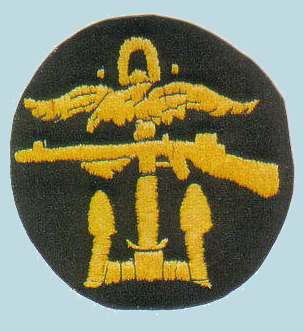
 2
This circular yellow embroidered wartime 'economy' Combined Ops badge
is on dark blue felt. The 'Royal Navy' white embroidered
title on dark blue
felt battledress was worn above the Combined Operations sign. Yellow silk
thread was authorised as an
economy, instead of gold wire during WW2. 2
This circular yellow embroidered wartime 'economy' Combined Ops badge
is on dark blue felt. The 'Royal Navy' white embroidered
title on dark blue
felt battledress was worn above the Combined Operations sign. Yellow silk
thread was authorised as an
economy, instead of gold wire during WW2.
.........................
 3 This
embroidered Army badge, yellow on dark blue, was worn beneath the shoulder
title 3 Contingent OG. More information here
http://www.insigne.org/OSS-3OG.htm See also 22 below 3 This
embroidered Army badge, yellow on dark blue, was worn beneath the shoulder
title 3 Contingent OG. More information here
http://www.insigne.org/OSS-3OG.htm See also 22 below
..........................
 4 A variation of 3
above with gold wire embroidered on
black felt. 4 A variation of 3
above with gold wire embroidered on
black felt.
.........................

5 This is a Royal Navy badge - blue on white felt. It is a
printed item and was used on white uniforms. See No 32 below.
.........................
 6 This is a locally made variation of the
Combined Operations badge on felt worn below a 'British Pacific Fleet'
shoulder title silver wired on the same material. 6 This is a locally made variation of the
Combined Operations badge on felt worn below a 'British Pacific Fleet'
shoulder title silver wired on the same material.
.........................
 7
This tombstone, red on black Army badge is a variation of the standard Combined Operations
badge worn during WW2. They were issued in pairs and worn on the
right arm. 7
This tombstone, red on black Army badge is a variation of the standard Combined Operations
badge worn during WW2. They were issued in pairs and worn on the
right arm.
.........................
 8 This is a variation of No 7 but possibly worn by Commandos in the early
period after their formation in the early 1940s. Worn on left arm. 8 This is a variation of No 7 but possibly worn by Commandos in the early
period after their formation in the early 1940s. Worn on left arm.
.........................
 9 This
circular badge was worn by a No 9 Commando guard of honour when part of No 2
Commando Brigade HQ in the Mediterranean Theatre in 1945. The No 9
Commando title was red lettering on dark blue above the Combined
Operations badge which was the original red embroidered on a dark blue
circle. 9 This
circular badge was worn by a No 9 Commando guard of honour when part of No 2
Commando Brigade HQ in the Mediterranean Theatre in 1945. The No 9
Commando title was red lettering on dark blue above the Combined
Operations badge which was the original red embroidered on a dark blue
circle.
.........................
 10 This
square badge was worn by Commando units. 10 This
square badge was worn by Commando units.
.........................


11. Matching pair of
circular badges, red on black. When worn on both arms, the guns and eagles
always pointed forwards, symbolically towards the enemy.
.........................
12 Spare.
.........................

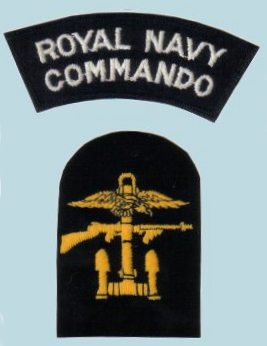
13 A Royal Navy yellow on dark blue Combined Operations badge which was
worn below a white embroidered Royal Navy Commando title on dark blue.
Click here and scroll down to
'Miscellaneous' for news of the shoulder title in 2014.
[Terry Carney writes; I believe these shoulder titles are post WWII
and came in to use much later than the wartime R.N. Commando shoulder
titles. The No 13 badges were possibly worn by Commando trained
Royal Navy Surgeons. When I was researching the Royal Navy /
Commando title I could never find any proof of it being worn with
the C.O. Badge. If the person who supplied the illustrations (or
anyone else) has any proof that these two items were worn together,
including photographic evidence, if any, I'd be pleased to
receive a copy].
.........................
 14
Similar to 13 above but may have been worn in the immediate post war
period. 14
Similar to 13 above but may have been worn in the immediate post war
period.
.........................
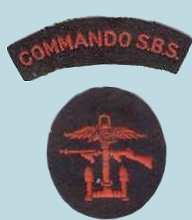
 15 The SBS (Special Boat Service) was, by the nature of their dangerous and
clandestine operations often behind enemy lines, a secretive
organisation. Even to this day precise details of their activities are
hard to come by. [Provided by Tom Colville whose late
father was in the SBS]. 15 The SBS (Special Boat Service) was, by the nature of their dangerous and
clandestine operations often behind enemy lines, a secretive
organisation. Even to this day precise details of their activities are
hard to come by. [Provided by Tom Colville whose late
father was in the SBS].
.........................
 16
Circular red on black or dark blue. Unknown variant. 16
Circular red on black or dark blue. Unknown variant.
.........................
_small.jpg)
 17 This badge is unique amongst the specimens
on this page in that it uses 3 different colours in the design and is in the
form of a shield.
The veteran concerned
was a stoker, likely on landing craft and he also manned guns as the need arose.
He was stationed at Gibraltar and Sicily for 4 yrs. The badge may be a locally
produced, unofficial badge. The photo of the badge on the right was received in
2019. It suggests the badges may have been worn as a facing pair on each sleeve
with the guns pointing forward. If further information comes to light, we'll up-date this information. 17 This badge is unique amongst the specimens
on this page in that it uses 3 different colours in the design and is in the
form of a shield.
The veteran concerned
was a stoker, likely on landing craft and he also manned guns as the need arose.
He was stationed at Gibraltar and Sicily for 4 yrs. The badge may be a locally
produced, unofficial badge. The photo of the badge on the right was received in
2019. It suggests the badges may have been worn as a facing pair on each sleeve
with the guns pointing forward. If further information comes to light, we'll up-date this information.
........................
 
18 Unknown CO badge. Merchant Navy? Unofficial?
Decanter Label? More definitive information will be posted if/when received.
.........................
 19
This particular badge saw
"active service" off the Normandy beaches on the arm of a Royal Canadian Air Force
Leading Air Craftsman on board the radar and communications vessel Fighter Direction Tender 217. 19
This particular badge saw
"active service" off the Normandy beaches on the arm of a Royal Canadian Air Force
Leading Air Craftsman on board the radar and communications vessel Fighter Direction Tender 217.
.........................
 20 USA variant of the British badge. An article on the American Army
Engineering Amphibian Units mentions that the shoulder patch worn by
members was approved on June 17th 1942. This patch, embroidered in
yellow on a light blue background, was worn at the top of the left arm
only. 20 USA variant of the British badge. An article on the American Army
Engineering Amphibian Units mentions that the shoulder patch worn by
members was approved on June 17th 1942. This patch, embroidered in
yellow on a light blue background, was worn at the top of the left arm
only.
.........................
 21 USA variant of the British badge. The American Naval Amphibious forces
shoulder insignia is embroidered on a scarlet background of the same
colour as the scarlet chevrons of a rating badge. The badge was approved
by the Secretary of the Navy in BUPERS Circ LTR-44 on June 15th 1944. It
was worn at the top of the left arm only. The authorisation to wear the
insignia terminated with the individuals detachment from the Amphibious
Forces. 21 USA variant of the British badge. The American Naval Amphibious forces
shoulder insignia is embroidered on a scarlet background of the same
colour as the scarlet chevrons of a rating badge. The badge was approved
by the Secretary of the Navy in BUPERS Circ LTR-44 on June 15th 1944. It
was worn at the top of the left arm only. The authorisation to wear the
insignia terminated with the individuals detachment from the Amphibious
Forces.
.........................
 22 A badge worn by some, if not all, of the 125 Jogoslav speaking Americans
of 3 Contingent US Operational Group (USOG) under 22 A badge worn by some, if not all, of the 125 Jogoslav speaking Americans
of 3 Contingent US Operational Group (USOG) under Land Forces Adriatic (LFA)
command. This was a locally manufactured version of the British Combined
Operations formation sign. It was accompanied by a matching shoulder
title embroidered yellow on black. This insignia was very short-lived
since 3 Contingent, USOG, became Company C 2671, Special Reconnaissance
Battalion in August 1944. Land Forces Adriatic (LFA)
command. This was a locally manufactured version of the British Combined
Operations formation sign. It was accompanied by a matching shoulder
title embroidered yellow on black. This insignia was very short-lived
since 3 Contingent, USOG, became Company C 2671, Special Reconnaissance
Battalion in August 1944.
.........................
 23 A facing pair of hand made WW2 Combined Ops badges.
There is a little moth damage to one of them. [Photo and information from Colin Allmark,
USA]. 23 A facing pair of hand made WW2 Combined Ops badges.
There is a little moth damage to one of them. [Photo and information from Colin Allmark,
USA].
.........................
 24 This USA Combined Operations patch is similar to No 21 above but this
time it was worn by Albert Casani of the US 326th
Glider Infantry. 24 This USA Combined Operations patch is similar to No 21 above but this
time it was worn by Albert Casani of the US 326th
Glider Infantry.
........................
[No 25 spare].
.........................
 26 An
original American version. I thought it was faded but behind the
backing it was the same colour. Photo and information
courtesy of Colin Allmark, USA. Terry Carney, who has researched the
history of the Combined Operations badge states that
this is a British made badge and was the first of
three attempts to produce badges for the Americans. When worn on the
left arm of the American uniforms, the Eagle faced in the wrong
direction. The second attempt reversed the Tommy Gun. These were
then returned to the manufacturer and the wings were extended. The
Combined Operations Head Quarters received a report in 1943 that a
Combined Operations Badge, embroidered in yellow on blue, believed to
be the one worn by the Americans, was on sale in any number of shops
in London. Terry Carney. To see
Terry Carney's fascinating account of the history of the Combined
Operations badge click here]. 26 An
original American version. I thought it was faded but behind the
backing it was the same colour. Photo and information
courtesy of Colin Allmark, USA. Terry Carney, who has researched the
history of the Combined Operations badge states that
this is a British made badge and was the first of
three attempts to produce badges for the Americans. When worn on the
left arm of the American uniforms, the Eagle faced in the wrong
direction. The second attempt reversed the Tommy Gun. These were
then returned to the manufacturer and the wings were extended. The
Combined Operations Head Quarters received a report in 1943 that a
Combined Operations Badge, embroidered in yellow on blue, believed to
be the one worn by the Americans, was on sale in any number of shops
in London. Terry Carney. To see
Terry Carney's fascinating account of the history of the Combined
Operations badge click here].
.........................

27 Gold thread anchor, gold wire thread Tommy
gun with brass cast eagle secured by folding pins on black cloth. This
is the third one I have seen now so its not a "one off " made by an
individual but probably part of a production run. Is this an official issue? If you know anything about this
patch please contact us. Photo and information
courtesy of Michael Whittaker.
 Terry
Carney, who has researched the history of the Combined Operations
badge explains that,
during
WW2, printed Combined Operations badges were issued and were the
official badges. All embroidered Combined Operations badges during
this period were considered unofficial. However, it is known that
embroidered badges were worn extensively and were available from
Military Tailors shops. I do have one of the badges shown as
specimen No. 27. It is of a different construction than any
other C.O. Badge I have come across. The Anchor is embroidered in
yellow Terry
Carney, who has researched the history of the Combined Operations
badge explains that,
during
WW2, printed Combined Operations badges were issued and were the
official badges. All embroidered Combined Operations badges during
this period were considered unofficial. However, it is known that
embroidered badges were worn extensively and were available from
Military Tailors shops. I do have one of the badges shown as
specimen No. 27. It is of a different construction than any
other C.O. Badge I have come across. The Anchor is embroidered in
yellow
 threads
and highlighted in gold wire and the Tommy gun is embroidered in
gold wire. The Eagle has never been embroidered on this badge and in
its place a brass Eagle with two brass wires for fixing has been
used. It's possible that this type of brass eagle was originally
made for RAF officers' Service Dress cap badges and is the reason
the Eagle is facing in the opposite direction or possibly for the
Royal Navy Fleet Air Arm officers. I believe that these badges were
possibly made for a Royal Navy Fleet Air Arm Unit which operated
under the Combined Operations Command. Does any reader know of such
a unit? See the photographs of my badge with the Eagle removed
to show how it was made. Yours sincerely Terry Carney. threads
and highlighted in gold wire and the Tommy gun is embroidered in
gold wire. The Eagle has never been embroidered on this badge and in
its place a brass Eagle with two brass wires for fixing has been
used. It's possible that this type of brass eagle was originally
made for RAF officers' Service Dress cap badges and is the reason
the Eagle is facing in the opposite direction or possibly for the
Royal Navy Fleet Air Arm officers. I believe that these badges were
possibly made for a Royal Navy Fleet Air Arm Unit which operated
under the Combined Operations Command. Does any reader know of such
a unit? See the photographs of my badge with the Eagle removed
to show how it was made. Yours sincerely Terry Carney.
.........................

28 Locally made example of the Combined
Operations patch believed produced in Yugoslavia 1943 - 45. Photo and information courtesy of Michael Whittaker.
.........................
 29 Gold wire on black as worn on the British naval square rig top (No.1
or no.2 dress?) This particular patch was worn by a member of the
Combined Ops Bombardment Units who was parachuted in with the airborne
units the night before D-Day. Photo and information courtesy of Michael Whittaker. 29 Gold wire on black as worn on the British naval square rig top (No.1
or no.2 dress?) This particular patch was worn by a member of the
Combined Ops Bombardment Units who was parachuted in with the airborne
units the night before D-Day. Photo and information courtesy of Michael Whittaker.
.........................
 30 It
was not unknown for badges to be made locally in remote locations
overseas. The history of this rather crude hand-made example is unknown
but most likely falls into that category. Photo courtesy of
Michael Whittaker. 30 It
was not unknown for badges to be made locally in remote locations
overseas. The history of this rather crude hand-made example is unknown
but most likely falls into that category. Photo courtesy of
Michael Whittaker.
.........................
 31
Circular, embroidered in red onto blue cloth then stitched around a cardboard template. Photo courtesy of Michael Whittaker. 31
Circular, embroidered in red onto blue cloth then stitched around a cardboard template. Photo courtesy of Michael Whittaker.
.........................
 32 An official issue example, blue design on white cloth as worn by
Royal Navy service personnel. See No 5 above. Photo courtesy of Michael Whittaker. 32 An official issue example, blue design on white cloth as worn by
Royal Navy service personnel. See No 5 above. Photo courtesy of Michael Whittaker.
.........................
  33 This badge, together with the Stars and Stripes of the USA (displayed
under no 34), was worn by RAF Servicing Commando Unit 3201 when part of
Operation Torch near Algiers in North Africa. The American flag (about 3
inches by 5 inches) was worn by British forces to appease the French.
The Combined Ops badge is about 2 and a half inches in diameter. For
more information about Operation Torch
click here. 33 This badge, together with the Stars and Stripes of the USA (displayed
under no 34), was worn by RAF Servicing Commando Unit 3201 when part of
Operation Torch near Algiers in North Africa. The American flag (about 3
inches by 5 inches) was worn by British forces to appease the French.
The Combined Ops badge is about 2 and a half inches in diameter. For
more information about Operation Torch
click here.
.........................
No 34 unused.
.........................
 35 Unknown Naval Badge, likely local and
unofficial. An information or suggestions? Please
contact us. 35 Unknown Naval Badge, likely local and
unofficial. An information or suggestions? Please
contact us.
.........................
 36 Printed on cloth rather than
embroidered, this badge is believed to have been worn by a WW2 RAF
servicemen. It is approx 2 5/8" in diameter. Photo and information from John
McIntosh. 36 Printed on cloth rather than
embroidered, this badge is believed to have been worn by a WW2 RAF
servicemen. It is approx 2 5/8" in diameter. Photo and information from John
McIntosh.
.........................
   37,
38 & 39 These three badges show stages in the British attempts to produce
badges for the Americans. When 37 was worn on the left arm the Eagle and
Tommy gun faced in the wrong direction. The second (38) attempt reversed
both. These variants were returned to the manufacturer and the wings were
extended as in 39. Combined Operations Head Quarters received a report
in 1943 that the combined Operations Badge embroidered in yellow on blue,
believed to be that worn by the Americans, was on sale in any number of
shops in London. [Terry Carney]. 37,
38 & 39 These three badges show stages in the British attempts to produce
badges for the Americans. When 37 was worn on the left arm the Eagle and
Tommy gun faced in the wrong direction. The second (38) attempt reversed
both. These variants were returned to the manufacturer and the wings were
extended as in 39. Combined Operations Head Quarters received a report
in 1943 that the combined Operations Badge embroidered in yellow on blue,
believed to be that worn by the Americans, was on sale in any number of
shops in London. [Terry Carney].
.........................

40 Embroidered version of the
American badge obtained from a well known American collector who
informed me that this badge had been manufactured in Germany. Terry Carney,
.........................

41 Gold coloured wire version of the American badge. Terry Carney.
.........................

42 Amphibious Force - US
Atlantic Fleet. Tom Bryan.
.........................
Post WW2
and Modern Combined Operations Badges

1 The Combined Operations device comprised of the
anchor, tommy gun and eagle was used by Canadian forces during WW2. In 1998
use of the device was revived with the development of a Canadian amphibious
warfare establishment badge by Naval Lieutenant Karl Gagnon, a noted
military heraldry designer, of a design by Major R.D. Bradfiord, the
Canadian Armed Forces' amphibious warfare officer. This insignia remains in
the approval process and is still in use.
.........................

2 In 2005, the basic device was adopted as an
expedient, temporary logo for the new Standing Contingency
Task Force (SCTF), a rapid-response, seaborne, sea-based tri-Service
formation. It was intended that this be superseded by a new badge, but the
retention of the Combined Operations device for the specialist amphibious
elements was intended.
.........................

3 In 2006, the officer commanding the Amphibious Reconnaissance &
Clearance Squadron, Lieutenant-Commander D. Hopkie, arranged for the
acquisition and issue of temporary badges for the Maritime Amphibious
Unit (MAU) a new unit comprised of reconnaissance, clearance, landing
craft and naval beach party elements. This patch entered service
unofficially in 2006 and remained in use until the unexpected
disbandment of the new force and the Maritime Amphibious Unit in 2007.
.........................
_small.jpg)
4 This badge is a desert-coloured version
of badge 10. It could very well have been worn by helicopter crewman
serving in Iraq, or anyone else who had served with the UK JFACHQ as
cadre staff or by attachment prior to the adoption of the new badge (No
8) in the latter half of 2005. Information
provided by
Neale
Dewar. [Images provided by
Glynn Roberts a member of the Military Heraldry Society].
.........................
 5 As for 40 above. 5 As for 40 above.
........................

6 Commander, United Kingdom Amphibious Forces. May be worn by Royal
Marines and possibly other forces. Any information about this badge would be very
welcome.
Neale Dewar further explains,
"This is simply a subdued version of badge 9, to be worn on DPM rather
than used on letterhead. (See
Contact Us at the bottom of this page). [Images provided by Glynn Roberts a
member of the Military Heraldry Society].
.........................

7 Badge used by the United Kingdom Permanent Joint Headquarters, known as
PJHQ, based in Northwood. It is UK's senior operation military
command, responsible for all the joint contingency operations outside
UK's shores. The staff of the HQ have a strong affinity with their
Combined Operations forbears and wear the same badge with pride. [Image
provided by Glynn Roberts, a member of the Military Heraldry Society and
the information provided by John McIntosh].
.........................

8 UK JFAC(HQ) badge introduced on 1 Apr 2006 in its triangular format in
order to differentiate it from the JTFHQ and other force elements, who
had adopted the Combined Arms centre elements and a green outer/base
replacing only the text, hence all looking remarkably similar. It replaced the circular
badge numbered 25 above. (AK). Neale
Dewar further explains; "Badge 8
was introduced to stop confusion with the JTFHQ or other CO-based
badges. (At any distance the script on the green border was impossible
to discern.) The triangular shape recalls the colour patch of the WW1
Australian Flying Corps (without the CO badge!), with colours charged to
be more indicative of the RAF, which provides the vast majority of
JFACHQ staff."
.........................
 9 The Commander United Kingdom Amphibious Forces (COMUKAMPHIBFOR) is the
very high readiness deployable 2 Royal Marines HQ embedded within the
Fleet Battlestaffs. COMUKAMPHIBFOR is a permanently constituted 2 HQ
held at very high readiness to command joint and combined operations at
the operational level. It is commanded by a Royal Marine Major General,
and located in the Fleet Battlestaff buildings on Whale Island in
Portsmouth. Commander United Kingdom Maritime Forces (COMUKMARFOR),
commanded by a Royal Navy Rear Admiral, is co-located. Collectively
COMUKMARFOR, COMUKAMPHIBFOR, COMATG, COMUKTG and HQ 3 Cdo Bde RM
comprise the "Fleet Battlestaffs". (9/06) 9 The Commander United Kingdom Amphibious Forces (COMUKAMPHIBFOR) is the
very high readiness deployable 2 Royal Marines HQ embedded within the
Fleet Battlestaffs. COMUKAMPHIBFOR is a permanently constituted 2 HQ
held at very high readiness to command joint and combined operations at
the operational level. It is commanded by a Royal Marine Major General,
and located in the Fleet Battlestaff buildings on Whale Island in
Portsmouth. Commander United Kingdom Maritime Forces (COMUKMARFOR),
commanded by a Royal Navy Rear Admiral, is co-located. Collectively
COMUKMARFOR, COMUKAMPHIBFOR, COMATG, COMUKTG and HQ 3 Cdo Bde RM
comprise the "Fleet Battlestaffs". (9/06)
.........................

10 This shoulder patch is currently (May 05) used by the UK Joint Force Air
Component Headquarters, based at High Wycombe. The JFACHQ was formed in Apr
2000, adopting a variation of the Combined Operations badge as already used
by the deployable Joint Force Headquarters at Northwood. Since formation,
the JFACHQ has deployed on operations including PALLISER (Sierra Leone),
ORACLE/VERITAS (Afghanistan) and TELIC (Iraq). A new patch, more
recognisable as unique from the JFHQ, is under development however, although
it will retain the Combined Operations badge as its centrepiece. See 33
below. [N.D]
.........................

11 This modern badge was for the Commodore
Amphibious Warfare. The title was changed on December 1 1997 to Commodore
Amphibious Task Group (COMATG) in recognition of the growing importance of
amphibious warfare. The group comprises several assault and Royal
Fleet Auxiliary vessels.
.........................

12 The recent commissioning of HMNZS CANTERBURY
(LSL-421) has allowed us to use the Combined Operations symbol as the
basis of the ship's unofficial badge (as opposed to official crest) and
as a headmark for the development of a future ad hoc capability. In
addition, in recognition for the ship’s mission, the motto is
Kotahitanga which means
Unity. [HMNZS
Canterbury on U-Tube].
.........................

13 Logo of the United Kingdom Permanent Joint Headquarters, known as
PJHQ, based in Northwood. It is the UK's senior operation military
command, responsible for all the joint contingency operations outside UK
shores. For more information click on the link. See also No 43.
.........................

14 Buckle of a Joint Operations stable belt, showing the three single service colours and a buckle with the Combined Ops badge. This particular belt pre-dates PJHQ
(see 43 above) since I
received mine when working in the JHQ, High Wycombe, established for the
1990 - 91 Gulf War. [Image and information provided by John McIntosh].
.........................

15 The 1990/91 Gulf War Medal showing the
Combined Ops badge with an SA80 rifle replacing the Thompson sub-machine
gun. The colours at the edge of the medal ribbon, bordering the desert
yellow, are those of the three Services. [Image and information
provided by John McIntosh].
.........................

16 Belt buckle from the Senior Non Commissioned Officer in Charge of HF / TX
HMS Bushrincon J.C.U.F.I (Joint Communications Unit
Falkland Islands Dec 88 - Apr 89. [Photo and information courtesy of Michael
Whittaker].
.........................

17 LST
and Landing Craft Association. The Association was founded in 1987 by
Shipmate W J (Bill) Chalk. It had the aim of promoting and maintaining
fellowship between members of a similar service background. It also served
to give moral support to members in case of need and to provide financial
assistance to less fortunate members, as funds allowed. It closed down in
2011, although some local branches continued to operate independently for a
few years.
.........................
_small.gif)
18 UK Forces in
Afghanistan (2011). The next deployment of UK forces in Afghanistan is due to take place in
April 2011. The UK’s current framework Brigade in Helmand, 16 Air Assault
Brigade, will be replaced by 3 Commando Brigade. The badges at 18 and 19
will be worn by the Theatre Logistic Group and the Joint Force Support HQ. [Image courtesy of Si Soley].
(12/10)
.........................

19 UK forces in Afghanistan.
The UK’s current framework Brigade in Helmand, 16 Air Assault
Brigade, will be replaced by 3 Commando Brigade in 2011. The badges at 18 and 19
will be worn by the Theatre Logistic Group and the Joint Force Support HQ. [Image courtesy of Si Soley]. (12/10)
.........................

20
United States Army 1st Engineer Brigade shoulder insignia.
According to The Institute of Heraldry
The insignia was re-designated for the 1st Engineer Brigade and amended to
update the description and add a symbolism on 20 July 2007. The scanned patch is the ACU (Army Combat Uniform) variation, but the
traditional gold on a blue background is worn on dress uniforms. There is
possibly an ACU variation with a black border also.
My father was a member of the 348th Engineer Combat
Battalion, 5th Engineer Special Brigade and in April 1944, while training
near Swansea, Wales, received their amphibian patches and painted the front
of their helmets with the amphibian assigned personnel insignia underneath a
white arc. [Tom Bryan, Nebraska,
USA].
.........................

21 USA Naval Amphibious Forces Base, Little Creek, Norfolk,
Virginia. Dept of Defense Police shoulder patch. The DoD Police are civilian
military base staff. [Image courtesy of Terry Carney].
.........................

22 ditto
.........................

23 Canadian Amphibious Warfare tactical patch,
adopted in 2009 for wear by Amphibious Warfare staff officers/NCOs and
members of amphibious augmentation teams assigned to field operations.
The purpose is to increase the visibility of amphibious warfare personnel in
joint formations and units during amphibious operations.
[Major R.D. Bradford, Canada].
.........................

24 Joint Forward Air Control Training and Standards Unit (JFACTSU).
This version of the badge is worn on their uniform.
When
Close Air Support (CAS) is called upon it's vital that aircrew can
communicate directly with the ground force. The man calling the shots is
known as the Forward Air Controller (FAC) who is skilled in directing
combat aircraft to the precise co-ordinates of troublesome enemy positions. [Image courtesy of Craig Flewitt]. Nov 2012.
.........................

25 JFACTSU official unit insignia. See 24 above. [Image courtesy
of Craig Flewitt]. Nov 2012.
.........................

26 Battle Group B, 1st Pulk Specjalny Komandosow (PSK),
Polish Special Forces, International Security Assistance Forces in
Afghanistan. [Courtesy of Tom Bryan].
.........................

27 1st Engineer Brigade, US Army
(Colored Version) Except for the modern construction techniques and
materials, essentially the same as the WWII version. [Courtesy of Tom
Bryan].
.........................

28 Amphibious Force, U.S. Atlantic Fleet.
[Courtesy of Tom Bryan].
.........................

29 Joint Forces Command (JFC) ‘Combined
Operations’ gold on black formation flash
"standard"
version. For use on MTP (Multi
Terrain Pattern) clothing. The flash
utilises the WWII Combined Operations design and measures 60mm x 60mm.
Generally for use in a tactical environment such as HQ and barracks. [Images
and badges provided by Tolley Badges at
www.tolleybadges.co.uk]
.........................

30 JFC ‘Combined Operations’ "subdued" formation
version
of 29 above.
This version complements MTP
camouflage and therefore befits the tactical environment on specific
occasions or operational deployments out of the HQ / barracks environment.
.........................

31 I am currently (2005) serving with 6 Assault Sqn RM onboard HMS
Albion as an LCU Mk10 Cox'n and although we do not officially wear
the insignia the ship does. We wear it on t-shirts, rugby shirts, rugby
club tie etc. We are very proud to carry on the traditions of the
Combined Ops ethos into the 21st century. [Photo and
information provided by Sgt Tom Clow RM].
.........................

32
The first Greek Commando Units insignia, post WWII.
The insignia was
designed in 1947 by the Greek Army General Staff Sub-directorate of Raiding
Forces, based on the similar insignia of British Commando Units, during
WWII. The
overall design was in the shape of a shield with the submachine gun, anchor
and paratrooper wings representing the three types of raiding operations by
land, sea and air. It was black, with dark red background.
.........................
The badge
was worn by all ranks within the Greek Commando units, together with the
shoulder titles "ΔΥΝΑΜΕΙΣ ΚΑΤΑΔΡΟΜΩΝ" (Raiding Forces) of the same colour,
positioned at the top of the left sleeve of all khaki uniforms. The insignia
was in use from 1947 during which these Commando units were organised, until
the Spring of 1949. [Information
received with thanks from Lt General N Lazaris (Ret)].
.........................

33 This Canadian design was created in
consultation with the Dieppe Veterans and Prisoner of War Association to
recognise those who participated in the Dieppe Raid on August 19 1942... to
be worn on a blue blazer.
.........................

34 Pictured is
a Challenge Coin, made around 2007, for presentation by the 1st
Engineer Brigade currently located at Fort Leonard Wood, Missouri, USA.
Challenge coins are used within the modern-day military ranks, but their use is
highly prevalent in many arenas. Members of the US Armed Forces have a
long-standing tradition of carrying such coins that symbolize unit identity and
brotherhood. [Courtesy of Tom Bryan].
.........................
Further Reading
There are around 300 books listed on
our 'Combined Operations Books' page. They, or any
other books you know about, can be purchased on-line from the
Advanced Book Exchange (ABE). Their search banner link, on our 'Books' page, checks the shelves of
thousands of book shops world-wide. Just type in, or copy and paste the
title of your choice, or use the 'keyword' box for book suggestions.
There's no obligation to buy, no registration and no passwords.
On this website read about the
design and development
of the Combined Operations Insignia,
Insignia in Use and a short biography of the
badge's designer, Lt D A Grant.
Correspondence
Photos of British Army and Royal Marine Cloth Badges in use on Uniforms.
I am completing a book which tells the story of the many cloth badges worn on
battledress, khaki drill and jungle green uniforms by the British Army and Royal
Marines between 1939 and 1967. I'm looking for original clear photos of such
badges being worn - especially from the period 1946 to 1947. If possible I
would like to borrow original photos which will be scanned and returned by Royal
Mail Special Delivery within a few days. I am happy to pay any postage incurred.
Scans at 600 dpi are fine for
 my
purpose if you would prefer not to send originals. If you can help please
contact me on the e-mail link opposite. Many thanks in anticipation. Jon Mills. my
purpose if you would prefer not to send originals. If you can help please
contact me on the e-mail link opposite. Many thanks in anticipation. Jon Mills.
Royal
Naval Commando Uniforms. I've just joined Combinedops by
Paypal and
already I have some questions which you might be able to help me with. All are
about Royal Naval Commando uniforms. Firstly were green berets worn by ranks and
ratings and if so what sort of cap badge was worn by other ranks? Secondly, did
Royal Naval Commandos wear the yellow thread tombstone Combined Operations
insignia on their battledress or was it for dress uniform? For those
Commandos trained as parachutists, were the wings worn above or below the
combined operations insignia on the right arm?... and finally what colours of lanyards did each Naval Commando wear as I believe each
"letter" wore a different colour.
Many
thanks for any help you can give. Simon Moore.

I enjoyed reading your web site and I found
the design of the insignia very interesting. The combined Operations insignia
bears a striking similarity to the Chinese character (Opposite), which means
coincidentally, to strike, attack, or hit. I wonder if the designer of
the insignia, and the ancient Chinese who designed that ideograph, went thru
similar thought process when looking for a symbol to represent strike or attack,
and came up with similar designs. Bo (1/06)
I believe that Combined Ops flashes were round and not square [this
changed in the 1970's] - certainly in 148 Commando Forward Observation Battery.
This was the only regular unit of the British Army to wear the combined ops
flashes until the more recent exponential integration of different arms. I
recently saw a 'Crab Air' officer in the Gulf theatre wearing them!
BENZENIA@telefonica.net (12/03)
The RN cap tally below, and a similar "COMBINED
OPS" one may have been approved by the naval authorities or were they
unofficial? Either way does anyone know if they were worn?


Acknowledgments
We are especially indebted to The Military
Heraldry Society for most of the images of WW2 Combined Operations cloth
insignia which are displayed on this page. The Society is a gathering of
collections of cloth formation signs i.e. shoulder & sleeve insignia, shoulder
titles, regimental and unit flashes and similar items. [These images should not
be used to validate the authenticity of any specimens that may come into your
hands].
|






.jpg)


.jpg)


.gif)