|
Combined Operations Badge Design & Development.
The inspired design endures around the world
 The
designer of the Combined Ops badge, Lt D A Grant, could not have
known his design would spread around the world or that it would endure to the present day. The
designer of the Combined Ops badge, Lt D A Grant, could not have
known his design would spread around the world or that it would endure to the present day.
Mountbatten's 'Design' Challenge
On
13 Jan 42, Lord Louis
Mountbatten, Chief of the Combined Operations Command,
requested designs ideas for a badge to represent the
Command. It was an open competition and from
the many designs received, one of several submitted by
Lt D A Grant, RNVR, of HMS Tormentor,
a landing craft
training base in the south of England, was of
particular interest.
In his submission,
Lt Grant provided a number of symbols that might be
used to represent each of the three services.
The symbols where: Navy - fouled anchor, naval crown, ship or landing craft;
Military - crossed sabres, daggers and guns, tanks or Tommy guns; Air Force -
Eagle, Aircraft silhouette or propellers.
Design Developments in Graphics
 1
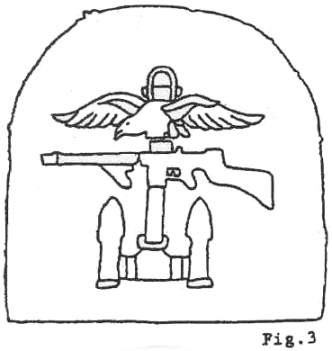
The original design for the badge submitted by Lt
D A Grant,
RNVR. The bird had the appearance of a seagull
and
was later changed to an eagle.
The Tommy Gun also faced in the opposite direction
to that used on the final approved design. 1
The original design for the badge submitted by Lt
D A Grant,
RNVR. The bird had the appearance of a seagull
and
was later changed to an eagle.
The Tommy Gun also faced in the opposite direction
to that used on the final approved design.
 2
The gold bullion
version as worn within the Royal Navy. Wartime
economy versions exist with the design worked in
yellow threads on navy blue cloth. 2
The gold bullion
version as worn within the Royal Navy. Wartime
economy versions exist with the design worked in
yellow threads on navy blue cloth.
3 The Embroidered
red on navy blue 'tombstone' version.
4 The circular red
on navy blue badge.

5 The light blue on
white embroidered 'tombstone' version worn in the
Royal Navy.
 6 The printed
ordnance issue red on navy
blue 'tombstone'
version, referred to in the text as '291A'. 6 The printed
ordnance issue red on navy
blue 'tombstone'
version, referred to in the text as '291A'.
 7
The light
blue on white printed
version on a square
background, referred to in the
text as '292B'. 7
The light
blue on white printed
version on a square
background, referred to in the
text as '292B'.
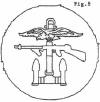
8 The red on navy blue printed circular version referred to
in the text as 291A.
Diary of
Major Events
19 Feb 42 designs
were approved.
30 Mar42
A letter was
sent to Mr Bradley of the Ministry of Works and
Buildings, Lambeth Bridge House, Albert Embankment,
London, SE1, who at this stage had
been given the task of making the alterations to the original design. Extract
from this letter:
Dear Mr. Bradley,
Lord Louis Mountbatten
is very pleased with your design for the Combined
Operations Badge, marked 'B'. Would you please have
two cop1es of this done, as early as practicable, in red and blue. I
will then have them photographed.
22 Apr 42
Proposals were put forward for
wearing the
CombinedOperations Badge.
24 Apr 42
Sample
badges were embroidered. It was
also suggested at this time that the only way the manufacturers would be able to
produce the required number
of badges within a reasonable time
was by having the badges printed, which were
considered to be indistinguishable from the
embroidered version at a distance of about ten feet.
29 Apr 42
The
badge, as described by Lord Mountbatten, consisted of a "Tommy"
gun, an eagle and a stockless anchor,
representing the Army, the Royal Air Force and the
Royal Navy.
12 Jun 42
Badges were in the process of
being manufactured.
16 Jun 42
Letter from Captain J
N Knox,
RN with a request for alterations to the
design of the badge: 1) that
the bird should resemble an eagle and not a seagull and 2) the
Tommy gun should face the opposite way, if not too
late.
23 Jun 42
An extract, reproduced below, from
a letter in answer to these
suggestions. The letter was addressed to Captain
J. N. Knox, R.N., Combined Operations Liaison
Officer, C/O British Joint Staff Mission, Washington,
DC, USA.
As regards the Combined Operations Badge, I always
intended that the bird should be an eagle and I think it is shocking bad
work on the part of the artist that has made it look
like a seagull, I will arrange, if it
is not too late, to get the bird to look more like an
eagle and send you a copy. I also agree to changing around
the Tommy gun if it is not too late.
Mountbatten had approved the original design and although the badges were
being printed, he agreed to the alterations. [Fig.1 is
drawn from a tracing made from a black & white photograph
of the original design held in these records at the PRO.]
24 Jun 42
Combined Operations
Headquarters received a letter of this date
from the War Office, Hobart House,
Grosvenor Place, London, SWI requesting two specimens
of the Combined Operations Badge. It vas also pointed
out that under authority of Army Council Instruction (A.C.I.) No 2587 of 1941
they were required to obtain two badges from each
formation.
4 Jul 42
Authority has now been granted for the
issue of the Combined Operations Badge.
10 Jul 42
New design for the Combined
Operations Badge received.
11 Jul 42
Captain Knox was sent three copies of
the new design, with a letter from Lord Louis Mountbatten, in which he
mentioned: Would you please make sure that the
Americans concerned are given this new design which I hope will please them.
27 Jul 42
The first order of Combined
Operations Badges for the Royal Navy, including stocks of each of the three pattern numbers given to the badge: 291A
(produced in pairs)
red on blue,
292A (single badge) red on blue, 292B (single
badge) blue on white, 291A similar
to number 292A but produced in pairs, for
wear by those naval personnel attached to Combined
Operations organisations who wear
battledress. 5,000
pairs. 292A for
wear on the blue jumper 1.5 inches above the right
cuff, 100,000 items. 292B
for wear on the white uniform, 50,000 items.
Men entitled to wear these badges were to be issued with two pair 291A, two
badges 292A or two badges 292B.
Replacements available 2 pence
a pair obtainable from HMS Quebec. Purchase of
these badges other than from official sources is
prohibited.
24 Aug 42
A letter to Dwight D
Eisenhower, Commander-in-Chief United States Army, European
Theatre of Operations, 20 Grosvenor Square,
London, WI.
I enclose a specimen of the Combined Operations Badge
which it is proposed should be worn by all British, U.S. and Allied Other Ranks connected
with Combined Operations.
Would you like me to send you a supply of badges similar to this
specimen so that they can be worn by the Ranger Battalions on the left shoulder? If so, would you be good enough to let me
know how many you require. You may remember General
Marshall gave approval for the Rangers and any
personnel specially trained in Beach Party or
assault signal work at "Dundonald"
to wear this badge.
(signed)
Louis Mountbatten.
2 Sep 42
Americans
applied for supplies of Combined Operations Badges.
19 Sep 42
In a letter from America it was reported that United States Army
Officers are now wearing their own version of
the Combined Operations Badge, which is very similar to ours.
These were being worn by members of the Engineer Amphibian Corps.
[Mountbatten was concerned about the word 'similar'
again pointing out that it was intended that the same
badge be worn by all connected with Combined Operations].
These badges were produced with the American Eagle
replacing the original, embroidered in yellow on light blue backing. It was also
reported about this time that the
US Navy intended having their own version
of the Combined Operations Badge,
asking Mountbatten not to press
them into having the
same colour as those
introduced by the American Army.
The United State Navy Amphibious Forces badge was the same
pattern, this time embroidered on a red backing.
8 Feb 43
It was reported that some members of the Royal Navy were arriving at the
Combined Training Centre wearing what were considered unofficial badges,
embroidered in gold or yellow. In fact it was intended that naval personnel were
required to satisfactorily complete one months Combined Operations Training
before being issued with the badge.
Some of these badges were mentioned in a
catalogue belonging to J & J Edwards Ltd, 99/100 High Street, Lowestoft.
Gold wire Combined Operations Badge 11/6d,
gold spun silk 2/6d and red silk 1/8d. Gold spun silk and red silk can be
supplied by return post. Owing to the large number of badges being ordered
in gold no more orders can be taken until the following month.
8 Feb 43
Extract. from a letter.
I understand
that the CCO recently gave permission to the ATS employed at Dundonald to
wear the Combined Operations badge when he was approached by the senior ATS
officer present. The ATS at Castle Toward hearing this have also put up the badge. The ATS personnel serving with Special Service Brigade are also wearing this badge.
11Mar 43
Instructions
on the issue, purchase and wearing of the badges were
displayed on the Combined
Operations Headquarters Club notice board.
1
Combined Operations badges are now available at 2 pence a pair.
2
The sale is confined to Military
Officers including (ATS), Other Ranks and
Auxiliaries on the Staff
of COHQ.
3 A free issue of one pair will be
made to each Other Rank and Auxiliary and further
pairs may be purchased through Junior
Commander Lawrie, (ATS) and SQMS. Gillespie (Other Ranks). Officers can obtain their badges
on
repayment to TMDAQ, (Montague House, room 12).
4
Junior Commander Lawrie will make initial free
distribution to Auxiliaries at a time and date to be notified.
5
Wearing of Combined
Operations Badges is not applicable to Royal
Navy, the Royal Air Force, the
Women's Royal Naval
Service and the Women's Auxiliary Air Force personnel
serving at COHQ as they are not authorised
under Admiralty or RAF regulations
to do so.
6 The Combined Operations
badge will be removed on
being off-posted from CCO's Command.
7 Method of wearing:
The badge will be cut to form a circle 2.5ins
in diameter and will be worn with the muzzle
of the Tommy gun pointing forward at the top of both
sleeves of the Service Dress
tunic and Battledress blouse.
The top of the badge will be positioned one inch below the shoulder strap
seam. It will not be worn on the Greatcoat,
on Khaki Drill or tropical shirts. The Arm-of-Service strip will be worn below the Combined Operations Badge and Regimental
Flash below the strip.
24
May 43
15,000 Combined Operations Badges sent
to Admiral H.K Hewitt,
USN, United States Naval Forces, North West
African Waters. I would like to make clear the
correct positioning for wear of the badges pattern numbers 292A and 292B when
worn on the Royal Navy blue jumper and the white uniform. Originally it was
mentioned, that when the
badge was worn on the front of the sleeve, the
muzzle of the Tommy gun would point away from the
body. There is a later dated instruction for 15
June 1944 in which it is actually
mentioned that the muzzle of the Tommy gun
would point to the rear.
17
Jun 46 Wearing of Combined Operation. Badge.
The use of the Combined Operation Badge
is to be discontinued with effect from
1 July 1946.
(CR3195/46).
GBH
Secretary,
COHQ.
This was the last instruction in the Combined Operations archive relating to the use of the Combined Operation Badge for the period 1942-46.
Postscript
The Combined Operations insignia
lives on in the Joint Forces of today's armed forces (2014) in the UK, Canada and New
Zealand. There are examples of these on our Insignia
Specimen page.
The Combined Ops badge is currently worn by the staff of the
Joint Force Headquarters (JFHQ) which is the deployable element of the UK's
Permanent Joint Headquarters (PJHQ) based in Northwood. This explains why it is
worn by a large variety of cap badges and all three
services. PJHQ staff wear a similar badge, smaller but on a square background of
the three colours of the Services (i.e.
Dark Blue for Navy, Red for Army and light blue for the RAF). I know - I used to
wear one!
Any information on the post war period will be warmly
welcomed. Use the 'contact us' link at the bottom of this page.
Further
Reading
On this website see
badge specimens,
Insignia in Use and a short biography of the badge's designer,
Lt D A Grant.
There are around 300 books listed on
our 'Combined Operations Books' page. They, or any
other books you know about, can be purchased on-line from the
Advanced Book Exchange (ABE). Their search banner link, on our 'Books' page, checks the shelves of
thousands of book shops world-wide. Just type in, or copy and paste the
title of your choice, or use the 'keyword' box for book suggestions.
There's no obligation to buy, no registration and no passwords.
Correspondence
(10/04) This RN cap tally below, and a similar "COMBINED OPS" one may have been
approved by the naval authorities or was it unofficial? Either way does anyone
know if it was worn? A photo of the tally in use would be very helpful.

If you can shed any light on this please contact us (link at bottom of this
page). Many thanks.
Acknowledgments
The information above is a
copy of an article entitled 'The Combined Operations
Badge, 1942-1946' by Terry Carney based on research
carried out at the Public Records Office (PRO), Kew,
London. The dates are those found on the various PRO papers from which
this information was obtained. (PRO
now called The National Archive).
We are indebted to Terry Carney, the author of this
article and to Brian Leigh Davies,
the editor of 'The Formation Sign' (the journal of the Military Heraldry
Society), for permission to reproduce this article. [Copyright The Military
Heraldry Society].
The designer of the
Combined Operations Badge was Douglas Adshead-Grant, son of the Rev and Mrs J Grant of Chichester. Born 1913(?), died 28/01/56, Ashford District,
Kent, aged 42. Rank; T/S Lt 19/4/40, T/A Lt 19/4/41, T/A Lt Cdr 01/45. Retired
04/46. Postings; 10/40 to 02/41. No appointment listed. 02/41 - 08/42
HMS
Tormentor (Combined
 Operations base Warsash, Hamble, Southampton). 04/44 -
01/45 Experiments & Developments Branch, Combined Operations Head Quarters. Operations base Warsash, Hamble, Southampton). 04/44 -
01/45 Experiments & Developments Branch, Combined Operations Head Quarters.
|