|
HMS
Royal Ulsterman - Landing Ship Infantry (Hoist).
Distinguished Service Including D Day
 HMS
Royal Ulsterman
was a WW2 troop carrying ship called a Landing
Ship Infantry (Hand Hoisting) or LSI (H). Its purpose was to carry
large numbers of fully armed
troops and the Landing Craft Assault (LCAs) they would use to travel the last few miles to the landing beaches. LSIs are often referred to as 'mother
ships' because of their 'brood' of LCAs, 6 in the case of the Royal Ulsterman,
all securely fixed to hand operated davits ready to be lowered, fully laden,
into the water. HMS
Royal Ulsterman
was a WW2 troop carrying ship called a Landing
Ship Infantry (Hand Hoisting) or LSI (H). Its purpose was to carry
large numbers of fully armed
troops and the Landing Craft Assault (LCAs) they would use to travel the last few miles to the landing beaches. LSIs are often referred to as 'mother
ships' because of their 'brood' of LCAs, 6 in the case of the Royal Ulsterman,
all securely fixed to hand operated davits ready to be lowered, fully laden,
into the water.
[Photo; HMS Royal Ulsterman, underway.
© IWM (FL 12259)].
An LCA typically carried around 36
fully armed
troops, which would require the Royal Ulsterman's 6 LCAs to undertake 4
round trips to deliver the full complement of 830 troops to the landing
beaches.
Steve Robertson's father, S/M Freddie Robertson, was well known to those
whose recollections follow, hence the correspondence with Steve. The bulk
of the text is from crewman, George M Saunders.
Background
In September 1942, the Royal Ulsterman sailed from Penarth,
South Wales for Greenock in Scotland, where amphibious training exercises and manoeuvres
were practiced on nearby Loch Fyne. These involved embarking the troops into the
LCAs, lowering them into the water, navigating to the designated landing beach
and disembarking the troops safely onto the beach.
On board were the 1st
Battalion, American Rangers and British Army Commandos. On completion of the
exercises in October 1942, the ship was provisioned in Gourock
on the River Clyde and joined the invasion fleet for North Africa in the
3rd week of October. It was said to be the largest convoy ever at that time.
 North
Africa North
Africa
US Ranger, Seymour
Miller, recalls, "Yes Steve, I was one of your dad's
'tough cookies' and I do remember the Royal Ulsterman, which I
believe was originally a channel ferry. I was on board her for over twenty days
en route to Arzew, North Africa. I remember being seasick for the first time in
my life. The seas were extremely rough and the removal of part of the Royal
Ulsterman's keel, to reduce its draft for work in shallow waters, made it
bounce around like a cork... at least that's what I heard. One day a giant wave
grabbed a landing craft and left it dangling by just one davit, when a second wave finished the job!
[Photo;
Lieut Commander W R K Clark, DSC, RD, RNR, Commanding Officer of
the ROYAL ULSTERMAN, on the bridge.
© IWM (A 22478)].
On another occasion, I
drew guard duty at the foot of the grand stairway that led to the officers' mess. A
passing Navy officer offered me a sardine sandwich.
After one bite, I decided I wasn't hungry and offered it to the ship's cat,
which took a momentary sniff and went on his way. He seemed to be suffering too,
which was confirmed next day when I heard he had died!
Another first for me was
sleeping in a hammock. We slept in what was the enlisted men's mess during the
day.
The hammocks were good for sleeping in, because there was little sense of the
ship's rolling movement; but they were very difficult to get into. There was a delicious
aroma of mutton stew, which slowly cooked all night, mingled with the smell of Diesel oil,
which pervaded the whole ship. We did envy your dad and his shipmates when they
lined up with their tin cups for their daily ration of Rum... it was a wonder to
behold!"
At 2am on
the 7th of November, 1942, we landed the 1st Battalion
American Rangers assault troops, including Seymour, on beaches at Arzew, a port south of Algiers. There was very little action through the
night but by morning Vichy French aircraft attacked causing no damage and were soon fought off. Once the Rangers had
consolidated their positions on the beaches, we sailed on to Algiers, companioned
by the Royal Scotsman, Ulster Monarch, Queen Emma and
Princess Beatrix, where we would transport troops from Algiers to Bougie. If the Germans retreated eastward,
there would be a further troop movement to Phillipville and Bone to meet up
with the eighth army in Tunisia.
The five ships were
nicknamed 'The Moonlight Squadron' and the route along the North African coast
'dive bomb alley', because Stuka dive
bombers greeted us on every passage we made. After the fall of Tunisia, we operated from the ports of Souse and Sfax.
 Pantellaria - 11 Jun 1943 Pantellaria - 11 Jun 1943
The next operation we were involved
in was Operation Corkscrew, the invasion of the
island of Pantelleria, when we embarked troops of the Eighth Army from the
North African coast. They were not very happy about it, because they had already
fought right through the western desert with Monty.
[Map
courtesy of Google Map Data 2017].
However, the landing at 10 am on the
morning of June 11, 1943, was very quiet, although in the late afternoon, we were dive bombed by Stukas flying in from Sardinia
after our escorts had left the area. We destroyed
3 of them, which was our best single bag throughout the war. That landing was
very easy, because it relied heavily on bombing the enemy into submission.
Sicily - 9/10 Jul 1943
We
next prepared for Operation Husky, the invasion of Sicily
on 9/10 July, 1943. By this time the preparations were becoming easier for us
because of previous preparations for amphibious operations.
 Before we left Sfax to join the Sicily Invasion
force, Lord Louis Mountbatten, Chief of Combined Operations, came aboard
and gave us a pep talk. He also arranged for a 6 week backlog of mail to be
forwarded to us, from FMO Gibraltar, before we sailed. Before we left Sfax to join the Sicily Invasion
force, Lord Louis Mountbatten, Chief of Combined Operations, came aboard
and gave us a pep talk. He also arranged for a 6 week backlog of mail to be
forwarded to us, from FMO Gibraltar, before we sailed.
[Map
courtesy of Google Map Data 2017].
HMS
Royal Ulsterman was the HQ ship for this landing, responsible for
controlling the movements of landing craft and personnel. There was fierce
opposition when we landed on the southern tip of Sicily at Porto Paolo. The German defences
were very strong but our sea and air bombardment
overcame the enemy opposition. After the troops established a beachhead, they
moved inland and we sailed to Malta, where we stayed for 3 weeks, then Tunisia for a spell
and then to Tripoli. Meanwhile, Sicily was taken and the Army
advanced into Southern Italy, an operation we were not involved in.
Later we transported
troops between Sicily and Italy, managing to damage a propeller when we struck a
wreck in Taranto Bay. We returned to the UK, via Belfast, to pick up a new
screw, then on to the Mount Stewart dry dock in Cardiff, where repairs
were carried out. The local people of Tiger Bay
adopted the ship and presented us with our Battle Ensign as a gesture of
their hospitality to the ship’s company.
 [Report
of Landing by Lt, N W Cooper DSC, RNVR,
Flotilla Officer of the 64th LCA Flotilla, HMS Royal Ulsterman]. [Report
of Landing by Lt, N W Cooper DSC, RNVR,
Flotilla Officer of the 64th LCA Flotilla, HMS Royal Ulsterman].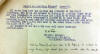
Salerno, Italy - 9 Sep 1943
We returned to Algiers to prepare for the Salerno landings
on the 9th September, 1943. We thought that it was going to be fairly easy
following the surrender of the Italians the day before the landings.
To mislead the enemy air and sea patrols, we started northwards towards Naples
then turned south towards Salerno at
midnight; but the deception didn’t
work out!
German aircraft picked up our
positions as we steered south and German land forces had taken over
the shore defences from the Italians. By the time we attempted to land our
troops, the enemy were ready for us! It was tough on the approaches and tough
establishing a beachhead and getting off the beaches.
 For
some time, we stood by ready to evacuate, however, back-up forces were brought in
earlier than intended and tipped the balance in favour of the Allies. It had
been an anxious few days with bombing and shelling from shore batteries. We were
relieved when our contribution to the invasion of Salerno was over. For
some time, we stood by ready to evacuate, however, back-up forces were brought in
earlier than intended and tipped the balance in favour of the Allies. It had
been an anxious few days with bombing and shelling from shore batteries. We were
relieved when our contribution to the invasion of Salerno was over.
For us the intense
pressure eased off and we enjoyed shore leave in Algiers. We then assisted on a
couple of commando raids along the Italian coast and acted as a decoy ship by
sailing close to the coast to attract gunfire from German shore positions, while The
Nelson, Rodney and 2 cruisers located the gun emplacements from their
flashes and returned fire
from about 10 miles out.
[Photo;
S/M Freddie Robertson].
Anzio - Feb 2 1944
US Ranger Jud 'Lucky'
Luckhurst recalls
"Steve, I was
with the US Rangers when they landed at Anzio. The two ships we used were the Royal Ulsterman
and the Princess Beatrix. At my age, 82, it is hard for me to remember
for sure but I think I landed with the Princess Beatrix. They were both
the best. Many Rangers from other landing craft were drowned, because they were
disembarked too soon. As a result a rumour spread that Col Darby asked for the Royal Ulsterman and the
Princess Beatrix to be assigned to him for any further invasions.
It was
said by many of the Rangers, in admiration, that if those
crazy Limey's had roller skates on the bottoms of their boats, they would even take us
inland! I know that I was only wet up to my knees at Anzio. Some of the crew
saved up their RN grog ration for their Ranger friends. The crew were a good
bunch of men and were highly respected by the Rangers."
We landed the troops at the Anzio
beachhead. It started off quietly because the Germans had retreated inland but
they counter-attacked and it ended in a bloody battle. Lots of lives were
lost, including a large percentage of the American Rangers. Despite the heavy
losses, it turned out all right in the end.
Work for the LSIs in the Mediterranean was over
but there were top secret plans in preparation for our next deployment. We returned home to
'Blighty' for a spot of leave and then preparations for D Day.... "the Big One."
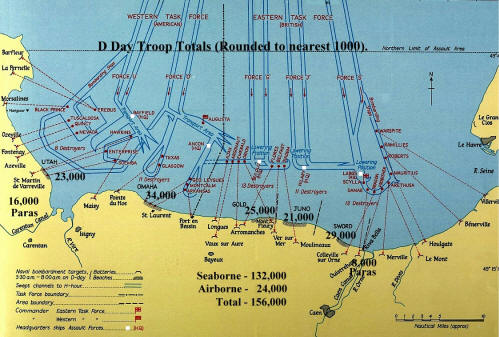
D-Day, Jun 6 1944,
Juno Beach
On return to the UK, we docked for 2
days in Greenock, then on to Southampton for repair work and new assault
craft.
We embarked the assault troops at berth 37 in Southampton harbour and
sailed from our holding position on the Solent at Area 19E, North of East Cowes,
at 1600 hours on the 5th of June 1944.
Our convoy was assault convoy J14
of the J3
Reserve Force under the command of Acting Lt. Commander W R K Clarke DSC RD RNR. We
safely crossed the English Channel and were on station at our lowering point, ready to winch down the LCAs
at 0808 hours on the next day, D-Day. We carried troops of the 9th
Brigade of the 3rd Canadian Division, comprising the following regiments;
-
the Highland Light Infantry
of Canada,
-
the Stormont, Dundas &
Glengarry Highlanders,
-
the North Nova Scotia
Highlanders,
-
a total assault force of
approximately 400 men.
 The
first of our troops were landed on NAN WHITE, at Berniers-Sur-Mer and NAN RED,
at St Aubin-Sur-Mer at 1133 hours.
These beaches were within an area of JUNO Beach. All troops were recorded ashore
by 1150 hours. We lost some army lads when one of our LCAs was hit by gunfire.
Our Sub-Lieutenant lost an arm. After the landings, we brought back
wounded servicemen to England, shipping more troops to France on the return trip. This lasted quite a
long period, after which it was easy going to de-mob. The
first of our troops were landed on NAN WHITE, at Berniers-Sur-Mer and NAN RED,
at St Aubin-Sur-Mer at 1133 hours.
These beaches were within an area of JUNO Beach. All troops were recorded ashore
by 1150 hours. We lost some army lads when one of our LCAs was hit by gunfire.
Our Sub-Lieutenant lost an arm. After the landings, we brought back
wounded servicemen to England, shipping more troops to France on the return trip. This lasted quite a
long period, after which it was easy going to de-mob.
[Extract from the Admiralty's Green List for June 5th, 1944
showing the disposition of the Royal Ulsterman and the 6 LCAs she carried to
Normandy].
LSI(H) Royal Ulsterman came
through with flying colours, just showing signs of her old age. It was a great
honour to have served with S/M Freddie Robertson and the rest of the ship's
company aboard LSI (H) Royal Ulsterman.
Reading
Material
On this
website there are around 50 accounts of
landing craft training and
operations and landing craft
training establishments.
There are around 300 books
listed on our 'Combined Operations Books' page which can be purchased on-line
from the Advanced Book Exchange (ABE) whose search banner checks the shelves of
thousands of book shops world-wide. Type in or copy and paste the title of your
choice or use the 'keyword' box for book suggestions. There's no obligation to
buy, no registration and no passwords. Click
'Books' for more information.
Correspondence
I was really thrilled to see your page on The Royal Ulsterman. My grandfather,
Captain Henry Paterson DSM, served with the Royal Navy through WWI and was in
the Merchant Navy at the start of WW2. He was with Burns and Laird who
provided a ferry service from Glasgow to Dublin/Belfast and Londonderry.
During WW2 the ships of the line, including the Ulsterman, were commandeered
for Navy use. My grampa was seconded to other duties as he was in the RNR. He
served in the Narvik convoys amongst other duties and managed to survive both
wars unscathed despite numerous close shaves.
He was reunited with the
Ulsterman after the War and remained Master of her, her sister ship and the
Laird's Loch (on rotation) until his retiral in the mid 60s. Sadly, he died
very shortly after retiral. His sons, William (my dad), and Harry served in
WW2 also. My dad, an ex Artilleryman, is still going strong, but my uncle was
killed in his 21st year while serving in the Fleet Air Arm as a pilot. The
Ulsterman went on until 1967 on the Irish routes and was later scrapped after
being sunk off Beirut on 3rd March 1973. I believe she struck a mine. It seems
such a pity to end in that way after her brave war service. I hope this is of
interest to you!
Ann Donaldson.
I was interested to read about HMS Royal Ulsterman. My father was in the
North Nova Scotia Highland Regiment
so the odds are good that he was on that ship when it sailed off to D-Day.
Paul Schwartz, British Columbia, Canada.
Acknowledgments
 Written largely by crewman
George H Saunders with contributions from Steve Robertson whose father, the late
S/M Freddie Robertson, also served on HMS
Royal Ulsterman. Written largely by crewman
George H Saunders with contributions from Steve Robertson whose father, the late
S/M Freddie Robertson, also served on HMS
Royal Ulsterman.
|