|
Operation Biting,
Bruneval, North France 27th/28th Feb 1942.
Operation Biting was a daring Combined
Operations raid on a German radar station at Bruneval in northern France
Background
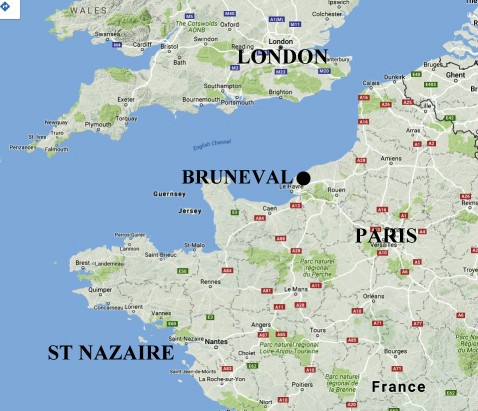 In
February 1942, men of the newly formed British 1st Airborne Division
went into action for the first time. Their target was the German 'Wurzburg'
radar installation at Bruneval. Their objective was to seize vital radar
components and to bring them back to the UK for inspection by trained scientists. In
February 1942, men of the newly formed British 1st Airborne Division
went into action for the first time. Their target was the German 'Wurzburg'
radar installation at Bruneval. Their objective was to seize vital radar
components and to bring them back to the UK for inspection by trained scientists.
[Map courtesy of Google Map Data
2017].
Radar was one of the key,
high-technology battlegrounds of the war. Without radar, the outcome of RAF
Fighter Command's narrow victory in the "Battle of Britain", might have been
very different. The Luftwaffe, meantime, were using radio navigation aids for
blind bombing during the blitz. In 1941,
Bomber Command extended its reach into
the German heartland, forcing the Luftwaffe to develop its own
defensive radars and Britain responded with jamming techniques. So the "battle of the beams" developed between
scientists on both sides as they strived to gain the advantage. Heading up the
British team, was Dr RV Jones, of the Air
Staff.
Plans & Preparations
Throughout
1941, Jones and his team formed a detailed picture of the
developing German radar network along the Channel coast. That autumn, a
series of low-level photo reconnaissance pictures revealed the
presence of a newly installed 'Wurzburg' early warning radar. It
was located on a cliff top close to the village of Bruneval near
Le Havre. The beach below the installation caused Jones to
consider
the possibility of dispatching a Commando raid to retrieve the Wurzburg array
for close examination. Air Intelligence approached Combined Operations
HQ, whose chief, Lord Louis Mountbatten, approved the plan.
From
intelligence gathered by the French resistance, a frontal assault on
the beach would suffer heavy casualties from enemy defensive positions.
It was, therefore, decided to drop paratroops inland by Whitley bombers
under the command of Squadron Leader Charles Pickard. The plan
envisaged the raiding party being recovered from the beach by the Royal Navy,
with No 12 Commando providing covering
fire against German coastal positions.
 C Company of the 2nd Battalion of the
1st Parachute Brigade was chosen for the operation - 120 men commanded by Major John
Frost. Nearly all the men were drawn from Scottish regiments,
including the Black Watch, Cameron Highlanders, King's Own Scottish
Borderers and the Seaforths. To identify the components of interest, they were to be accompanied by RAF radar operator, Flight Sergeant CWH Cox.
He was a former cinema projectionist, ill equipped for such an
operation since he had never been in a ship, or on an aircraft,
before! C Company of the 2nd Battalion of the
1st Parachute Brigade was chosen for the operation - 120 men commanded by Major John
Frost. Nearly all the men were drawn from Scottish regiments,
including the Black Watch, Cameron Highlanders, King's Own Scottish
Borderers and the Seaforths. To identify the components of interest, they were to be accompanied by RAF radar operator, Flight Sergeant CWH Cox.
He was a former cinema projectionist, ill equipped for such an
operation since he had never been in a ship, or on an aircraft,
before!
[Photo; Low level oblique of the
WURZBURG radar near Bruneval, taken by Sqn Ldr A E Hill on 5
December 1941. Professor Jones described these photos as classics of
their kind, which enabled a raiding force to locate, and make off
with, the radar's vital components in February 1942 for analysis in
Britain. © IWM (D 12870)].
The utmost
secrecy was applied to the project from the outset. If German Intelligence
became aware of British interest in the Bruneval site, the whole
project would be compromised with disastrous consequences for those
taking part. The "need to
know" doctrine was, therefore, strictly applied. The parachute unit,
for example, believed the War Cabinet wanted them to demonstrate
techniques and capabilities for raiding a headquarters building behind
enemy lines.
Training took
place at an existing
training area used by the Glider Pilot Regiment, so the arrival of
another unit caused little interest. When naval units were involved,
most training was conducted at night in Scotland, but it did not
go well and ended miserably. Locations were often changed and during
transfer, all unit and qualification insignia were removed from the paras' uniforms. Most sailors didn't discover the identity of the
raiding force until the final stages of the training were completed.
The plan for the
operation was simple. The paratroops were to be dropped in three
units. The first, under the leadership of Lieutenant John Ross and
Lieutenant Euen Charteris, was to advance on, and capture, the beach.
The second, subdivided into three sections and commanded by Frost, was
to seize a nearby villa and the Wurzburg, while the third, led by
Lieutenant John Timothy, was to act as a rearguard and reserve.
The raiding party
was ready for action by February 20th 1942. A scale terrain
model, made by the RAF's Photographic Interpretation Unit, was
used to familiarise the raiding force with the area around Bruneval.
Until the last minute, the various buildings were labelled by function,
without any geographical information. Full-scale exercises on the
south coast of England completed the training. After several
days of anxious waiting for the weather to clear, the raid went ahead
on the night of February 27/28th 1942. The Whitley bombers dropped the paratroops
from a height of 600ft (180m) on to the countryside below.
Action
Lieutenant
Charteris' two sections were dropped about a mile and a half (2.5km)
beyond their intended position. However, Charteris quickly gained his
bearings and he and his men crossed the icy
landscape to their intended drop zone.
Frost's section
took only ten minutes to gather at their rendezvous point. They met
no opposition as they moved on the villa, which they surrounded and
then advanced towards the open front door. Frost blew his whistle and
immediately explosions, yells and the sound of automatic fire came
from the proximity of the radar set. His
paratroops rushed the villa, which was completely empty save for a
single German firing from the top floor.
Flight Sergeant Cox and
an engineer detachment hauled trolleys over a succession of barbed
wire obstacles. Soon afterwards Cox, and the engineers, dissembled the Wurzburg's components,
ripping most of them out by sheer force as bullets whistled nearby. Heavy
gun fire, from German positions in a wooded enclosure about 300 yards
(275m) to the north of the villa, was making life increasingly
hazardous for Cox and the paras. Their safety was further threatened
by the arrival of vehicles with mortar capability and, after half an
hour, Frost gave the order to withdraw. However, a
machine gun in a pillbox still occupied by the Germans, now
barred the way to the beach. The Germans regrouped and advancing
from the villa. Charteris' two sections arrived
on the scene just in time, having already had a brisk encounter with an enemy
patrol. The pillbox was silenced and the beach taken.
It was now about
02.15 hrs and the raiders were not yet out of danger. Frost's signallers were unable to make
contact with the landing craft which were to evacuate the raiding
party. As a
last resort, several red Verey lights were fired. Frost
prepared to rearrange his defences to meet the anticipated German
counterattack when one of his signallers shouted, 'Sir, the boats are
coming in! The boats are here! God bless the ruddy navy, sir!' Three LCAs
came inshore, escorted by three gunboats. Each LCA had the additional
fire power of 4 bren guns manned by men of No 12 Commando.
Allen
Mitchell reports; My father's elder brother - John (Jackie)
Mitchell - was one of the Para Engineers on the Bruneval raid as
part of C Company. He was one of those detailed to dismantle the
radar, so pieces could be brought back to the UK for detailed
examination by scientists. My uncle did not survive the war
(killed in Tunisia 1943) and my father has now passed away,
however one sister is still alive in Annan, Dumfriesshire. We both
remember many stories about this time, including one of Jackie
sliding the largest radar pieces to the beach effectively
'riding' them down the cliff to get there faster. We also recall
that they destroyed the remaining radar installation to obscure
the real purpose of the raid by making it appear to be a
search and destroy mission.
I also have access to some family memorabilia - though this is
mostly in UK (Norwich) and I live in Zurich, Switzerland. These
include a French Franc note issued to the paratroopers in case
they became separated in France and had to make their own way
back. This is signed by about 10 or so of C Company REs (I partly
recall there being 2 "John Mitchells" on the raid, but mine went
by the name Jack or Jackie). There are also blackened badges and
insignia worn by Jackie at that time. After the raid, they got
leave immediately and Jackie returned to the Borders, apparently
still pretty much armed to the teeth!
I've visited Bruneval with
my father where there is a monument unveiled by Mountbatten.
It is very close by the famous cliffs of Etretat, near
Dieppe. I also took him to the Airborne Forces Museum,
then in Aldershot, where I recall finding another French
Franc note as described above.
 The evacuation
into six landing craft, with the sea running high and the Germans
firing, was anything but orderly. Two of Frost's signallers failed to
rendezvous and were left behind. However,
the Commandos managed to keep the German troops at bay until 03.30
hours when the last LCA left the beach area under heavy German fire.
The raiders, and their precious Wurzburg cargo, were transferred to
gunboats. The evacuation
into six landing craft, with the sea running high and the Germans
firing, was anything but orderly. Two of Frost's signallers failed to
rendezvous and were left behind. However,
the Commandos managed to keep the German troops at bay until 03.30
hours when the last LCA left the beach area under heavy German fire.
The raiders, and their precious Wurzburg cargo, were transferred to
gunboats.
[Photo courtesy of Stuart Foster.
Annotated on the reverse by Sam Tunstall "Taken coming back from
Bruneval after the raid on the radiolocation station Feb 1942].
They learned later, that the Navy had been delayed by the presence
of a German destroyer and two E-boats. The German warships had passed
within a mile (1.6km) of the landing craft but had not spotted them. With the dawn,
Royal Navy destroyers and a squadron of Spitfires arrived to escort
the flotilla to Portsmouth. The Destroyers played 'Rule Britannia'
over their loudhailers.
It has been suggested that the Commandos had orders to shoot Cox if his capture
by the Germans seemed inevitable. True or not, there is no doubt that
Cox's knowledge of British radar, had it fallen into German hands, would have gained some advantage in the 'battle of the
beams'. However, a much greater prize to German intelligence would
have been the capture of
Don Preist. Here is the account from the author of the book
Schonland - Scientist and Soldier (see 'Reading Material' below
for details);
In
1942, Schonland was Superintendent of the Army Operational Research
Group (AORG) and he personally trained the R.E. sappers under the
command of Lt Vernon, who accompanied Frost's paras with the specific
purpose of dismantling the Wurzburg radar at Bruneval. I corresponded
with D.H. (Don) Preist (not 'Priest' as in most accounts of the raid)
who was the radar expert designated to ensure that the crucial
components of the Wurzburg were recovered. Since Preist, who worked at
the Telecommunications Research Establishment (TRE), was very
knowledgeable about British radar it was decreed that he would not
land at Bruneval but would accompany the RN recovery team and control
the removal operation from off shore. The risk of his being captured
alive by the Germans was just too great to allow him ashore. Flt Sgt
Cox, often described as a "radar expert" was a highly skilled radar
technician who supervised the actual dismantling of the Wurzburg but
he had nothing like Preist's in-depth knowledge of radar in general
and so was far less of a risk should he be captured. The story that
the Paras were under orders to shoot Cox if his capture looked likely
is one of those myths that appear after the event.
While Preist sat just off-shore in one the RN vessels, he had with him
a special receiver with which to monitor the Wurzburg's radar
transmissions from which he could deduce many of its characteristics.
This intelligence would have proved to be very useful had the raid
itself failed. As it turned out, it was hugely successful and TRE were
able to rebuild the Wurzburg from the "stolen" sub-assemblies and had
it working within a couple of weeks.
Prof Sir Maurice Wilkes, who made his name after the war as one of the
pioneers of modern computing, and who was Schonland's radar expert in
the AORG at that time, felt that the Wurzburg was not a very
sophisticated radar and TRE learnt nothing special from it, other than
they knew exactly how to jam it - which they did very successfully
during the D-Day landings.
Amongst the Schonland papers at the
Churchill Archive in Cambridge, is a letter from Schonland, written
after the war, to Professor Leo Brandt, his German opposite number,
describing the raid. An extract from it appears on p240 of my book.
In
his letter, he said that the parabolic reflector of the Wurzburg at
Bruneval proved too big to dismantle to take back to England but
they sawed off its feet, which really was the significant component.
Also they took a few flashlight photographs of the reflector, because
the Germans had very conveniently painted all the radar's
specifications on the face of the dish!
 Two men were
killed in the operation and six were missing, all of whom survived the
war. Two German prisoners were brought back, one of whom was the Wurzburg's operator. The German report on the raid commented: 'The
operation of the British Commandos was well planned and executed with
great discipline... although attacked by German soldiers they
concentrated on their primary task.' The raid had been a great success
due in large measure to the element of surprise. Even while reading an
account of the action in a newspaper, the Supply Officer of the Glider
Pilot Regiment, whose training area the paras shared, did not
associate them with the raid. Two men were
killed in the operation and six were missing, all of whom survived the
war. Two German prisoners were brought back, one of whom was the Wurzburg's operator. The German report on the raid commented: 'The
operation of the British Commandos was well planned and executed with
great discipline... although attacked by German soldiers they
concentrated on their primary task.' The raid had been a great success
due in large measure to the element of surprise. Even while reading an
account of the action in a newspaper, the Supply Officer of the Glider
Pilot Regiment, whose training area the paras shared, did not
associate them with the raid.
[A Royal Navy MTB brings men of 'C' Company, 2nd
Parachute Battalion, into Portsmouth harbour on the morning after the
Bruneval raid, 28 February 1942. The CO of the assault force, Major J
D Frost, is on the bridge, second from left. © IWM (H 17365)].
A
little reported fact about Operation Biting, was the involvement of a
section from 181 Airlanding Field Ambulance RAMC, who provided
medical cover. Lieutenant A Baker and twenty men travelled from
their base at Chilton Foliat, together with C Company of the 2nd
Parachute Battalion, to Inveraray, Scotland, for specialist
training prior to the raid. Rehearsals were later held off the coast of
Dorset. On the raid itself, they sailed part of the way on the MV Prins Albert, a former Belgian ship, before transferring to ALCs,
LCSs and a Motor Gun Boat, to act as medical support to the returning
paratroopers. Several casualties were treated on the journey home.
[For more details on
181's involvement see Chapter 2 of the book Red Berets and Red
 Crosses
- The story of the Medical Services in the 1st Airborne Division by our member N Cherry, 3 Church Road, Warton,
Lancs PR4 1BD. Click on the e-mail button]. Crosses
- The story of the Medical Services in the 1st Airborne Division by our member N Cherry, 3 Church Road, Warton,
Lancs PR4 1BD. Click on the e-mail button].
It is not easy to
quantify what was gained from the operation...but it was very
significant indeed. One of the many off-shoots was the construction of
three radar and communication vessels known as
Fighter Direction
Tenders
(FDT 217, 216 and 13). The FDTs provided vital radar and
communications cover off Normandy from D-Day to D+20. Only when land
based radar and communication units became operational in France did
they move off station. Their design incorporated two types of radar,
one using British frequencies and the other using German frequencies.
Allied Forces:
Air - 1 Whitley Squadron; Sea
- Landing Craft & Escorts; Land -
1st Airborne Division, elements of the French Resistance.
Axis Forces:
Sea - 1 Destroyer, 2 E-Boats;
Land
- Infantry patrols & Bruneval defence force.
Outcome
(Positive) - Wurzburg radar components successfully removed from
German radar installation + capture of an operator.
Outcome
(Negative) - Two men killed & six missing.
Correspondence
My
Grandfather, William Balloch, was one of the paratroopers who took
part in the Bruneval raid and I would like to know more about the men
he served with and to see any photographs prior to and post the raid
itself. As part of this I will be contacting the Public Archive at Kew
and the Imperial War Museum in London but any information, especially
from veterans or their families, would be very much appreciated.
Chris Manuel
Further Reading
There are around 300 books listed on
our 'Combined Operations Books' page. They, or any
other books you know about, can be purchased on-line from the
Advanced Book Exchange (ABE). Their search banner link, on our 'Books' page, checks the shelves of
thousands of book shops world-wide. Just type in, or copy and paste the
title of your choice, or use the 'keyword' box for book suggestions.
There's no obligation to buy, no registration and no passwords.
Further information & photos
*Schonland
- Scientist and Soldier, by Brian Austin (2001). Published by the
Institute of Physics Publishing, ISBN 0 7503 0501 0. *(later Sir Basil Schonland CBE FRS).
Most
Secret War by R V Jones. Published by Wordsworth. ISBN 1-85326-699. One full chapter devoted to
the raid plus other relevant background information.
A Drop
Too Many by Major-General
John Frost. His tale starts with the Iraq Levies and goes on the major
airborne operations in which he took part - Bruneval, Tunisia, Sicily,
Italy, Arnhem.
The Red
Beret - The Story of the Parachute Regiment at war 1940 - 45
by Hilary St.George Saunders. First
published by Michael Joseph Ltd, 26 Bloomsbury St, London W.C.1
October 1950, 7 more impressions published through to 1952.
The Bruneval
Raid by George Millar. Pub by Cassell. (About one third of the
book devoted to the raid the remainder covering early radar and photo
reconnaissance) ISBN 0-304-36221-2.
Combined
Operations 1940-1942
by The Ministry of
Information. Published HMSO. 144 pages with photos. Includes chapter
on Bruneval.
Commandos
1940 - 1946 by Charles Messenger. Pub by William Kimber, London
1985. ISBN 0 7183 0553 1
The Watery
Maze by Bernard Fergusson. Pub 1961 by Collins.
Acknowledgments
 Written
by Geoff Slee using an article by James Paul plus other sources. Written
by Geoff Slee using an article by James Paul plus other sources.
|