|
Pykrete - Experimental Ice Ships in the Rockies.
A Project Overtaken by Events
 Background Background
In early 1943, two American professors
discovered that a very tough material was created from a frozen mixture of
wood pulp and water. They called this material Pykrete in honour of
Geoffrey Pyke, who had earlier proposed the construction of ships made of
ice. This is the improbable but true story of a top secret WW2 project to
undertake research into the use of ice in the construction of ships.
[Map courtesy of Google Map Data 2017].
To reflect the unbelievable nature of the
project, the codename Habakkuk was taken from the book of the same name in
the Hebrew Bible; Behold ye among the heathen, and regard and wonder
marvellously: for I will work a work in your days, which ye will not
believe, though it be told to you.
In 1942, the Allies were already developing
plans for the invasion of Europe, which included experimentation in the
construction of large floating platforms to support the landings. In
addition, the allies were suffering heavy merchant shipping losses from
German U-boats, due, largely, to the limited range of patrolling aircraft
and the resulting "mid Atlantic air gap." Churchill, therefore, welcomed
the idea of building large ships made of ice, as explained to him by Lord
Louis Mountbatten,
 Mountbatten,
Chief of the Combined Operations Command, worked alongside the Chiefs of
Staff on all matters concerning offensive joint operations against the
enemy. These operations involved the three services in small amphibious
raids on the coasts of enemy occupied territory as well as major landings,
which culminated in D Day. Mountbatten's remit also included the
development of equipment and special craft for these offensive operations. Mountbatten,
Chief of the Combined Operations Command, worked alongside the Chiefs of
Staff on all matters concerning offensive joint operations against the
enemy. These operations involved the three services in small amphibious
raids on the coasts of enemy occupied territory as well as major landings,
which culminated in D Day. Mountbatten's remit also included the
development of equipment and special craft for these offensive operations.
One of his scientific advisers, Geoffrey
Pyke (photo opposite), suggested constructing "berg-ships" up to 4,000
feet long, 600 feet wide and 130 feet in depth, that could be made
cheaply, in great numbers, from ice. The ships would be insulated and
cooled and would be practically invulnerable to bombs and torpedoes. They
could be used by aircraft to provide protection for shipping, particularly
in the mid Atlantic and as a base for invasion. With Winston Churchill’s
enthusiastic endorsement, the project got underway.
Lord Mountbatten had a block of Pykrete
prepared by a Canadian engineering company and took it to the Quebec
Conference in the fall of 1943. As it appeared that "Habakkuk" would run
into supply, technical and financial problems ($100 million for the first
ship), Mountbatten hoped the Americans might take over the project, if
they could be convinced. What better way than to set up a live
demonstration! The story goes that he took out his revolver and fired at a
block of ordinary ice, which immediately shattered. He then fired at a
similar block of Pykrete, which was so strong that the bullet ricocheted,
narrowly missing Sir Charles Portal, Chief of the Air Staff!
The Trials
Studies commenced into the two paradoxical
elements of ice – plastic flow and brittleness. One such study involved
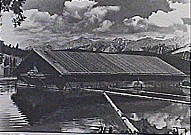
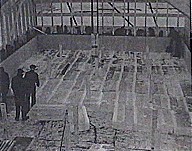
the creation of a structure, 60 feet long by 30 feet wide and 19.5 feet
high. The top secret location for this experimental work was Patricia
Lake, near Jasper in the Canadian Rocky Mountains.
[Photos opposite; work in progress on
Patricia Lake, Jasper, Alberta, Canada. Circa 1943. Courtesy of the
National Research Council of Canada].
The structure comprised a wood frame with 3
inch x 6 inch studs and 3 inch x 8 inch floor joists. It was filled with
ice cut from the lake, insulated and cooled by 3 Freon compressors driven
by 10 hp electric motors. Cold air was distributed throughout the ice by a
network of 6 inch galvanized-iron cooling pipes. This study was to
identify problems in construction and to record the thermal behaviour of
ice in the heat of summer. No Pykrete was used in these trials.
A concurrent experiment was undertaken in
front of the Chateau Lake Louise, near Banff, Alberta. This project was to
determine ways to reinforce large ice units. The work at Lake Louise
indicated that a hull at least 35 feet thick would be needed to contain
damage from bombs and torpedoes. However, by this time, the 'Battle of the
Atlantic' was all but won and new conventional aircraft carrier
construction was promising to further strengthen defences. With these
changes in circumstances, the project was shelved.
The floating structure in Patricia Lake was
abandoned at the end of August 1943 after removing all machinery. It was
left to sink. In the 1970s, scuba divers discovered the remains, which
were subsequently studied by the Archaeology Department of the University
of Calgary.
In 1988, the Underwater Archaeological
Society of Alberta marked the site with an underwater monument. The
following year, with the assistance of the National Research Council and
the National Parks branch, a plaque, commemorating these unusual wartime
events, was erected on the shore of the lake.
Further Reading
There are around 300 books listed on our 'Combined Operations Books'
page. They, or any other books you know about, can be purchased on-line
from the Advanced Book Exchange (ABE). Their search banner link, on our
'Books' page, checks the shelves of thousands of book shops world-wide.
Just type in, or copy and paste the title of your choice, or use the
'keyword' box for book suggestions. There's no obligation to buy, no
registration and no passwords.
Elsewhere on this site -
Geoffrey
Pyke 1894 - 1948
Find out about the
properties of
Pykrete including photographs of blocks
subjected to gunfire.
Imperial War Museum, Lambeth Walk, London -
books available:-
The Past has Another Pattern memoirs by
George W. Ball 1982 ISBN 0-393-01481-9
Pyke: the Unknown Genius David Lampe 1959
(no ISBN given?)
The Challenge of War: Scientific and
Engineering Contributions to World War II Guy Hartcup 1970 ISBN
0-7153-4789-6
"Scientists at War" Wilfred Eggleston 1950
(no ISBN given)
Canadian War Museum- books available:-
No Day Long Enough George R. Lindsey.
Canadian Institute of Strategic Studies 1997
I wish I'd made you angry earlier - Essays
on Science and Scientists by Max Perutz. The essay that discusses the
development of Pykrete is entitled 'Enemy Alien'. A fantastic read written
by one of the greatest scientists ever. ISBN:0879696745.
Butter Side Up: Delights of Science by
Magnus Pyke (ISBN: 0330253093 / 0-330-25309-3) This book was written by
Geoffrey Pyke's first cousin and includes a chapter on Pykrete. Copies
available on line through ABE Books mentioned above.
Acknowledgments
Researched and written by George H Pitt,
Alberta, Canada.
|