|
Operation Flipper - Commando Raid to
Capture Rommel.
North Africa 14/18 Nov 1941

Background
The Commando raid to capture Rommel
at his Libyan HQ was codenamed Operation Flipper. The small raiding
party achieved total surprise but, due to poor intelligence, the mission was
impossible since Rommel was in Rome at the time. Lt Col Geoffrey Keyes was
posthumously awarded the Commando's first VC for his role in the action.
[Photo; Courtesy of Google. 2017]
Rommel had Tobruk under siege and Cyrenaica under occupation. Churchill placed Auchinleck under increasing
pressure to counter attack and by October 1941, a plan of action, code named Crusader, was in place.
In advance of this main thrust, Middle East
Commando was given two tasks. L Detachment was to raid landing grounds in the Gazala-Tmini area, while No 11 Commando was to target various HQ
buildings in the Cyrene area, including Rommel's HQ. In addition, telephone and
telegraph communications were to be sabotaged. The raids were to take place on
the night of 17/18th November - the eve of the launch of Operation Crusader.
The Action
A small party left Alexandria on the evening of the 10th of November 1941 in submarines Torbay and Talisman. On
board the former were Lt Col
Geoffrey Keyes, two officers and 22 men and on the latter were Laycock, two officers and 24 men. They arrived off the landing beaches on the
14th November, with Keyes in command of
the raid on Rommel's HQ and Laycock in command of the wider Flipper operation.
Waiting for them on the
landing beach, were Captain Jock Haselden and an Arab soldier from G(R) Branch.
They would guide the folbots
(collapsible canoes) and dinghies to the beach and to
assist in bringing the vessels ashore. The
remainder of Haselden's men, comprising two British officers, a Free Belgian Captain and an Arab soldier, were laid up inland. All had been
dropped in the area earlier in the day by the Long Range Desert Group (LRDG).
Haselden's team had some local knowledge, which would be useful in the operation.
As the operation developed, they became involved in sabotaging the enemies
communication wires and masts.
 At 6.30 pm, Haselden
signalled the submarines by flashing his torch out to sea and by 6.50 pm, the first of the folbots
from Torbay arrived out of the darkness carrying Keyes and his men.
However, only 7 men and Laycock himself made it ashore from Tulisman
before rough weather brought the landing to a halt. With reduced
numbers now available, the plans for
Operation Flipper were quickly reviewed, including the arrangements to
co-ordinate their activities with
Operation Crusader on the night of the 18th. At 6.30 pm, Haselden
signalled the submarines by flashing his torch out to sea and by 6.50 pm, the first of the folbots
from Torbay arrived out of the darkness carrying Keyes and his men.
However, only 7 men and Laycock himself made it ashore from Tulisman
before rough weather brought the landing to a halt. With reduced
numbers now available, the plans for
Operation Flipper were quickly reviewed, including the arrangements to
co-ordinate their activities with
Operation Crusader on the night of the 18th.
[Photo; Italian radio station at Appollonia, which was an original target
(1 of 3) during the raid on Rommel's HQ. Courtesy of Western Desert Battlefield
Tours].
The amended
plans provided for an attack on Rommel's house & HQ by Keyes and 18 other ranks
(ORs), the sabotage of telephone and telegraph communications at the cross-road south of Cyrene by Lieutenant Cook and 6 ORs and on the El Fridia
to Slonta road by Haselden and his 5 ORs. Under cover of darkness, on the 15th, they set off
in heavy rain on their 15/20 mile trek inland.
Laycock
decided to remain at the beach rendezvous (RV) with the reserve ammunition, in
the hope that the remainder of his men would join him. For security reasons, only
he and Keyes understood the plan in its entirety and Haselden was, therefore, needed to lead his men should they succeed in coming ashore.
As Keyes approached his objective at Beda Littoria on the 17th November, friendly Arabs indicated that Rommel's HQ was located at
Sidi-Rafa, a view also held by Haselden. With Sidi-Rafa as the new target, the plan was for Keyes, Captain Campbell and Sergeant Terry to enter the building. Other ranks were to take up positions to prevent enemy
interference from the outside. These deployments were; 3 men to disable the electric light plant,
5 men to watch the exits from the guard tent and car park, 2 men to prevent
anyone from leaving a nearby hotel, 2 men to guard the road either side of the
building and 2 men to guard whatever entrance Keyes and his men used to gain
access to the building.
All parties took up position just before midnight. Having found no entry at the rear of the building, Keyes, Campbell and Terry walked up to
the front door and beat heavily upon it. Campbell demanded entry in German. The door was opened eventually and on realising
he had been duped, the sentry put up resistance. Unable to overpower him
silently, Campbell shot him, alerting any enemy within hearing distance.
 A
burst of fire from Terry's Tommy gun persuaded two Germans, who came to investigate the
commotion, to promptly return upstairs. Outside, sentries gunned down two others who were
seen running towards the building. Lights were switched on in many of the rooms.
Keyes and Campbell started a systematic search of the ground floor. The
occupants of the second room decided to resist and a burst of fire hit
Keyes as he opened the door. He fell back into the corridor mortally
wounded. Terry emptied two magazines into the room and Campbell finished
the job by lobbing in a hand grenade and closing the door. They took Keyes
outside, where he died almost immediately. A
burst of fire from Terry's Tommy gun persuaded two Germans, who came to investigate the
commotion, to promptly return upstairs. Outside, sentries gunned down two others who were
seen running towards the building. Lights were switched on in many of the rooms.
Keyes and Campbell started a systematic search of the ground floor. The
occupants of the second room decided to resist and a burst of fire hit
Keyes as he opened the door. He fell back into the corridor mortally
wounded. Terry emptied two magazines into the room and Campbell finished
the job by lobbing in a hand grenade and closing the door. They took Keyes
outside, where he died almost immediately.
[Photo of where Keyes was killed provided
courtesy of Western Desert Battlefield Tours].
While attending to
Keyes,
Campbell's lower leg was broken by a stray bullet. He ordered Terry to
regroup the men and to throw their remaining grenades through any
available windows. He then ordered himself to be abandoned, so his men
could more easily return to their operational RV over 18 miles and 2000 ft
of decent over precipitous terrain. Campbell's leg was amputated later in an Italian prison camp.
Jack Terry and his, then, 17 men, met up with Laycock
and his base party of 3 at the RV but there was no further contact from Cook and his group of
6. On the
night of the 18th, Torbay made contact with Laycock by Aldis lamp.
However, the seas were too rough to launch the dinghies but the submarine
managed to get food and water ashore. The next day, it became clear that the enemy was aware of Laycock's position on the beach. First Arab
Carabinieri, then small groups of Germans and then Italians, were seen in the area. Fire was opened on Laycock
and his men, forcing them to abandon their position and move inland. He ordered
his men to form small units of no more than 3
 and to make their escape from the
area to
destinations which included; an alternative beach where Talisman would be waiting, the Slonta area where the Long Range
Desert Group was operating or wadis to the north of Cyrene, where they could lay up until the progress of Crusader
became known.
Later, friendly Arabs told Haselden that a map of the landing beach had been found on one of the British prisoners. This accounted for the early
discovery of the well concealed beach party. and to make their escape from the
area to
destinations which included; an alternative beach where Talisman would be waiting, the Slonta area where the Long Range
Desert Group was operating or wadis to the north of Cyrene, where they could lay up until the progress of Crusader
became known.
Later, friendly Arabs told Haselden that a map of the landing beach had been found on one of the British prisoners. This accounted for the early
discovery of the well concealed beach party.
Outcome
Of the entire force, Laycock and Terry made it back to British lines after 37 days in the desert
and Bombardier John Brittlebank, DCM, 930882 RA, 3 & 8 Cdo & 1 SBS,
managed to get back to Allied lines alone. His DCM citation reads, "This NCO had
previously taken part in the raid on Rommel's HQ and had succeeded in finding
his way back to his unit after being 40 days in the desert behind enemy lines"
(Cdo Gallantry Awards P65).
[Photo left: Portrait of Geoffrey Charles Tasker Keyes, son of
Roger Keyes, posthumously awarded the Victoria Cross.© IWM (E 4732); right
Keyes' initial grave marked with wooden cross].
It has recently come to light (2018)
that L/Cpl L J Codd, of the Royal Corps of Signals, made his escape as far as Tobruk
where he was captured by
the Italians. He escaped shortly afterwards and safely reached the Commonwealth
Forces. In 1944, he was recaptured on the island of Brac, while serving with 2
Commando who were attempting to liberate their CO, Jack Churchill. The remainder of the
Operation Flipper force were either
taken prisoner or killed by hostile Arabs. [See
correspondence from Alan Orton for more
information].
I ronically, Rommel's diaries confirmed that he had indeed used the HQ at Beda Littoria with
the original building at Sidi-Rafa used only as a logistics HQ. In any event, he
was in Rome
at the time of the raid and did not return to North Africa until the 18th. ronically, Rommel's diaries confirmed that he had indeed used the HQ at Beda Littoria with
the original building at Sidi-Rafa used only as a logistics HQ. In any event, he
was in Rome
at the time of the raid and did not return to North Africa until the 18th.
Jock Haselden and his men completed their demolition tasks and successfully returned to Allied lines courtesy of the LRDG. The raid was
largely unsuccessful, since few of its objectives were achieved and virtually all the men involved from Middle East Commando were lost in
the action or taken prisoner.
[Photo, courtesy of John
Williamson who wrote; the photo was taken on 20th March 1948 whilst I was
serving with the Royal Signals in Benghazi. The wooden crosses were, apparently,
subsequently replaced].
When Laycock and Terry arrived at 8th Army HQ on December 25, a signal was sent to Oliver Lyttleton, the Minister in Cairo, stating
"Feel it
would interest C-in-C and Minister to know that Laycock arrived today at 9.20 p.m. for his Christmas dinner." The reply was
"Please state
why Laycock was one hour 20 minutes late for his Christmas Dinner."
For his part in the raid, Lt Col Geoffrey Keyes was posthumously awarded the first Commando Victoria Cross. On Rommel's instructions, Keyes was buried with
full military honours, the ceremony conducted by Rommel's personal chaplain, priest Rudolf Dalmrath. Cypress crosses and wreaths were made for the British and German
dead. Photos of the ceremony were sent to Keyes' parents; a chivalrous wartime
act on the part of Rommel.
War Graves

We are grateful to L/Cpl MacQuarrie's great nephew, John Pattinson,
for the two photos left. The first is a
group photo about which little is known, other than the rather obvious desert
background. In the photo, L/Cpl MacQuarrie is identified with a cross. The
gentleman, seated to his left, is Cpl Alex Beattie. He was captured and ended up
in Stalag 344,
Lamsdorf, Poland.
See Correspondence section below for more information on Cpl Beattie. [Oct
2016]
If anyone recognises any of the others, please
contact us.
This photo below left is of L/Cpl Mcquarrie's grave when it was marked by a
wooden cross.
BENGHAZI WAR CEMETERY (Libya)
 KEYES,
Lieutenant Colonel, Geoffrey Charles Tasker, VC, MC, 71081. Royal Scots Greys
(2nd Dragoons), R.A.C. 18th November 1941. Age 24. Awarded Croix de Guerre.
FRASER, Private T C, The Queens Own Cameron Highlanders, No 11 Commando.
20 - 24 June 1941, age 23. MACQUARRIE Lance Corporal D, 3319006
Gordon Highlanders, No 11 Commando, 31/12/41 aged 24. KEYES,
Lieutenant Colonel, Geoffrey Charles Tasker, VC, MC, 71081. Royal Scots Greys
(2nd Dragoons), R.A.C. 18th November 1941. Age 24. Awarded Croix de Guerre.
FRASER, Private T C, The Queens Own Cameron Highlanders, No 11 Commando.
20 - 24 June 1941, age 23. MACQUARRIE Lance Corporal D, 3319006
Gordon Highlanders, No 11 Commando, 31/12/41 aged 24.
ENFIDAVILLE WAR CEMETERY (Tunisia)
BROWN,
Corporal. Leslie Jock, 5437777. Duke of Cornwall's Light Infantry. 15th-18th
January 1943. Age 26. NIXON, Private, Malvern, 3056939. Royal Scots.
15th-18th January 1943. Age 23.
KNIGHTSBRIDGE WAR
CEMETERY, Acroma (Lybia).
WOOD A J, Sgt 3054128, Royal Scots.
04/12/1941. Age 28.
[Photo courtesy of Western Desert Battlefield
Tours].
Further Reading
There are around 300 books listed on
our 'Combined Operations Books'
page. They, or any
other books you know about, can be purchased on-line from the
Advanced Book Exchange (ABE). Their search banner link, on our 'Books' page, checks the shelves of
thousands of book shops world-wide. Just type in, or copy and paste the
title of your choice, or use the 'keyword' box for book suggestions.
There's no obligation to buy, no registration and no passwords.
 Black Hackle (on this website)
by Graham Lappin - an historical account of No.11 (Scottish) Commando which
includes a section on Operation Flipper. Black Hackle (on this website)
by Graham Lappin - an historical account of No.11 (Scottish) Commando which
includes a section on Operation Flipper.
Get Rommel: The Secret British Mission to Kill Hitler's Greatest General
by Michael Asher, Weidenfeld & Nicolson, London 2004, 303pp 029784685X
 Rommel in North
Africa - more information on the 'desert fox'. Rommel in North
Africa - more information on the 'desert fox'.
The
SAS & LRDG
by
Ex L/Cpl X, QGM. A seminal project
comprising moving stories of every Special Air Service and Long Range Desert
Group casualty in WW2. All proceeds go to charities.
Geoffrey Keyes, VC of the Rommel Raid
by Elizabeth Keyes. Pub 1956 by George Newnes Ltd,
London, WC2.
Commandos and Rangers of World War 2 by James D. Ladd. Pub1978
by MacDonald & Jane's. 0 356 08432 9
Commandos 1940 - 1946 by Charles
Messenger. Pub by William Kimber, London 1985. 0 7183 0553 1
The Watery Maze by Bernard Fergusson published 1961 by Collins.
Correspondence
Dear Sir,
I write with regard the photo of members of 11
commando (immediately below the "War Graves" heading above) and can confirm
the man in the back row, 4th from the left, is my Grandfather Robert 'Bob'
Murray from Stonehaven, Scotland. He was captured during the raid but
returned to Stonehaven after the war ended. He passed away in 1996.
Yours Sincerely
Scott Hill
Hello Geoff,
It's generally
believed that only Jack Terry and Laycock,
from the Commando party, returned from this raid and later John Brittlebank of the SBS but,
having checked the WO 417 files in the National Archive at Kew, I found a
reference to L/Cpl L J Codd of the Royal Corps of Signals (RCS) dated 6/6/44.
It turns out that L/Cpl Codd made his escape as far as Tobruk where he was picked up by
the Italians. He escaped shortly afterwards and safely reached the
Commonwealth Forces. He was taken prisoner again in 1944 on the island of Brac
while serving with 2 Commando in an attempt to rescue their commanding officer, Jack Churchill.
There is a
further name that has appeared in at least one book namely medical orderly Pte E
C Atkins of the Beds and Herts Regt. After much searching I have
never found a Commando connection to this person and assume he was attached for
the operation. He does not appear as a POW in the WO 417 files until 1943, so
it's possible he made it back as well.
I have included
a list of all of all who appear to have taken part in Operation Flipper.
However, there are a few
anomalies. In one book, Heavysides is named as Stephen but his WO 417 file
attributes the initial W, which I have used. Drori and Birch were, along with
Sutherland, attached from 51 Commando. There's no O’Hagen with initial T but there are
files for R A - POWs with different initials. I checked various spellings but
nothing could be found.
Although it is
claimed that no signallers were taken on the operation, Larry Codd and D H
Stocks were both RCS trained and, if I remember correctly, Dick Pedder's men
learned Morse code before they left for the Middle East.
Hope this will
be of some interest to you.
Kind regards,
Alan Orton.
Reconnaissance
Party - October 1941
Capt. J M Radcliffe, Lt R T S
Macpherson, Lt T Ravenscroft & Cpl A Evans.
No. 3 Troop,
(No 11 (Scottish) Commando) Nominal Roll.
Detachment 1.
Pte E C Atkins, L/Cpl P
Barrand, Cpl A Beattie, Pte J Bogle, L/Cpl F Birch, L/Bdr D S Brodie, Sgt C
Bruce, A/Capt R F Campbell, L/Cpl L J Codd, Lt R R Cooke, L/Cpl D E Coulthread,
Pte A Davidson, Bdr G W Dunn, Cpl A Drori, Pte R Fowler, Pte T C Fraser, Gnr J
Gornall, Pte J Hamilton, Cpl W Heavysides, L/Cpl M E Hughes, A/Col R E Laycock,
Cpl C Lock, Sgt C Nicholl, Gnr J F Kearney, Cpl G Kerr, A/Lt Col G C T Keyes,
Sgt W McAdam, L/Bdr P McCrae, Pte J Mckenzie, Cpl D M MacQuarrie, Pte R
Murray, L/Bdr T O’Hagen, Pte C H Paxton, Pte J A Phiminster, Pte W Pryde, Cpl
H Radcliffe, L/Cpl L Stables, Dvr i/c D H Stocks, Sgt J Terry & Pte F E
Varney.
Detachment 2 -
Appolonia. Did not land.
Lt
H G Chevalier + 11 other ranks.
Detachment
3 -
Cyrene. Did not land.
Lt D G
Sutherland + 11 other ranks.
Did not land or
remained at base.
Cpl E A Brown, Cpl L Brown, Pte J Buckley,
Cpl H H C Butler, Bdr G Caton, Sgt C Cleverley, Sgt A Davidson, L/Cpl G Dowse,
Pte D L Fairweather, Pte R G Freke, Capt I M Glennie, L/Cpl J Innes, Gnr F Josling, Pte F Judge, L/Bdr T Kelly, Tpr
J Lappin, L/Cpl D Martin, Pte J S McDiarmid, Pte J Mackay, Pte J McKenzie,
L/Cpl W M McNinch, Sgt G Munro, Pte N Munro, Pte M Nixon, Pte D Pomford &
L/Cpl A E Spring. This list is not complete.
Detachment 4.
Capt J E Haseldon, Capt W Chapman,
Capt R E Melot, 2nd Lt Westall, Pte M Khaufer & Pte H bin Jedaalah.
Special Boat
Section.
Lt R Ingles, Lt T Langton, Lt J M Pryor, 2nd Lt. R K
S Allott, Cpl C Feeberry, Cpl C Severn, Bdr J Brittlebank & 1 further NCO.
Casualties.
L/Cpl P Barrand – Drowned, A/Lt Col G C
T Keyes – KIA, Cpl D M MacQuarrie – DOW as POW, Pte T C Fraser – KIA.
Geoff,
I
write to you with respect to an article that I have just seen on your website
concerning Operation Flipper. Towards the bottom of the page there is a photo of
8 soldiers in a desert camp that was sent to you John Pattinson, the
great-nephew of one L/Cpl MacQuarrie (who is marked by the ‘X’) and where Cpl
Alex Beattie is also identified seated to his left.
I can advise
that the soldier 2nd from right in the back row is my great uncle Sgt
Charlie Nicol. Charlie was a Gordon Highlander who joined 11 Scottish Commando
and later transferred to C Battalion Layforce after Litani River,
prior to participating in Operation Flipper. Charlie remained at the beach
during Flipper with Colonel Laycock (there is some family tale that Charlie was
Laycock’s defacto ‘Batman’ which could have been possible as at the age of
around 41 in 1941, he would have been one of the oldest in the unit) and he was
subsequently captured after several days in the desert only a few miles from
British lines. Charlie spent the rest of the war in various POW camps (with
several failed escapes along the way) one of which I know to have been Stalag
7A. Charlie died in 1985 at the age of around 85.
It is quite
possible that the group were all part of 11 Scottish Commando 8 Troop. I attach
here a photograph that I received via the Commando Veterans Association website.
The photo is identified thus;
“This is a copy of a photo in the Isle of Arran Heritage Museum. The CVA has
been granted permission to copy the photo and display it on our site by their
archivist Stuart Gough. The original remains in the museum.”
 There
is a list of the names of those in this photo which appears to have been
supplied by the curator of the Gordon Highlander’s Museum in Aberdeen. What was
immediately apparent is that L/Cpl MacQuarrie is 1st from left in the
bottom row and this is confirmed by the list of names where he is identified as
“1.
(3319006) L/Cpl. Donald MacLean McQuarrie (kia)”
Furthermore, the soldier 2nd from left in back row in your photo is
the same individual as 2nd from left back row in my photo – he is
identified simply by his surname of “Rollo”. There
is a list of the names of those in this photo which appears to have been
supplied by the curator of the Gordon Highlander’s Museum in Aberdeen. What was
immediately apparent is that L/Cpl MacQuarrie is 1st from left in the
bottom row and this is confirmed by the list of names where he is identified as
“1.
(3319006) L/Cpl. Donald MacLean McQuarrie (kia)”
Furthermore, the soldier 2nd from left in back row in your photo is
the same individual as 2nd from left back row in my photo – he is
identified simply by his surname of “Rollo”.
The other faces
are less obvious when comparing but given that 3 of the 8 were in 11 Scottish
Commando 8 Troop and that Cpl Alex Beattie was in 11 Scottish Commando (but
unknown Troop) I would say that it is entirely likely.
The full Roll
Call is as per below: -
Front row l-r: 1. (3319006) L/Cpl. Donald MacLean McQuarrie (kia); 2. Murray; 3.
Sgt. Charles Nicol; 4. (2876138) Sgt. John 'Jock' Cheyne (kia); 5. Taylor; 6.
Lumsden; 7. (2882830) Pte. Douglas Keith; 8. Humphries (standing).
Middle row l-r: 1. Sgt. Major Duncan Robert 'Bob' Tait DCM MM and bar; 2. Grant;
3. Davidson(15); 4. (2888389) Sgt. Cornelius 'Maggie' McGinn MM - also seen
spelt as McGuin; 5. Pte. Jim Bogle; 6. McKenzie; 7. (132513) Major William
'Bill' Fraser MM; 8. Sgt. John Clover Anderson; 9. Livingston; 10. Fairlie.
Back row l-r: 1. (2880632) L/Cpl. Daniel McSwiggan; 2. Rollo; 3. Loss; 4.
Ritchie; 5. Harper; 6. (2886121) L/Sgt. Alexander Davidson(kia with 1st SAS); 7.
(2060658) Sgt. John Vincent 'Jack' Byrne DCM
I attach a
pdf of
a Scottish Daily Express
cutting
of 9th
July, 1942, that mentions my great uncle Sgt Charlie Nicol
and other survivors from Operation Flipper. The
quality is not so good so a
transcript is immediately below for your
convenience.
PDF of newspaper cutting.
Twenty-three
survivors of the British Commando raid on Rommel’s headquarters, in which
Colonel Keys won the VC, are now interred in Italy, it is revealed by
repatriated New Zealanders.
They include
Sergeant Charles Nicol of Aberdeen, Sergeant Charles Bruce of Brechin Angus and
Bombardier D. Brodie of Ballinluig Perthshire.
They and
other Commandos told the New Zealanders that they had been taken up the coast in
a Submarine.
They were at
first unable to to land at their destination because of storm, but on the
following night they put off in rubber boats, one of which capsized. Some of the
men swam ashore in life-belts.
Sergeant
Bruce was nearly drowned but was dragged out by Sergeant Nicol.
On the beach
which was swept by a gale, they were met by an intelligence officer who was
dressed as a desert nomad. He guided them to Rommel's headquarters. They
travelled two days. On the final stage a thunderstorm soaked their bomb fuses.
While
shooting up Rommel's house Bombardier Brodie blew up the generating equipment
with three bombs. Bad weather prevented the survivors from getting away by sea.
Sergeant Charles Bruce, 41 year old Brechin man, went to Australia when he was
21.
He was
working on a farm there when war broke out. He tried to enlist but without
success.
So he came
home, volunteered and joined an Army unit in December 1939, transferring to the
Commandos more than a year ago. His parents Mr & Mrs Charles Bruce of Montrose
St, Brechin, have had letters from him since he was taken prisoner.
Villagers of
Ballinluig, Perthshire didn’t know that Bombardier Brodie, 27-year-old ex-local
ploughman and forester, had been in the raid.
My great uncle
Charlie Nicol must have been a strong swimmer as not only did he jump into the
sea and pull Sgt Bruce to safety during Flipper, he and another Commando were
noted in an article I once read to have swum with rope lines across the River
Litani to allow the rest of 11 Scottish Commando
TO
cross during the Battle of Litani River. Swimming the Rivers Dee and Don as the son of a farm labourer as a
child in rural Aberdeenshire clearly stood him in good stead.
On an unrelated,
but noteworthy point…seated to the left of my great uncle Sgt Charlie Nicol
(effectively middle position) in my photograph is one Sgt John ‘Jock’ Cheyne. My
great uncle mentioned this pal of his and I have since learned that Sgt Cheyne
joined the newly-formed SAS between Litani River and Operation Flipper. Sadly he
was KIA during the SAS first mission when his parachute failed to open. It is
possible that he was the very first SAS casualty in their history during this
mission which happened at the same time as Operation Flipper and was hampered by
the same gales and bad weather. I have often thought this quite poignant as my
great uncle told me at length that he tried to talk Sgt Cheyne out of joining
the SAS as he had a poor opinion of Lt Paddy Mayne (later Lt-Colonel and SAS
legend) as both a professional soldier and as a man…ultimately their fates were
already sealed for November 1941 irrespective of those decisions.
Hope the above
and attached is of some use to you.
Best regards,
Mark Nicol
Dear Geoff,
I read your website with great interest and would like to add to your content. I
noted the information you acquired on L/Cpl MacQuarrie. The gentleman sitting on
his right is my great grandfather Cpl Alex Beattie. He signed up with the Gordons and then the Commandos. He was captured during the raid on Rommel's HQ
but his name appears to be omitted from all histories of the raid.
I have another image (digitised newspaper) of my great grandfather with Robert
Murray, a Commando and former Gordon who was captured during Operation Flipper.
Cpl Beattie was first sent to Italy and then on to Stalag 344. He escaped with
an airman during the forced march from the camps when the Russians came on.
Hope this is of some interest to you.
Kind Regards,
Michael Strachan (3/17)
My father, Dennis Birch, ex
11 Commando, died in 2011. Whilst clearing out his house I found some
interesting material including the attached 1948 letter from the Rt. Hon.
Elizabeth Keyes, sister of Lt Col Geoffrey Keyes. (Cick
here to open). My father often mentioned the raid on Rommel’s HQ and his
involvement but otherwise spoke little of his time in North Africa other than to
say that they were constantly moving backwards and forwards ‘up the desert’.
Also in his belongings I found a copy of the Trobuk Truth from 1942, a
newsletter distributed to the troops and a printed copy of Montgomery’s rallying
speech. He kept these without really telling anyone.
I'm not sure if he replied
to Elizabeth Keyes but I've requested a copy of her book that was published in
1956 to see if my dad gets a mention.
Best regards
Tony Birch
Note: The book, called
Geoffrey Keyes V.C. Of The Rommel Raid,
is available for a few pounds
through the Advanced Book Exchange (ABE). Visit this website's "Books
page" and click on the ABE icon.
 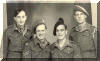 You
may be interested in the picture of my dad, Frank Varney of 11th Commando
(3rd from the left in photo). He was part of the raiding party who tried to
capture Rommel in 1941. I wonder if anyone has information about him or his
war service. Regards, Andrew Varney. You
may be interested in the picture of my dad, Frank Varney of 11th Commando
(3rd from the left in photo). He was part of the raiding party who tried to
capture Rommel in 1941. I wonder if anyone has information about him or his
war service. Regards, Andrew Varney.
|