|
Coastal Command's Anti-Submarine Patrols.
On the
flanks of Combined Operations.
 Coastal
Command was not part of Combined Operations but, on and around D-Day, it played
an important role in support of the invasion fleet. German submarines (U Boats) were
known to be concentrated in French ports and they were expected to attack the
invasion fleet, particularly on the approaches to, and in, the western side of
the English Channel. Coastal
Command was not part of Combined Operations but, on and around D-Day, it played
an important role in support of the invasion fleet. German submarines (U Boats) were
known to be concentrated in French ports and they were expected to attack the
invasion fleet, particularly on the approaches to, and in, the western side of
the English Channel.
[Photo; On the 10th of May, 1945, German
Submarine 516 was spotted in the South Western Approaches by a Coastal Command
Sunderland. The U-Boat was on the surface flying a surrender flag. HMS Cavendish
later despatched a whaler with surrender instructions.
© IWM (A 28553)].
Coastal Command's planes were equipped with radar and depth
charges. Their task
was to cover every part of the 'Operation Cork' area from southern Ireland to
the mouth of the Loire, 20,000 square miles, every 30 minutes, day and night for
an indefinite period... and it wasn't by accident that the interval was 30
minutes! This is one pilot's recollections.
Background
I’m not quite sure what I was doing on the afternoon of Monday, June 5, 1944 - the day
before D-day! I was certainly based at St. Eval, near Newquay in Cornwall, flying as a co-pilot with 547 Squadron
of the Liberator Wing. We were part of 53, 206, 224 and 547 squadrons that formed 19 Group, Coastal Command. Our squadron flew Liberator Vs and VIs equipped with a powerful searchlight, the Leigh Light. The proud
motto of the squadron was ‘Celer ad Caedendum’ - ‘Swift to Strike’.
The 30 squadrons of the Group included four Swordfish squadrons from the Royal Navy
and three Liberator squadrons of the US Navy. They were to provide anti-submarine air defence for
Operation Neptune, the amphibious phase of Operation Overlord - the great Combined
Operation for the invasion of Europe in the west. The details and timing were
top secret but both we and the Germans were expecting it. For us, the opposition were the 35 U-boats of the Group Landwirt,
allocated to the anti-invasion task and based on Brest and the Biscay ports.
 My captain was Flying Officer, "Charlie" Dingle, DFC, of the RCAF.
He earned his decoration while a navigator in Bomber Command. My captain was Flying Officer, "Charlie" Dingle, DFC, of the RCAF.
He earned his decoration while a navigator in Bomber Command.
[Photo;
An Avro Anson of No. 502 Squadron being refuelled at Aldergrove
in Northern Ireland, April 1940.
© IWM (HU 106265)].
I’d obtained what was grandly called a second-class navigator’s certificate from No 1 General
Reconnaissance School at Summerside, Prince Edward Island, Canada. We had two other fully trained navigators aboard,
so we should never have
got lost. Indeed we never did; that was not the problem.
The crew had arrived from No 111 Operational Training Unit at Nassau in the Bahamas, in
May 1944; five Britons and five Canadians. While there, we had flown Mitchell IIs
and then Liberator Vs. We had already flown two operational patrols in February,
when a U-boat was suspected to be north of the Bahamas. Mitchells and Liberators went out in force but there was no contact. We,
like many others, trained in submarine detection, arrived at St Eval as a tiny part of the build-up for
Neptune/Overlord.
Coastal Command, St Eval
The
Squadron Commander at St Ival checked our competency with a trial flight, which
we passed happily. During the second half of May, operational sorties were
reduced to enable training exercises to take place, to permit crews to
rest and to ensure the planes were brought to a high level of reliability and
availability. This relaxation in the frequency of operational sorties was possible, because many U-boats were being held in the
French ports in readiness for the anticipated invasion.
There had been considerable activity by enemy fighters, mainly Junkers
JU
88s, against our aircraft in the Bay of Biscay and Channel, so our training included ‘fighter affiliation’,
which was sparring with a Spitfire or Beaufighter. We soon learned that a
combination of skilful ‘weaving’ and our eight 0.5 in. calibre machine-guns could beat off a
single Spit or a single Beau but, if there were two of them, then we lost the duel.
If we had
the misfortune to meet two Ju 88s, we would rapidly retreat westwards!
 D-Day
- 1 D-Day
- 1
On the
morning of June 5, we flew to the 19 Group airfield at Angle, in Pembrokeshire,
to bring five aircrew back to St. Eval. I think they were survivors of a Liberator crash in Wales, but I’m not certain. It was not a nice day.
We did not know that Overlord, scheduled for that day, had been postponed because of the bad weather.
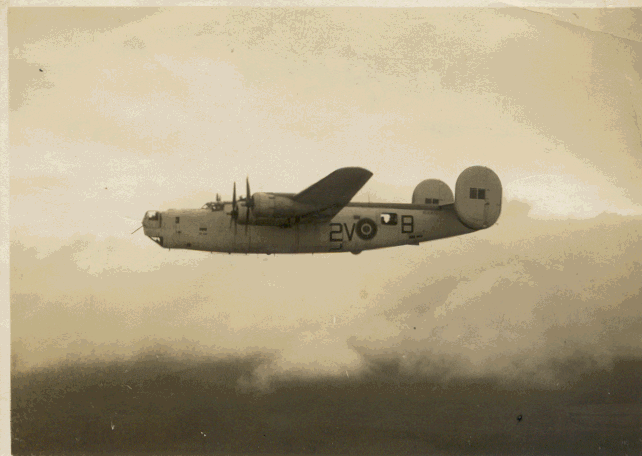
[Photo; B for Baker of 547 Squadron, being flown
by the writer. Ready to go].
Low cloud over the Bristol Channel forced
us to make a DTC (descent through cloud) to Angle; it is on such occasions that
good navigators are worth their weight in gold! It is not a nice surprise, when
you come out of a cloud, to find you are heading directly into a cliff or
mountain!
That afternoon, we practiced depth-charge attacks in the Channel. It was
raining and the cloud-base was still low, about 500 feet, so we undertook another DTC to reach our designated bombing area. We now know
the Luftwaffe’s HQ in Paris had decided that Allied aircraft were unlikely to be operational that day.
On emerging
from the murk, we were amazed at the awe inspiring sight below us. A great, grey
armada of ships of all shapes and sizes sailing slowly eastwards on our
port side. We had been ordered to an area in the Channel between the invasion fleet and the enemy. Why had we been ordered here? - to dupe the
enemy into thinking that it was just routine training in progress or perhaps a sacrificial cow to attract enemy fighters within the range of the fleet’s
guns or to give the convoys assurance that they had air support? In effect, we were riding shot-gun on the flank of the fleet. It was both surprising and spine-tingling.
 The convoy
was part of Task Force U out of Plymouth, Salcombe, Dartmouth and
Brixham. They were transporting the 4th Infantry
Division of the US First Army, to a rendezvous south of the Isle of Wight; from
where they would sail to Utah Beach, the most westerly of the
landing beaches. The convoy
was part of Task Force U out of Plymouth, Salcombe, Dartmouth and
Brixham. They were transporting the 4th Infantry
Division of the US First Army, to a rendezvous south of the Isle of Wight; from
where they would sail to Utah Beach, the most westerly of the
landing beaches.
D-Day +
On June 6, the 4th Division landed about a mile
north-west of their planned landing site on Utah, dragged off course by a strong
tidal current. Fortunately, the defences at their actual landing beach were less
than those at their designated beach!
By the end
of the day, over 23,000 men and 1,700 vehicles had landed on the beach with the loss of 160 men.
By then the vanguard was four miles inland and in
contact with the paratroopers of 101st Airborne Division. It was an
extraordinarily successful result, which could certainly claim to be a very
successful, large scale, Combined Operations.
 The next
day, the Coastal Command aircrews were briefed on the invasion and their role.
The Group had already started its operational plan, codenamed Operation CORK, to
protect the invasion force. Most operational U-boats were in French ports,
including the impregnable submarine pens at St Nazaire at the mouth of the
Loire. The next
day, the Coastal Command aircrews were briefed on the invasion and their role.
The Group had already started its operational plan, codenamed Operation CORK, to
protect the invasion force. Most operational U-boats were in French ports,
including the impregnable submarine pens at St Nazaire at the mouth of the
Loire.
The U Boats were expected to concentrate on the waters between the south of England and
Normandy and their approaches. Our air patrols were designed to prevent attacks
by constantly patrolling the area.
Coastal Command planes, using
radar to identify enemy subs on the surface,
would cover every part of the CORK area, from southern Ireland to
the mouth of the Loire, 20,000 square miles, every 30 minutes, day and night for
an indefinite period.
Thirty
minutes was chosen because U-boats were believed to use, in a crash dive, the
same amount of electrical energy as
could be charged into the batteries in 30 minutes on the surface. If the U-boats
were forced to crash dive every 30 minutes, they would gain nothing from
charging their batteries while on the surface and they would arrive in the
fighting-zone with their crews exhausted, little compressed air required to
surface and flat batteries.
 In the entire month of June, there were no losses to the invasion fleet known to have
been caused by U-boats. This was a tremendous achievement in support of the greatest
Combined Operation in history. It was good to have played a
small part in it, even if the introduction had been unforeseen and somewhat uncertain. In the entire month of June, there were no losses to the invasion fleet known to have
been caused by U-boats. This was a tremendous achievement in support of the greatest
Combined Operation in history. It was good to have played a
small part in it, even if the introduction had been unforeseen and somewhat uncertain.
[Submarine Pens at St Nazaire on the River Loire].
Further Reading
There are around 300 books listed on our 'Combined Operations Books' page which can be
purchased on-line from the Advanced Book Exchange (ABE) whose search banner
checks the shelves of thousands of book shops world-wide. Type in or copy and
paste the title of your choice or use the 'keyword' box for book suggestions.
There's no obligation to buy, no registration and no passwords. Click
'Books' for more information.
Acknowledgments
In 1945,
Flt Lt Salmon, the author of this page, was amongst the first to be posted to
Tiger Force. The force comprised
three Groups of Liberators and Lancasters to fly VLR (very-long-range) missions
against Japan. However, Tiger Force was disbanded after the surrender of Japan
so Dr Salmon finished his service with Air Sea Rescue, 1347 Flight, flying Liberators from Chittagong
in present day
Bangladesh to China,
over the Himalaya Mountains, affectionately known as 'the hump'.
|