|
Litani River Raid - No11Commando.
9/10 June 1941 in Vichy French Syria
 The Litani River
raid was, initially, a Commando operation to capture intact a key bridge in
Vichy French Syria, just prior to the arrival of Australian forces sent in to
occupy the country. However, the Commando's plans were changed and while the new
objectives were largely achieved, the cost in lives was high. This
is their story. The Litani River
raid was, initially, a Commando operation to capture intact a key bridge in
Vichy French Syria, just prior to the arrival of Australian forces sent in to
occupy the country. However, the Commando's plans were changed and while the new
objectives were largely achieved, the cost in lives was high. This
is their story.
Background
The Litani River raid was
in support of a much greater operation to occupy Vichy French Syria.
C Battalion's (11 Commando) objective was to secure the Qasmiye Bridge on the lower reaches of the River Litani,
50 miles south of Beirut on the coastal road. This would help the 21st
Australian Infantry Brigade to pass through the area as part of a larger
invasion force.
General De Gaulle had been
pressing for an invasion of Vichy French Syria for some months but the Commander
of Middle East forces,
Field Marshal Wavell,
had other problems and priorities on his mind. His resources
were already seriously stretched in North Africa, Abyssinia, Greece and in the defence of the islands in the Eastern Mediterranean.
 However,
other factors emerged that tipped the balance in favour of action in the east
Mediterranean. A pro-Fascist
revolt in Iraq led by Raschid Ali threatened the RAF's vital airfield at Habbaniyah and an undertaking by
Admiral Darlan, Vichy France's Foreign Minister, to make facilities in Syria available to the Germans, prompted Churchill to agitate forcefully for the territory
to be occupied. Wavell was still preoccupied with the deteriorating situation in
Crete but he ordered General Wilson, General Officer Commanding (GOC)
Palestine and Transjordan, to make preparations. However,
other factors emerged that tipped the balance in favour of action in the east
Mediterranean. A pro-Fascist
revolt in Iraq led by Raschid Ali threatened the RAF's vital airfield at Habbaniyah and an undertaking by
Admiral Darlan, Vichy France's Foreign Minister, to make facilities in Syria available to the Germans, prompted Churchill to agitate forcefully for the territory
to be occupied. Wavell was still preoccupied with the deteriorating situation in
Crete but he ordered General Wilson, General Officer Commanding (GOC)
Palestine and Transjordan, to make preparations.
[Please regard these maps as illustrative only].
The invasion of Syria was
to have three distinct thrusts. The main body, comprising the 7th Australian
Division, would advance northwards towards Damascus and Beirut from Palestine,
while the second and third forces would move from Iraq to Palmyra and the River Euphrates
respectively. There was a major obstacle for the Brigade, taking the coastal
route to Beirut, in the form of the River Litani, just north
of Tyre. The river at this point flowed from east to west, effectively blocking
their route.
Plans & Preparations
 The operation assigned to the Commandos was to land on two
beaches to the north of the River Litani and one to the south, seize and hold the Qasmiye bridge until relieved by
the 21 Australian Infantry Brigade approaching from the south. The landing was
planned to occur almost simultaneously with the Australians crossing the Syrian
border. The timing would allow the
Commandos to mount a surprise attack and capture the bridge intact before the French could
destroy it, even if, as suspected, it was prepared for
demolition. The operation assigned to the Commandos was to land on two
beaches to the north of the River Litani and one to the south, seize and hold the Qasmiye bridge until relieved by
the 21 Australian Infantry Brigade approaching from the south. The landing was
planned to occur almost simultaneously with the Australians crossing the Syrian
border. The timing would allow the
Commandos to mount a surprise attack and capture the bridge intact before the French could
destroy it, even if, as suspected, it was prepared for
demolition.
The Commandos were engaged on garrison duties in Cyprus when urgent orders came through to put to sea.
They embarked on the destroyers HMS Ilex and HMS Hotspur and left Famagusta harbour at 0540 hrs on June 4. The destroyers
made good time, arriving
at Port Said at 1700 hrs, having completed the passage at 25 knots.
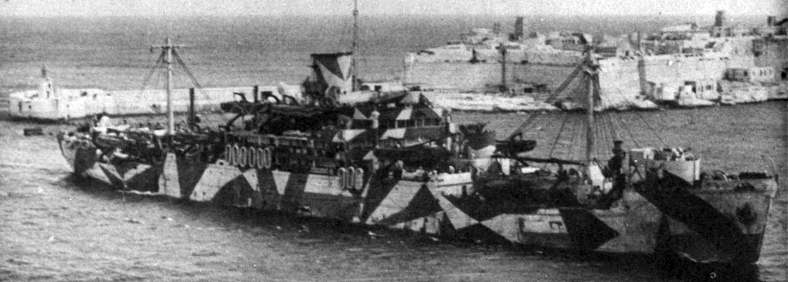
They boarded HMS Glengyle and made ready for a dawn landing on June 8. Glengyle
left
Port Said at 1200 hrs on June 7 with HMS Hotspur, HMS Iris and HMS Coventry as escorts. As planned, they arrived off the mouth
of the River Litani at about 0038 hrs on June the 8th.
The Battalion had earlier
embarked in Assault Landing Craft (ALCs) at 2350 hrs and all were lowered into
the water by
0100 hrs on June 8th. However, at 0130 hrs, the operation was cancelled by Captain Petrie, RN.
He had received disturbing information from Lt Potter, RN (Senior Beachmaster) and Sub-Lieutenant
Colenut, RNVR, a Palestinian Policeman from Haifa. They had reconnoitred the beaches on June 7
and their observations, together with Colenut's local knowledge of the coast,
gave rise to concerns about the troops landing safely. With the prevailing
weather and tidal conditions, there was a high risk of the ALCs broaching or even capsizing.
C Battalion's officers passionately
argued that the advantage of surprise against the enemy and the
crucial synchronisation of the raid with the advancing Australians was paramount and worth the risks envisaged.
It was to no avail and the Glengyle returned to Port Said with
their very disgruntled passengers. Hastily convened, possibly a crimonious, meetings
were held during the journey, resulting in the Glengyle performing a nautical U turn, leaving Port Said
a few hours after arriving there at 1500 hrs on June 8!! This time she was escorted by HMS Ilex and HMS Hero. crimonious, meetings
were held during the journey, resulting in the Glengyle performing a nautical U turn, leaving Port Said
a few hours after arriving there at 1500 hrs on June 8!! This time she was escorted by HMS Ilex and HMS Hero.
[Photo; HMS Glengyle, courtesy of Stewart Main of the
Blair Mayne Association].
En route, the original plan was modified.
All forces
would now land north of the river and the capture of the Qasmiye bridge
was no longer an objective. Keyes' main assault "X" party would now land north of
the river close to the enemy post at Aiteniye Farm. Having neutralised this
position, the redoubt on the north bank of the river would then be taken from the rear. "Y"
Party, led by the Commanding Officer, Lt Col Dick Pedder, was to act as the
reserve party in support of "X" Party, landing a mile or so
to the north of Aiteniye Farm. The third, "Z" party, was an additional reserve
landing a further mile to the north.
Action
On the morning of June 9, Glengyle's ALCs were lowered at 0300 hrs with
landings around 0420 - 0450 hrs. The setting moon was behind the men and the
first glow from the rising sun in the east was ahead of them. These were not
advantageous conditions for an attacking force against an enemy in waiting.
The most northerly "Z" Party, led by Captain George More, landed almost due west of the Kafr Badda
bridge. Unfortunately, their radio equipment was, by then, inoperable due to
water contamination, when an ALC hit a submerged rock 80 yards from the beach in 5 feet of
water. There was, therefore, no communication with the other parties until they linked up later in the action. The Kafr Badda
bridge spanned a stream that was just over 2 miles north of the main Litani river. Captain More's
mission was to block enemy reinforcements and supplies reaching the battleground from the north. This would primarily be achieved by capturing and holding the Kafr
Badda bridge during the critical period.
They encountered some inaccurate small arms fire as they moved off the beach and crossed the coastal road. They quickly overcome enemy resistance and set up defensive positions on both approaches to the bridge. 10
Troop was placed on high ground to the north of the bridge, while 4 Troop was placed in a similar position to the south.
Captain More and Lt Parnacott,
with a stray sub-section of 1 Troop from Pedder's centre party under the capable Sgt Terry, captured four 155mm guns and a
motor transport (MT) pool. When Captain Glennie arrived from the south with part
of 8 Troop (also from Pedder's Y Party), he helped defend the MT pool area which
now included the Regimental Aid Post (RAP) and French POW's cage. The 155mm howitzers took no part in the action, mainly because 11 Commando (Z
party) had cut the enemy's telephone lines! A good number of French prisoners were taken in these actions.
 The Commandos held off the French for most of the day but a counter attack by enemy armoured fighting vehicles (AFVs)
forced the Commandos to withdraw - first 4 Troop and then 10 Troop. No effective action could be taken
against these vehicles
because the flat terrain would have allowed them to simply drive around any road
blocks and light weapons were
ineffective against them. However, two pound shells fired by the enemy inflicted heavy casualties on the French prisoners under guard at the MT
pool. The Commandos held off the French for most of the day but a counter attack by enemy armoured fighting vehicles (AFVs)
forced the Commandos to withdraw - first 4 Troop and then 10 Troop. No effective action could be taken
against these vehicles
because the flat terrain would have allowed them to simply drive around any road
blocks and light weapons were
ineffective against them. However, two pound shells fired by the enemy inflicted heavy casualties on the French prisoners under guard at the MT
pool.
[Photo; Portrait of Geoffrey Charles Tasker Keyes, son
of Roger Keyes, posthumously awarded the Victoria Cross,
Operation Flipper, Libya, 17/18
November 1941.© IWM (E 4732)].
That night, some of the
party (10 Troop) headed east and then south towards the Australian lines and
successfully retired from the battle ground by a high level route. In the meantime, Captain More,
with a small group comprising Cpt Glennie, Lt Parnacott , Lt Eoin
McGonigal and part of 4 Troop - about 23 ORs, retreated towards the mouth of the River Litani
under heavy but inaccurate enemy fire.
Their aim was to link up
with force Y, be briefed on the progress of X and Y operations and to support their efforts. They were later caught in the open
by enemy machine guns (MGs) fire, barbed wire on the beach and friendly fire from the south. They suffered 8 casualties, including Lt Parnacott and
4 ORs killed and 3 ORs wounded. Their position was hopeless, so they surrendered to the French forces at Aiteniye Farm. The prisoners were taken inside the post, where they were quite well protected and decently treated. One of the party, L/Cp Tait,
managed to evade the French by swimming south and making contact with Keyes' party at the redoubt.
The centre "Y" party, led by Colonel Dick Pedder, successfully landed about a mile south of More's
party and about a mile and a half north of the Litani River. His was a reserve party to act in support of Keyes and his men. They headed inland
over sand dunes and soon crossed the main Tyre to Sidon road. On reaching the higher ground, they met stiff resistance
from the enemy. For a time the
barracks in the area were captured but the French recovered the position and their snipers took a toll on the party. Colonel Pedder was killed and his
officers became casualties. It fell to RSM Tevendale to regroup Pedder's party and
to head south for the river. However, after further action against superior French forces,
the group surrendered.
The southern "X" group,
under Major Keyes, landed south of the river missing their intended landing beach,
which was to the north of it. They worked their way north to a position opposite
the redoubt on the north bank - the same redoubt they were, according to the
revised plan, due to attack from the rear (north). They commandeered a boat and,
together with some Australian troops, managed to deliver Lieutenant Eric Garland and 6
men of 2 and 3 Troop across the river at 1000 hrs, during a lull in the French
artillery barrage. They were later reinforced when Captain, George Highland and 6 men,
took advantage of a second lull in the artillery barrage to cross the river.
[Painting by the late David A Thorp. Lieutenant
Garland displayed throughout the action cool and clear-headed leadership and
complete disregard for his own personal safety. He was the first individual to
cross the river and personally led the party which cut out the enemy wire on the
far side under heavy fire. On one occasion by deliberately exposing himself he
personally drew the fire of a sniper who was causing severe casualties and, on
locating the enemy position, Lieutenant Garland manned one of his Bren Guns and
shot the sniper. Lieutenant Garland also put out of action a 75 Gun, which was
covering the river, by accurate fire from a captured anti-Tank Gun.” Courtesy of
author Ian
McHarg who commissioned the work -
https://ianmcharg.co.uk/ ]
Highland took the surrender of the redoubt at about 1330 hrs
and Garland managed to subdue a sniper at great personal risk. He also used a
captured 25mm A/T gun in the redoubt to silence the 75mm field gun
responsible for the earlier heavy shelling. It is said that he fired 7 rounds, 3 of which went cleanly through the embrasure of the
gun emplacement! The wider action
 was later described by Laycock as a "Commando spirited" effort that "materially helped the
subsequent action of the main body." was later described by Laycock as a "Commando spirited" effort that "materially helped the
subsequent action of the main body."
The bridge at Qasmiye was blown up on June 8, when the Australian
advance guard was within 50 metres of it!
After a night-time action in the vicinity of the demolished bridge, Australian
sappers constructed a pontoon bridge. The next morning the
Australian advance continued and the French Commander at Aiteniye Farm handed
over his post to Captain More. The captives once more became captors! Captain
More and his men rejoined the main body of the Commando under Major Geoffrey
Keyes.
[Photo; After the demolition of the bridge over the Litani
River, the 2/6th Field Company assisted by infantrymen built a pontoon bridge
during the the night of 9/10th of June about 400 yards upstream of the
demolished bridge, enabling men and vehicles of the 2/27th Infantry Battalion to
cross].
Outcome
The Battalion had acquitted itself well, achieving the objectives in the revised plan but at very high cost in
terms of casualties. Had X group landed north of the river as intended, the
casualties would have been lower, since the time and effort Keyes' expended reaching the north
bank would have been used more productively elsewhere. A spit of sand, which
from the sea, was indistinguishable from the adjacent beaches, obscured the mouth of the river
and this may have contributed to the navigational
error. In his report on the action, Keyes noted also that aerial photographs given to Pedder did not cover the mouth of the River Litani,
stopping short about 1 mile north of Aiteniye Farm.
The War Diary's lists of casualties shows
5 officers killed, 1 wounded and 1 wounded and captured while 40 other ranks
were killed and 83 wounded giving total casualties of 130.
This was about a third of its strength. Geoffrey Keyes subsequently took over command of the Battalion and by
July 1, he and his men were back in Cyprus on garrison duty. MCs were later conferred on Major Keyes and Captain More and a bar to Lt. Garland's
MC. RSM Tevendale and Lance Corporal Tait, received DCMs.

[Photo of the graves of
some of the fallen at Latani River
was provided by
Stewart McClean of The Blair Mayne Association].
In this
cemetery are buried the following 10 men of the 11 Scottish Commando killed in
action at the Litani River on 9 6 41.
K Burton,
J Padbury,
J Lane,
D Woodnott,
W Gibbs,
C Burrows,
A Styles,
A Hamilton,
space and H Jones.
Sgt Terry later accompanied Keyes on
Operation Flipper - the raid on Rommel's
HQ. Only Sgt Terry and Bob Laycock,
Layforce's CO, returned
safely to British lines, after over 40 days in the desert. Sgt Terry later joined the SAS.
Correspondence
My father, Dennis
Birch, ex 11 Commando, died in 2011. Whilst clearing out his house I
found some interesting material including the attached 1948 letter
from the Rt. Hon. Elizabeth Keyes, sister of Lt Col Geoffrey Keyes.
(Cick
here to open). My father often mentioned the raid on Rommel’s HQ
and his involvement but otherwise spoke little of his time in North
Africa other than to say that they were constantly moving backwards
and forwards ‘up the desert’. Also in his belongings I found a copy
of the Trobuk Truth from 1942, a newsletter distributed to the
troops and a printed copy of Montgomery’s rallying speech. He kept
these without really telling anyone.
I'm not sure if
he replied to Elizabeth Keyes but I've requested a copy of her book
that was published in 1956 to see if my dad gets a mention.
Best regards
Tony Birch
Note: The book,
called
Geoffrey Keyes V.C. Of The Rommel Raid,
is available for a few
pounds through the Advanced Book Exchange (ABE). Visit this
website's "Books page" and click on the ABE
icon.
 I am editing and transcribing diaries of
my uncle (Stuart W H Jones, 1921-2006) whose friend, Geoffrey Parnacott
(Lt Geoffrey Alfred Henry Parnacott, 105607, York and Lancaster
Regiment) died serving under Geoffrey Keyes in the Litani Raid 10th
June 1941. I have a copy of a letter (no doubt many of
its type) sent to Geoffrey Parnacott’s mother . I attach this in case
it may be of use or interest. I am editing and transcribing diaries of
my uncle (Stuart W H Jones, 1921-2006) whose friend, Geoffrey Parnacott
(Lt Geoffrey Alfred Henry Parnacott, 105607, York and Lancaster
Regiment) died serving under Geoffrey Keyes in the Litani Raid 10th
June 1941. I have a copy of a letter (no doubt many of
its type) sent to Geoffrey Parnacott’s mother . I attach this in case
it may be of use or interest.
May I congratulate you on a wonderfully
informative site.
Yours sincerely
Charles Adams
Dear Charles,
My wife is the grand-niece of
Geoff Parnacott. We helped to clear out the family attic last year and were
privileged to find many mementos of Geoff, including the formal letter from King
George, but it was touching to see the copy letter you posted of which we did
not come across the original. It was remarkable to find that he was in such an
elite unit although it added to the sadness of his loss at such an early age.
His brother, Trevor, served with the Artists Rifles in North Africa so kept up
the family tradition, but sadly died in 2012. It is very good to find more
information about Geoff – many thanks.
Congratulations on such a
good website – a pleasure to find.
Regards,
Paul on behalf Felicity
Waterman (nee Parnacott)
Further Reading
There are around 300 books listed on our 'Combined Operations Books'
page which can be purchased on-line from the Advanced Book Exchange
(ABE) whose search banner checks the shelves of thousands of book
shops world-wide. Type in or copy and paste the title of your choice
or use the 'keyword' box for book suggestions. There's no obligation
to buy, no registration and no passwords. Click
'Books' for more
information.
Litani River
By Ian McHarg.
The author served in
Army Commando (59 Commando
Royal
Engineers) from 1984-1994.
ISBN:
1907463380 /
1-907463-38-0.
Further information
on
Amazon.
Geoffrey Keyes, VC of the Rommel Raid
by Elizabeth Keyes. Pub
1956 by George Newnes Ltd, London, WC2.
Black Hackle by Graham Lappin - an
historical account of No 11 (Scottish) Commando.
Commandos and Rangers of World War 2 by James D. Ladd. Pub 1978 by MacDonald & Jane's. ISBN
0 356 08432 9
Commandos 1940 - 1946 by Charles
Messenger. Pub by William Kimber, London 1985. ISBN 0 7183 0553 1
The Watery Maze by Bernard
Fergusson pub 1961 by Collins
1000 Men at War - Story of the 2/16th Battalion A.I.F. by Malcolm Uren.
WWII history of the unit led by Major General Stevens and raised in 1940 Western
Australia to form part of the 21st Australian Infantry Brigade. Traces the
exploits of these 1,000 troops who embarked at Freemantle that year for service
in the Middle East. Details their fighting in the
Syrian campaign, the Kododa trail at Gona, New Guinea and Borneo
highlighting their audacious heroism during the Battle of Shaggy Ridge.
Acknowledgments
We are indebted to Henry More of Los Altos, California, son of the late Captain George More, for his many,
substantial and invaluable contributions to this account of the Litani raid. His
detailed knowledge of the subject is beyond equal.
|