|
Landing Craft Tank (Mark 4) 749 - LCT (4) 749 on D Day.
LCT (4) 749 Carried Adapted Tanks for the clearance of obstacles
on Gold
Beach
 HM Landing Craft Tank 749 - HMLCT(4) 749 was
involved in the first assault wave onto Gold Beach on the morning of D-Day. It
was part of the 28th LCT Flotilla, ‘D’ LCT Squadron. Its cargo
included specially adapted tanks (known as Hobart's Funnies) for the clearance
of beach obstacles in advance of troop landings. HM Landing Craft Tank 749 - HMLCT(4) 749 was
involved in the first assault wave onto Gold Beach on the morning of D-Day. It
was part of the 28th LCT Flotilla, ‘D’ LCT Squadron. Its cargo
included specially adapted tanks (known as Hobart's Funnies) for the clearance
of beach obstacles in advance of troop landings.
[Photo;
LCT(4), Landing Craft Tank 1319 (Mark 4). Similar to LCT 749. ©
IWM (A 27907)].
Steaming for Normandy
Commanding Officer,
Lieutenant Jack E Booker RNVR, continues.
The 28th Flotilla departed the Solent at 0730 hours
on June 5th with an LCA(HR) (Landing Craft Assault-Hedgerow) in tow. These craft
had been converted to allow
them to give supporting mortar fire as the LCT made their approach.
It was rough crossing
the Channel with a south west Force 5 wind producing bigger seas than might have been expected,
although there may have been some choppiness from a strong gale for
several days beforehand. During the early hours, the unmanned LCA, we had in tow, broke
adrift as its towing belts tore away.
As dawn broke, we were at the head of a
formidable armada, which stretched beyond the horizon astern of us. Only
minesweepers and motor launches were ahead but they eventually turned
away as we deployed line abreast, heading for the low French
coastline ahead.
 Meanwhile warships astern
shelled the beaches with heavy and continuous salvos. The noise was horrendous, but
hardest on the ears was the continuous scream of successive flights of
rockets fired over our heads from LCT(R)s astern of us. Worryingly, some rockets,
which had the explosive power of a 6 inch shell, fell short into the sea not far
ahead of us. Meanwhile warships astern
shelled the beaches with heavy and continuous salvos. The noise was horrendous, but
hardest on the ears was the continuous scream of successive flights of
rockets fired over our heads from LCT(R)s astern of us. Worryingly, some rockets,
which had the explosive power of a 6 inch shell, fell short into the sea not far
ahead of us.
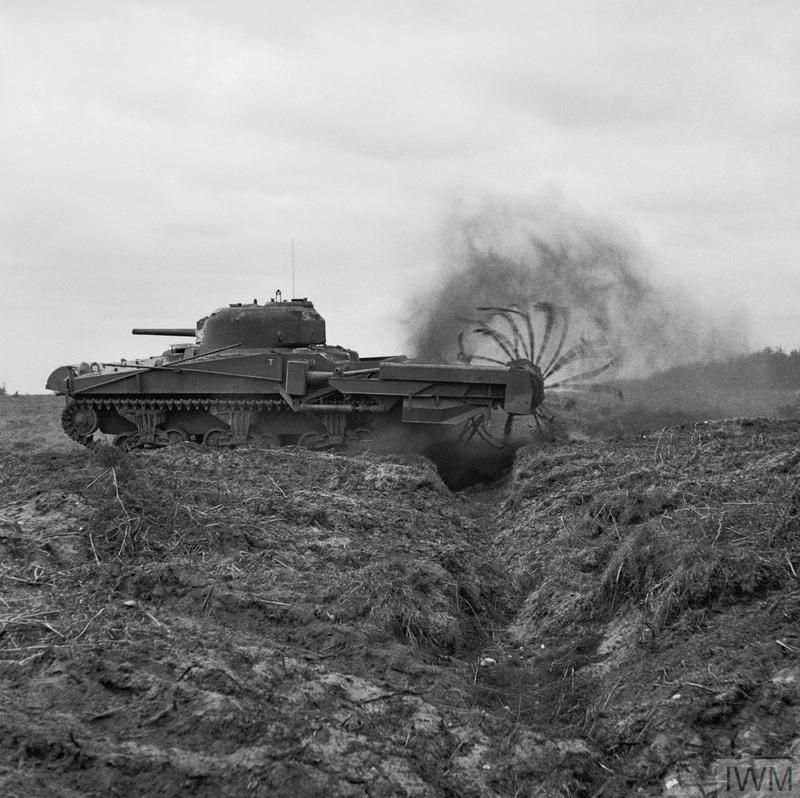
[Photo;
Sherman Crab Mk II flail tank, one of General Hobart's 'funnies' of 79th
Armoured Division, during minesweeping tests in the UK, 27 April 1944.
© IWM
(H 38079)].
Our Cargo
Each of the craft carried six Churchill AVREs
(Assault Vehicles Royal Engineers) plus
two collapsible boats loaded with explosives. The task of the Royal Engineers was
to clear beach obstacles that would impede the progress of the assault troops
through the beach area. The AVREs
were manned by men of the 82nd Assault Squadron, Royal Engineers.
The six Churchill tanks on my craft had been
specially adapted for this task. Two were equipped with forward facing rotating chain flails
to detonate mines on the beach, a third tank carried a huge bobbin of
strengthened matting, which was laid down over soft sand as the tank drove across
the beach, leaving behind a firm path for other vehicles and tanks to follow. The
gun turret of the 4th tank had been replaced
by a large folding girder bridge, which could be thrown forward over tank traps.
The fifth tank was armed with a powerful Petard gun for knocking out beach
emplacements. The shells discharged from a Petard were referred to as ‘Flying
Dustbins’, such was their power. The last tank we carried was a Fascine, fitted with a huge round bundle of brushwood lashed tightly in a cylindrical
bundle, which could be extended in front of the tank to fill a tank ditch.
Collectively, these tank adaptations were affectionately known as 'Hobart's
Funnies'.
 The
Landing The
Landing
At 0725 hours on the morning of June 6th
1944, my craft touched down at Le Hamel on the extreme western
limits of Gold beach. Six LCTs were present, being one half of the craft that
formed the 28th Flotilla under the command of Flotilla
Officer (FO), Lieutenant Commander, Arnold Nyburg RNVR. Our squadron was commanded by
Lieutenant Commander E N Langley.
We beached exactly at
H-Hour alongside HMLCT 88 which carried Lieutenant Commander Nyburg. The
remainder of our craft came in under shell and mortar fire. LCT 886 took a
direct hit on the bridge, disabling her and she finished broadside to the beach, incapable of discharging her tanks. [HMLCT
886 is a recorded ‘War Loss’ (T Chapman)].
749 was hit several times by shell-fire, two of
which shot away our starboard winch and wire. Nonetheless, our cargo was
disembarked without serious problems, due largely to our anchor winch
controller, Stoker Mountain. He stood by his winch, totally unprotected from
bullets and shrapnel, slowly easing 749 up to the beach during the half hour or
so it took to off-load our tanks. He was
later awarded the DSM (Distinguished Service Medal) for his cool conduct under fire. There were no casualties amongst my crew but, sadly, a
corporal of the Royal Engineers was killed in the tank hold.
%20749_small.jpg) We
were unable to raise our door because the winch was broken. To avoid seawater
pouring in, we proceeded stern first to a position about one mile off the
beach, dropped our kedge anchor and hoisted two black balls to signify we
were not under control. We rigged a spare kedge
wire from the aft anchor winch to the forward door using pulleys and shackles.
It took several hours but we managed to secure the door safely. Then
we ‘spliced the mainbrace’, thanks to the Royal Engineers who had overlooked a
full jar of rum as they took their supplies and equipment ashore. We
were unable to raise our door because the winch was broken. To avoid seawater
pouring in, we proceeded stern first to a position about one mile off the
beach, dropped our kedge anchor and hoisted two black balls to signify we
were not under control. We rigged a spare kedge
wire from the aft anchor winch to the forward door using pulleys and shackles.
It took several hours but we managed to secure the door safely. Then
we ‘spliced the mainbrace’, thanks to the Royal Engineers who had overlooked a
full jar of rum as they took their supplies and equipment ashore.
[Extract from the Admiralty's 'Green
List' showing the disposition of LCT (4) 749 just prior to D-Day].
While at anchor, we had
a grandstand view of the
landings in progress, as waves of follow-up craft landed in the area cleared by
the Royal Engineers. We saw several of our AVRE tanks being hit and bursting
into flames and their crews jumping out to save themselves. From accounts I've
since read the damage was inflicted by a well concealed
German 88mm gun, which was eventually destroyed by one of the Petard AVRE tanks.
Post D-Day
At about 1400 hours, we joined a homeward bound convoy
of empty LCTs. Later that afternoon we pulled out of formation and with our
Ensign at half-mast, we buried our dear soldier comrade at sea, in
accordance with naval orders for Operation Overlord.
It took about ten days at Thorneycroft's yard in
Portsmouth to repair our shell damage. One piece of good fortune arising from
this was to attribute items previously lost or mislaid from the bosun's store
as 'destroyed by shell fire'. When taking command of 749 from her previous commanding officer
some three months earlier, there was insufficient time for a thorough handover. I signed for
the whole craft with her contents largely unchecked.
We
next sailed to Portland, which was the major port supplying the American beaches. Over
the following six months, we visited those beaches
around 35 times carrying American troops and equipment. On one trip we carried large field
kitchens and on another, large 'washeries' for the clothes of US
troops near the front line.
HMLCT 749 was paid off at Chatham
Dockyard in January 1945. She had carried us safely through an eventful and, in
retrospect, a fascinating period of our island's history. [August 14th
1996].
Further Reading
On this website there are around 50
accounts of landing craft
training and operations and
landing craft training establishments.
There are around 300 books listed on our 'Combined Operations Books' page
which can be purchased on-line from the Advanced Book Exchange (ABE) whose
search banner checks the shelves of thousands of book shops world-wide. Type in
or copy and paste the title of your choice or use the 'keyword' box for book
suggestions. There's no obligation to buy, no registration and no passwords.
Click 'Books' for more
information.
Supplementary Information.
Of the LCA(HR) craft
mentioned in the opening paragraph of this page, Tony Chapman of the LST &
Landing Craft Association writes; [The LCA (HR)
mentioned here was part of the 591 Assault Flotilla under the overall command of Lieutenant
Commander Wallace. The craft of 591 were divided into two groups, those with
Wallace assigned to JIG sector, the western beaches of Gold beach. The remainder
of the flotilla were assigned to KING sector, the eastern beaches, and under the
command of Lieutenant Michael Irwin. Those under Irwin supported the LCT of the
34th Flotilla of ‘L’ LCT Squadron. (Tony Chapman)].

Acknowledgments
This account
of HMLCT(4) 749 was written by her Commanding Officer, Lieutenant Jack E Booker RNVR.
It was transcribed by Tony Chapman Official Archivist Historian for the LST and
Landing Craft Association (Royal Navy) and further edited by Geoff Slee for
website presentation, including the addition of photographs, maps etc.
|



%20749.jpg)